6 mins read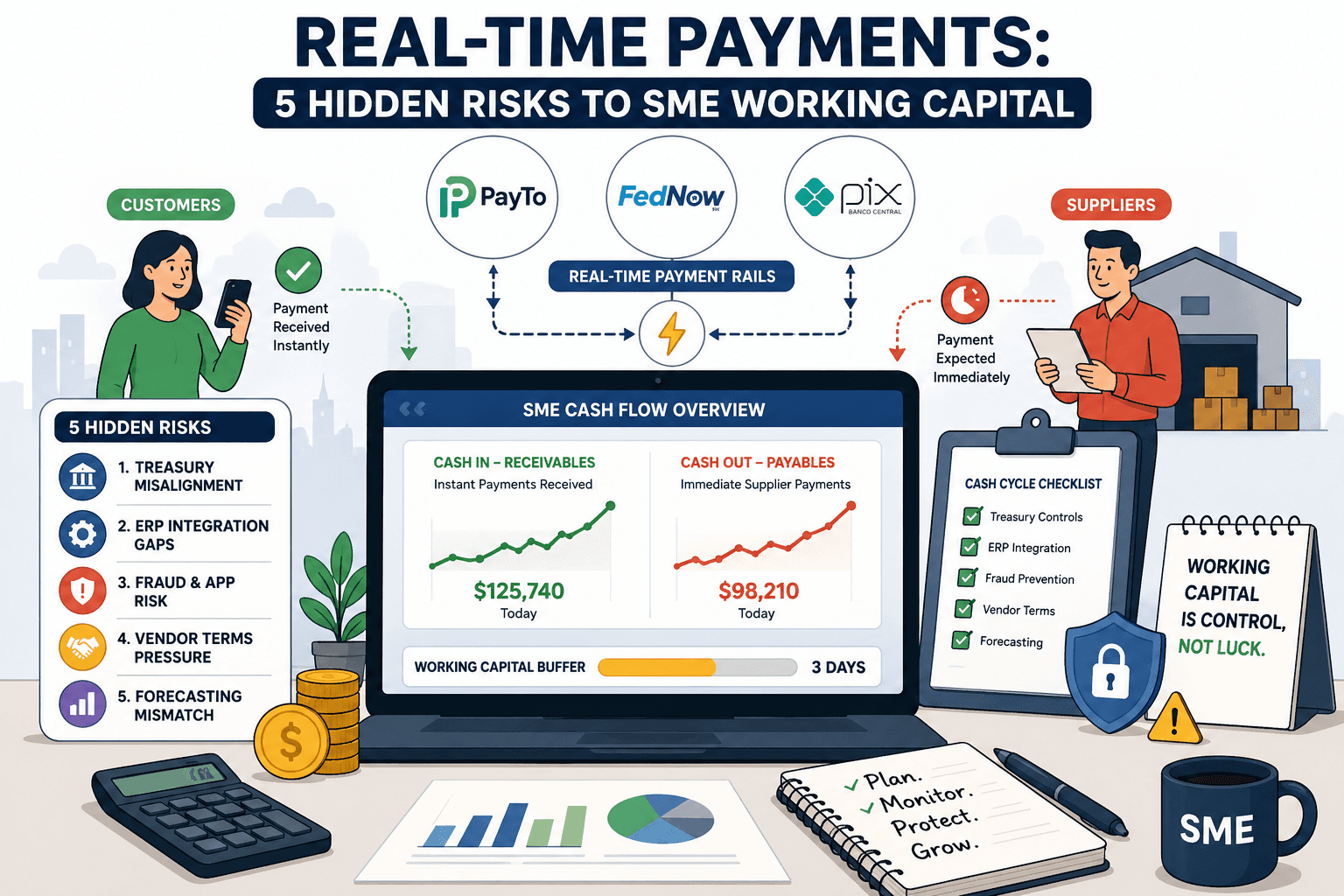
Author: Girish Songirkar, Delivery Manager, Enterprise Software Engineering, Arionerp
Real-time payments are quietly rewriting the operating economics of every SME running cross-border or even cross-state cash flows. PayTo in Australia, FedNow in the United States, and Pix in Brazil moved from rollout phase to operating standard between 2023 and 2026, with Pix now projected to handle 40% of Brazilian online shopping transactions by year-end. The headlines focus on consumer convenience. The operational story sits elsewhere: working capital control breaks down in subtle ways when settlement collapses from days to seconds.
The pitch is familiar. Funds land within seconds, not three business days. The float that traditional payment cycles built into SME working capital quietly vanishes. For owners who ran their businesses on weekly batch reconciliation and predictable cheque-clearing windows, that vanishing float is the entire game. SMEs that adapted their cash flow assumptions before adopting real-time payments captured the upside. Those that did not are watching their working capital control slip away.
How real-time payments compress the cash cycle in unexpected ways
Customer payments arrive instantly. So do supplier demands. The receivables side of the equation looks like a clear win because invoices that previously aged 30 to 60 days now settle on the same business day. Cash flow predictability improves. Late-payment chase calls reduce. The downside hides in the payables column, where suppliers who used to wait two weeks for payment now expect funds the moment an invoice clears. Real-time payments compress both sides of the cycle simultaneously, which means the working capital buffer most SMEs maintain shrinks proportionally. An SME that previously held two weeks of operating cash to bridge receivables can find itself running on three days of buffer once the rails go live, and that thinner cushion is exactly when an unexpected supplier demand or customer refund hits hardest.
This compression is genuinely useful when paired with proper forecasting. It becomes a problem when SMEs continue running on assumptions calibrated to slower rails. FintechBits’ analysis of the 60-day invoice black hole shows how cash flow drag operates even before instant settlement enters the picture. SMEs migrating to FedNow or PayTo without rebuilding their forecasting cadence often discover their cash position swings harder, not softer.
ERP integration is the silent bottleneck
Real-time payments only deliver working capital benefits when finance systems can process them in real time. Most SME ERP and accounting stacks were built for batch reconciliation. They run end-of-day cycles. They post journals overnight. When payments settle in seconds and ledgers update in 24-hour windows, the gap creates reconciliation chaos: cash positions show one thing, the bank shows another, and decisions get made on stale data.
Modern API-driven ERP platforms close this gap by syncing transactions as they post. The integration work is not trivial. SMEs need to map payment confirmations, settlement codes, and dispute flags into their accounting structure without breaking audit trails. The Decta analysis on the biggest payments innovations of 2026 notes that payment-as-a-service strategies are now common precisely because the integration burden became unmanageable for individual SMEs running real-time payments at scale. Mid-market accounting platforms have moved faster than their smaller counterparts, with instant-payment connectors now standard in Xero, QuickBooks Online, and NetSuite. The consequence of this gap is concrete: an SME finance team can see two different cash positions at 3pm depending on which dashboard it looks at, which is a problem when supplier payment decisions are being made in that exact window.
The fraud window narrows in dangerous ways
Settlement finality is the structural feature of real-time payments. Once a transaction clears, reversal is essentially impossible. This kills the traditional dispute window that gave SMEs time to catch fraud before money left the building. Brazilian banks have logged around 1 million phone robberies annually since Pix scaled, with thieves draining accounts faster than weekend banking hours allow recovery. Authorized push payment fraud has risen across every market with mature instant settlement rails.
For SMEs, the implication is operational. Payment authorization controls have to move upstream. Confirmation steps that were optional under batch processing become mandatory under real-time payments. Multi-party approval workflows, beneficiary verification, and out-of-band confirmation become standard rather than nice-to-have. FintechBits’ coverage on open banking and B2B payments lays out how account verification is being baked into the rails themselves.
Vendor relationships when float disappears
Float was a hidden subsidy in the supplier-buyer relationship. When buyers paid invoices on a 14-day cycle and the actual cash arrived three days after that, suppliers absorbed the gap as a cost of doing business. Real-time payments expose that gap. Suppliers now know exactly when money should arrive, and any delay becomes a relationship issue rather than a banking quirk. SMEs that paid early to maintain goodwill lose that lever entirely. Strategic timing of payments becomes the new lever, and it requires precise visibility into both inflows and outflows.
This shifts negotiation dynamics. Suppliers who previously offered 2/10 net 30 discounts had built those discounts around the assumption of slow payment. Some are renegotiating those terms now. Others are offering deeper discounts for instant settlement. Either way, SMEs that automate vendor payment timing through their ERP capture more value than those still running manual approval queues. The shift to real-time payments rewards process discipline more than it rewards bigger budgets.
Treasury teams need a new playbook
Treasury used to be a weekly or even monthly function for most SMEs. Real-time payments make it a continuous one. Cash positions update by the second. Liquidity decisions that were calendar-driven now require triggers and thresholds. The treasury teams that have adapted built dashboards with rule-based alerts: when the operating account drops below a defined level, sweep from the reserve account; when it spikes above, route excess to short-term yield. Some teams have written rules covering FX exposure too, automatically converting incoming foreign-currency receipts when local currency weakens against a defined threshold.
The CFO function has to keep pace. FintechBits’ practical breakdown of the late payment crisis playbook covers the discipline required when payment timing variability collides with thin margins. Real-time payments amplify that variability. The good news is that the same rails enabling the volatility also support automation, so the manual reconciliation burden falls if the underlying systems are configured properly.
Real-time payments are not optional infrastructure for SMEs in 2026. The rails are the rails, and customers, suppliers, and competitors are all moving onto them. The working capital question is not whether to migrate but how to rebuild forecasting, ERP integration, fraud controls, vendor relationships, and treasury practice fast enough to keep up. SMEs that treat the migration as a finance department project will fall behind. Those that treat it as an operating model upgrade will compound the advantage for years.