6 mins read
Author: Abhinav Gupta, Founder, Profitjets
A late payment crisis rarely starts with the overdue invoice. It starts with the liquidity architecture that was always fragile, waiting for one slow-paying client to make that fragility visible. One invoice sits forty-seven days overdue. Thirty-four percent of the month’s projected cash inflow is trapped in someone else’s accounts payable queue. On paper, the spreadsheet still balances. In practice, however, the business is already making distorted decisions downstream.
This pattern repeats across founder-led businesses operating on 45-to-90-day payment cycles with enterprise or government clients. Opportunity capital freezes: vendor discounts expire, growth initiatives pause, and team confidence in leadership quietly erodes.
Late Payment Crisis Signals Start Before Day 60
The first thirty days of a late invoice are administrative. Teams send reminders. Accounts payable contacts offer vague assurances, and the internal narrative holds that this will resolve. It almost always does at this stage, which is precisely why the thirty-one-to-sixty-day window is so dangerous. As a result, complacency takes hold.
Good Business Pays reports that UK companies paid £8.75 billion in supplier invoices late during just six months to December 2025, with 29 firms averaging over 100 days to settle. Across the Atlantic, QuickBooks found that US small businesses with outstanding invoices are owed more than $17,000 each on average. The EU late payment regulation is now actively reshaping payment expectations for SMEs, pushing 60-day terms toward the upper acceptable limit.
Most finance leaders will not say this out loud, but most of what becomes a late payment crisis is at least partially self-inflicted. At day 15, signals often appear: a delayed response to payment confirmation, a finance contact routing correspondence through a junior, or a portal returning a vague “under review” status.
Experienced CFOs call this the payment behaviour signal. Patterns in the first 30 days predict what the next 60 will look like with remarkable accuracy. A client who pays a smaller prior invoice slightly late, then requests extended credit on the next engagement, is exhibiting a pattern rather than an anomaly. Corrective action at this stage costs nothing. A personal call framed around invoice confirmation rather than collection changes the dynamic entirely, because collections language triggers defensiveness while relationship language triggers resolution.
The 13-Week Model as Your Operating Instrument
When an invoice crosses day 45 with no confirmed payment date, the 13-week rolling cash flow model becomes the operating instrument. Sagelight’s 2026 CFO guide confirms that businesses using 13-week forecasts reduce cash crunch incidents by 60 to 80 percent compared to those monitoring only monthly financials. Every late payment crisis demands this level of weekly granularity.
Rebuild the model around a scenario structure: confirmed receipts, probable receipts weighted at 70 percent, and speculative receipts weighted at 30 percent or removed entirely. Move the overdue invoice from confirmed to probable at day 45 and to speculative at day 60. This is disciplined reclassification, not pessimism. After all, a receivables line carrying false certainty creates downstream decisions the cash account cannot support.
Under this framework, a founder planning an infrastructure upgrade in week 6 sees clearly that the backing capital is speculative. So the upgrade waits. Payroll in week 4, backed by confirmed receipts, proceeds with full confidence. The PO-to-payment gap already leaks an estimated 23 percent of cash that CEOs never track, making real-time visibility non-negotiable during any late payment crisis.
Fintech Workarounds That Solve the Receivables Gap
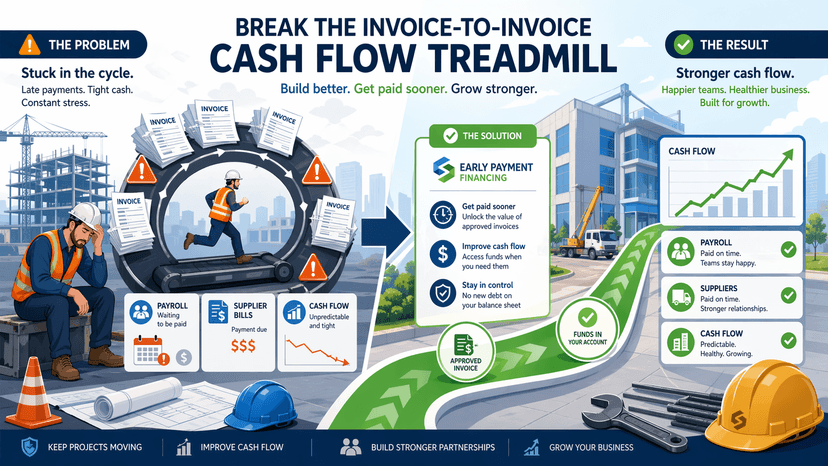
Waiting for a client to pay is no longer the only option. Invoice financing now exceeds $3 trillion globally, with AI-powered platforms delivering funding decisions in hours rather than days.
Invoice discounting platforms let a business sell its receivable at a 2 to 4 percent discount in exchange for immediate liquidity. For a business carrying a 90-day cycle on a large enterprise client, this translates to an annualised cost of capital comparable to a standard overdraft facility. Run the calculation first: what does the discount cost versus what will the liquidity shortage force?
Revenue-based financing solves a related problem differently. SaaS businesses with recurring revenue visibility can access advances at 6 to 12 percent of monthly recurring revenue, repaid as a percentage of incoming receipts. This structure keeps the cap table clean and removes personal guarantee requirements. Early payment discount structures offer yet another lever, and open banking solutions are streamlining how these transactions flow between organisations. None of these tools resolve a late payment crisis alone, but each buys the time needed to resolve it strategically.
Dynamic discounting flips the model entirely. Buyer platforms allow suppliers to offer early payment in exchange for a small yield. Enterprise buyers deploy idle treasury through these mechanisms, while small businesses use them to smooth receivables timing. B2B payment innovations are expanding options at every stage of the receivables cycle.
Three Levers That Define Every CFO’s Response
When an invoice crosses 60 days with no resolution, disciplined CFOs run a three-lever review. Each lever produces a clear decision trigger that removes ambiguity from the late payment crisis response.
Coverage comes first: how many weeks of operating expenses are fully funded by confirmed cash and liquid reserves, independent of the overdue receivable? A business with 8 weeks of confirmed coverage holds different options than one with 3. This number determines the urgency of every subsequent decision.
Concentration follows: what percentage of total monthly receivables does this single overdue invoice represent? At 15 percent, it is an irritant. At 40 percent, it is a survival question. Concentration risk above 30 percent on a single client is a structural problem the late payment crisis has merely revealed. Enterprise Nation confirms that payment performance is becoming a standard reputational metric by which investors, journalists, and employees judge companies in 2026.
Relationship capital is the third lever: what is this client worth across a 24-month horizon, and what does escalating collection activity cost against that value? A client with significant long-term revenue does not get handed to a collections agency over one overdue invoice at day 62. A client showing a pattern of delays with no forward contract receives a different response entirely.
Clear triggers follow from this review. Coverage below 4 weeks activates receivables financing immediately. Concentration above 35 percent triggers a client diversification review the following quarter. Relationship capital above a defined threshold keeps the CFO personally involved in resolution, while anything below that threshold escalates through formal channels. A fractional CFO often brings the structured perspective needed to execute this framework without internal bias.
What Survives the Late Payment Crisis Matters Most
Two kinds of finance leaders emerge from a late payment crisis. One treats it as a one-time event, celebrates the wire when it finally arrives, and moves on. However, the other treats it as a system diagnostic.
CFOs who update payment terms, tighten client concentration limits, implement early payment discount financing, and maintain a 13-week model weekly come out structurally stronger. Conversely, those who resume business as usual encounter the same late payment crisis eighteen months later at a larger scale.
Ultimately, the invoice will clear. The question a CFO owes the business is what the system looks like on the other side.