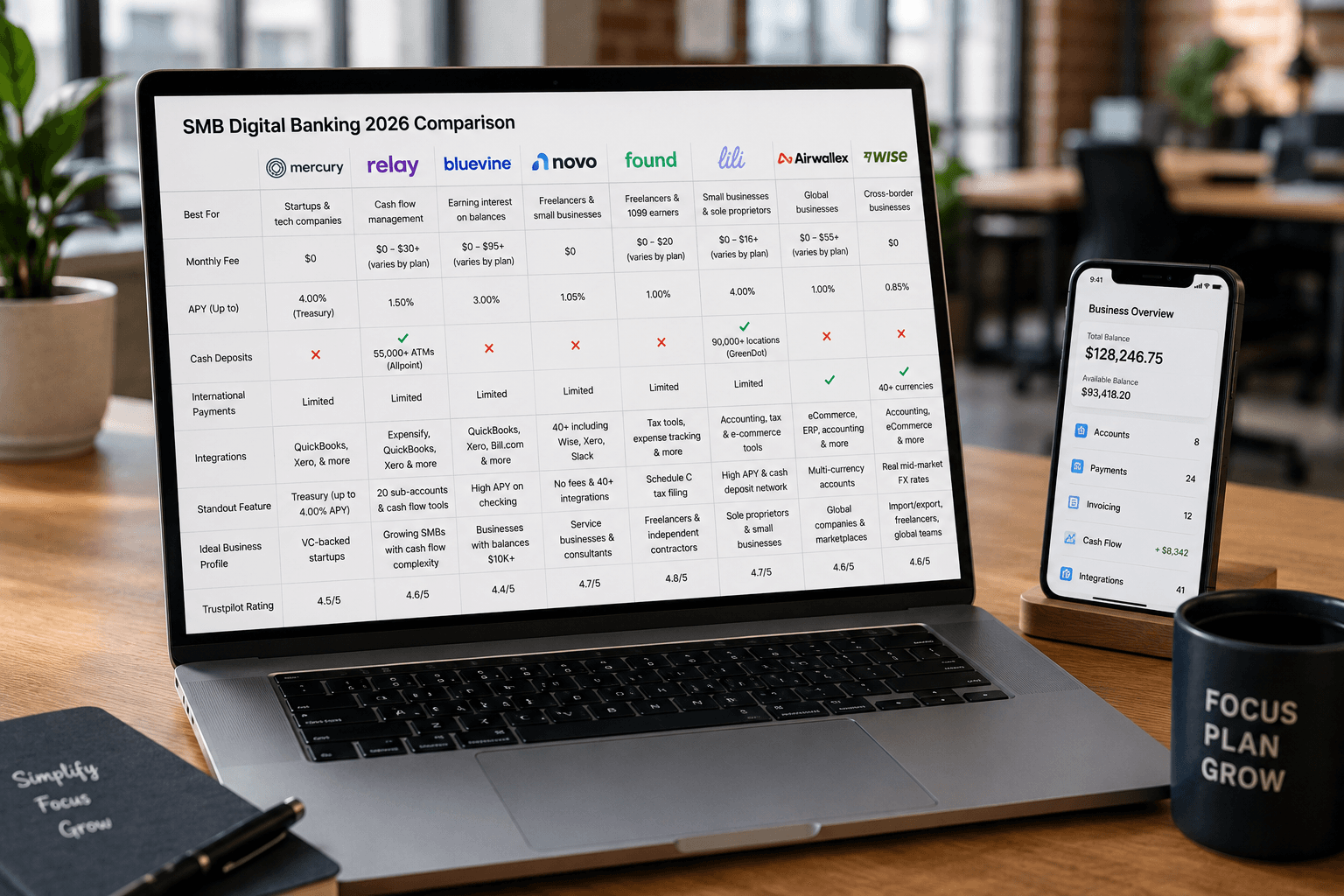
SMB digital banking 2026 features a market where over 30 million US small businesses can choose from more digital banking platforms than ever, with differentiation now sitting in product fit rather than feature counts. According to a June 2025 Morning Consult survey for the Financial Technology Association, 98% of small businesses report high satisfaction with the fintech products they use, indicating the category has cleared a basic quality threshold. The harder question for SMB digital banking 2026 is which platform fits a specific business profile. A venture-backed startup has different needs from a sole trader or a cash-heavy retail operation, and the wrong choice generates compounding friction.
SMB Digital Banking 2026 Landscape Snapshot
Mercury serves over 200,000 customers and reported $650 million in annualised revenue as of November 2025, with three years of GAAP profitability. According to Mercury’s December 19, 2025 announcement, the company has applied for a national bank charter from the OCC and federal deposit insurance from the FDIC.
Across the rest of the SMB digital banking 2026 field, Relay focuses on cash flow management with up to 20 sub-accounts and global ATM access. Bluevine offers up to 3% APY on checking depending on plan tier. Novo provides no monthly fees and over 40 integrations including Wise, Xero, and Slack. Found targets freelancers with integrated Schedule C tax filing. Lili offers up to 4% APY and operates a 4.7/5 Trustpilot score across over 4,000 reviews.
Question 1: Does the Business Handle Significant Cash?
The cash-handling question removes a significant portion of the SMB digital banking 2026 market in one move. Mercury does not support cash deposits, making it better suited for digital-first businesses than retail or cash-heavy operations. The same limitation applies to most pure-play digital banking providers. Furthermore, businesses that take regular cash payments need either a traditional bank with branch infrastructure or a digital platform with cash deposit partnerships. Lili offers cash deposits at over 90,000 GreenDot retail locations, and Relay provides access to a global network of over 55,000 Allpoint ATMs without out-of-network fees. As a result, cash-handling businesses should prioritise these providers when comparing SMB digital banking 2026 platforms.
Question 2: Domestic or International Operations?
The international question is increasingly material as supply chains globalise and remote teams span multiple countries. Airwallex stands out for international payments and multi-currency features, while Wise Business provides real mid-market exchange rates with no markup, plus international transfer fees ranging from 0.33% to 2.0% depending on currency, supporting over 40 currencies.
By contrast, Mercury remains primarily USD-focused and serves the domestic US tech ecosystem most effectively. American Express Business Checking charges a 2.7% foreign transaction fee on international purchases. For deeper context, see Fintechbits coverage of global business banking and stablecoin infrastructure, where the gap between domestic-optimised and globally-optimised SMB digital banking 2026 products is widening as the cross-border payments market matures.
Question 3: How Much Does APY Matter for Cash Balances?
The interest rate environment of 2024 and 2025 made APY on business checking and savings a material variable rather than marketing language. Specifically, Bluevine offers up to 3% APY on checking balances subject to plan tier and activity requirements, with no monthly maintenance fees and unlimited transactions. Lili offers up to 4% APY across its tiers. Mercury’s Treasury product earns up to 4% APY on deposited balances. However, APY rates vary by plan tier, depend on activity thresholds, and shift with the prevailing rate environment. Businesses carrying substantial cash balances should treat APY as a material factor in SMB digital banking 2026 platform selection rather than as a footnote.
Question 4: Which Integrations Does the Business Actually Need?
A platform’s value lives in the connection between banking and the accounting, payroll, invoicing, and e-commerce tools an SMB already uses. Novo provides no monthly maintenance fees with unlimited transactions and over 40 business integrations, including Wise, Xero, and Slack. Mercury integrates with QuickBooks, Xero, and a range of accounting platforms. Furthermore, Found provides integrated Schedule C filing support, expense categorisation, and tax automation, making it particularly suited to freelancers and self-employed business owners who carry quarterly tax filing without a dedicated finance team. The question for SMB digital banking 2026 buyers is not which platform has the longest integration list but which integrates deeply with the specific tools the business depends on day to day.
Question 5: What Is the Regulatory and Insurance Structure?
The 2024 Synapse collapse and its aftermath exposed the risks of the Banking-as-a-Service model for business depositors whose funds were at risk through partner bank failures. As a result, Mercury migrated customers from Evolve Bank and Trust to Column N.A. and Choice Financial Group, then applied for an OCC national bank charter in December 2025. Companies pursuing their own charters provide a fundamentally different risk profile from those reliant entirely on partner banks.
Notably, FDIC insurance coverage amounts also vary substantially across SMB digital banking 2026 platforms. Lili and Mercury both offer up to $3 to $5 million in FDIC coverage through sweep networks, while standard FDIC insurance through a single partner bank covers only $250,000 per depositor. For broader context on charter strategy, see Fintechbits analysis of primary bank loyalty fragmentation.
Question 6: How Does AI Automation Fit Operational Workflows?
The AI and automation layer is the differentiating frontier in SMB digital banking 2026. Generative AI, open APIs, and full digital onboarding are now baseline expectations rather than premium features. Specifically, real-time dashboards showing cash flow, receivables, payables, and pattern-based alerts are standard across competitive platforms.
The question for buyers is not whether a platform offers these features but how deeply they integrate with operational context. As covered in Fintechbits analysis of bank AI overhaul moves, Ramp has set the benchmark for AI-driven financial automation in the spend management category through autonomous agents handling vendor negotiations, compliance checks, and treasury sweeps. By 2027, the gap between platforms using AI cosmetically and those using it operationally will define SMB digital banking 2026 selection outcomes.