Author: Charitarth Sindhu, Fractional Business & AI Workflow Consultant
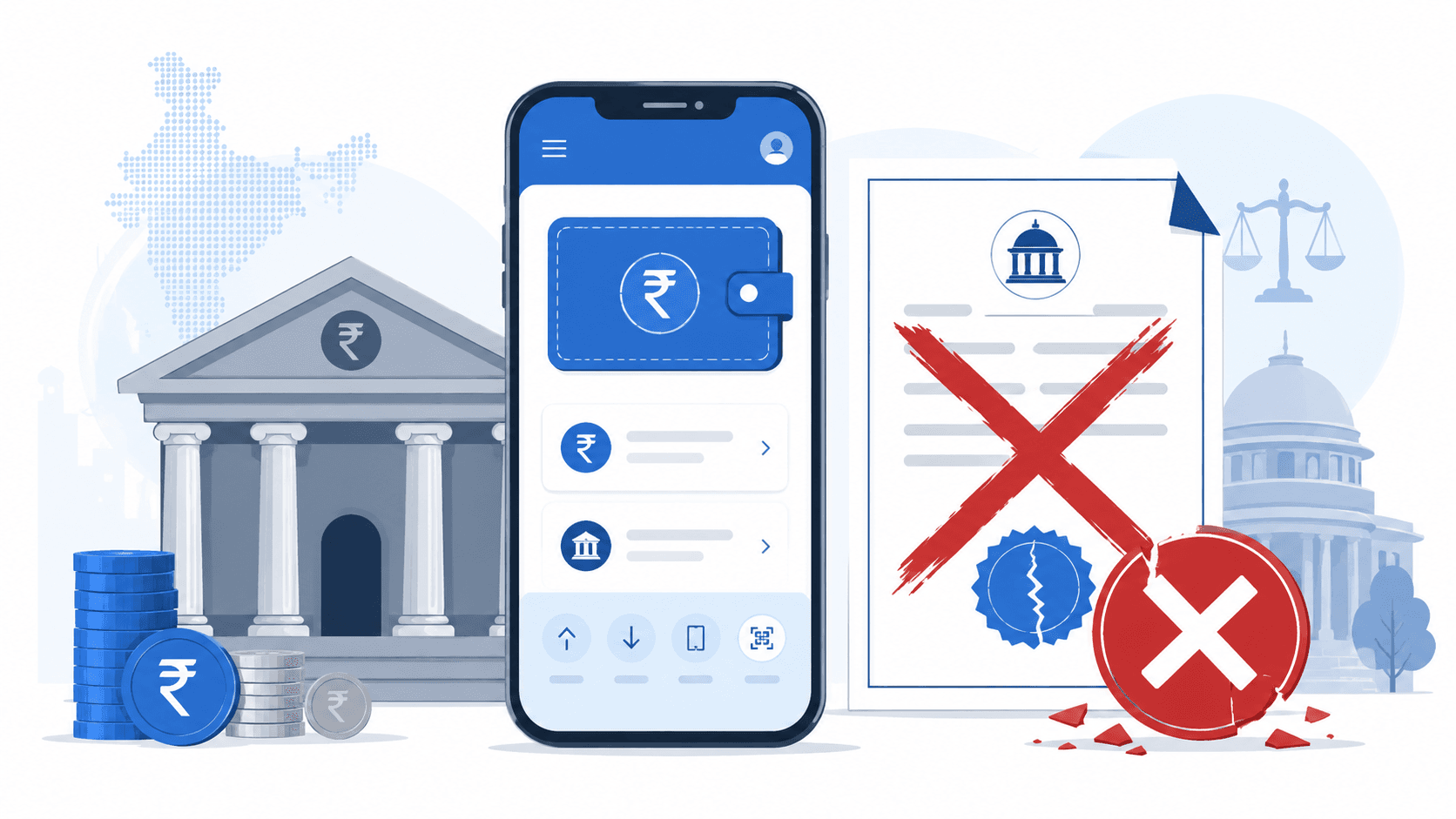
Paytm Payments Bank licence cancellation took effect on 24 April 2026 when the Reserve Bank of India invoked Section 22(4) of the Banking Regulation Act, 1949. The order ended the Paytm Payments Bank licence at the close of business that Friday. From then on, the bank could not accept deposits, run customer accounts, or call itself a bank at all.
RBI also said it would file a winding-up petition in the High Court. Yet the order described the bank as having enough liquidity to repay every depositor. So this was less a rescue than a burial. The Paytm Payments Bank licence had been functionally dead since March 2024, when an earlier RBI ban froze its core banking functions.
For most users, the change is invisible. The Paytm app still works, UPI flows through four partner banks, and parent One97 Communications had already written off its investment two years ago. Still, the order matters. It is the first time RBI has revoked a payments-bank licence in India.
Why RBI cancelled the Paytm Payments Bank licence
RBI’s order listed four grounds under Section 22(3). The bank had run affairs “detrimental to the interest of the bank and its depositors”. Its management was “prejudicial to the interest of depositors as also the public interest”. No useful purpose would come from letting it continue. And it had failed to meet the conditions of its original licence.
The Paytm Payments Bank licence had carried strict conditions on deposits, KYC, and IT controls from day one. The bank breached most of them well before 2022.
That year, RBI stopped new customer onboarding citing supervisory concerns. A CERT-In empanelled auditor then reviewed the bank’s IT systems and compliance posture. Bloomberg later reported allegations of weak KYC, opaque links to the parent company, and accounts not matching the official PAN database.
Then came the October 2023 penalty. RBI fined the bank ₹5.39 crore for KYC breaches, cyber-security failings, and a video-KYC platform accepting connections from IP addresses outside India.
By January 2024, the regulator had run out of patience. RBI’s 31 January 2024 release said the auditor reports revealed “persistent non-compliances” warranting tougher action. After 15 March 2024, the Paytm Payments Bank licence allowed no new deposits, top-ups, or transfers in customer wallets, FASTags, or NCMC cards.
So the April 2026 cancellation closed a regulatory file that had been open for years. Medianama called it a formality, not fresh action.
What the Paytm Payments Bank licence cancellation means for customers
For account holders, the operational hit is small. The Paytm Payments Bank licence had been clinically dead since March 2024. Wallets, FASTags, and savings balances stopped accepting top-ups long before this week. UPI handles migrated to four partner banks: SBI, HDFC, Axis, and Yes Bank. The Paytm app itself now runs as an NPCI-approved third-party application, with mobile banking flows fully decoupled from the dead bank.
Deposits will be repaid through a court-supervised winding-up. RBI said the bank holds enough liquidity to meet its full deposit liability. Total customer deposits stood at just ₹1,395 crore as of March 2025. So the absolute exposure is small. The Deposit Insurance and Credit Guarantee Corporation also covers up to ₹5 lakh per depositor as a statutory backstop. Payments banks cap deposits at ₹2 lakh, so the insurance ceiling sits comfortably above any single balance.
FASTag holders need to switch to another NPCI-approved issuer. NHAI dropped the bank from its authorised list back in February 2024. Any residual security deposits will flow through the liquidator once the High Court admits RBI’s winding-up application.
How One97 Communications responded
One97 Communications, the listed parent, filed two stock-exchange disclosures within 24 hours. The first stated bluntly that the company has no exposure to PPBL and no shared services. The second confirmed PPBL’s board and shareholders had passed winding-up resolutions. After that, PPBL ceases to be an associate of One97.
The stock told its own story. On 27 April 2026, shares gapped down to an intraday low of ₹1,051. That was an 8.4 percent fall and wiped out roughly ₹5,800 crore of market value in minutes. By the close, bargain-hunters had pared the loss to around 3 percent. Over the following week, the stock found a band between ₹1,104 and ₹1,184.
Brokerage reaction split along familiar lines. Jefferies kept its Buy rating with a target of ₹1,350. Goldman Sachs went further, putting its target at ₹1,400 and calling the Paytm Payments Bank licence cancellation a “procedural closure”. Bernstein, Emkay, and YES Securities all stayed bullish. Motilal Oswal stood out as the cautious voice with a Neutral call.
Vijay Shekhar Sharma stayed quiet on the day itself. On the 7 May 2026 earnings call, he said there were “no implications” from the cancellation. He also confirmed One97 will not apply for an NBFC licence. The cash pile of ₹13,315 crore will go into AI instead.
What the Paytm Payments Bank licence cancellation tells India’s fintech sector
This is the first revoked payments-bank licence in India. Of the eleven 2015 approvals, six began operations and five remain standing. Fino has now got in-principle approval to convert into a Small Finance Bank, which may map the survival route for the rest. The pattern echoes regulatory tightening on fintechs in other markets too.
The wider signal is sharp. RBI used its strongest tool, Section 22(4), to terminate a high-profile licensee after years of unfixed audit findings. So the message to fintechs is plain. Scale does not buy time forever. Persistent KYC, governance, or related-party failures will trigger action eventually. PhonePe and Google Pay, both running as TPAPs without banking ambitions, picked up most of the UPI volume Paytm shed.
Yet RBI also granted Paytm’s payment-aggregator subsidiary an in-principle licence in August 2025. So the regulator is willing to separate a compliant business engine from a non-compliant legacy entity. The Paytm Payments Bank licence cancellation marks one ending, but the parent keeps running. That precedent may comfort other banks and financial institutions carrying legacy compliance baggage of their own.
For now, the Paytm Payments Bank licence joins the regulatory archive. The era of “fix it later” governance is over.