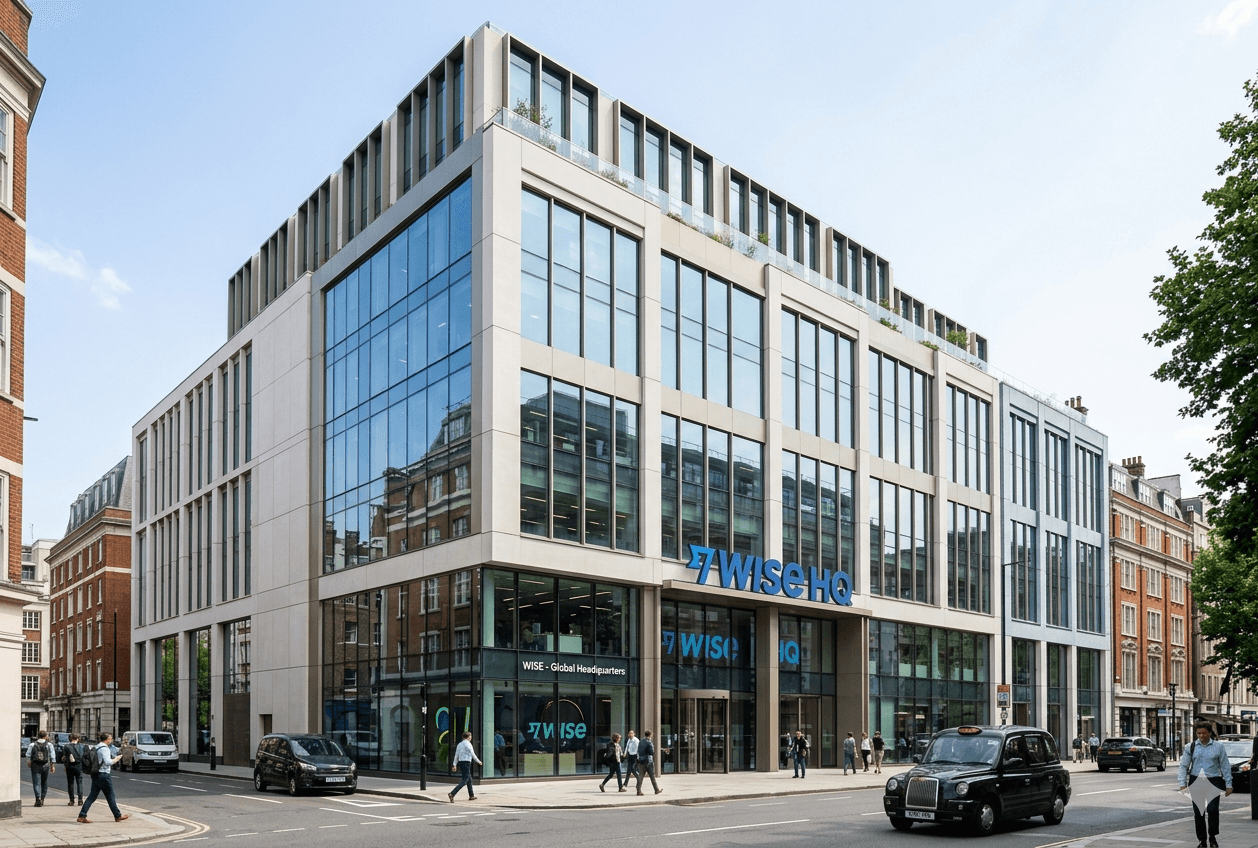
Wise Nasdaq listing began trading on Monday, May 11, 2026, under the ticker WSE, with a quiet ceremony on the floor of the New York exchange. The London-founded money transfer company that began life as a challenger to the foreign exchange rip-off model of legacy banks rang the opening bell as a primary Nasdaq-listed company. It had completed the migration it announced via its newsroom in June 2025: shifting its primary listing from the London Stock Exchange to New York while keeping a secondary listing in London, where the company remains headquartered. The move was diplomatically framed by Wise as an expansion rather than a departure. For the London financial establishment, the subtext was unmistakable. One of the most consequential fintech companies Britain has produced has concluded that London cannot give it what it needs.
Wise Nasdaq Listing Caps a Year-Long Migration
The Wise Nasdaq listing comes after extensive preparation. Nearly 91% of class A shareholders backed the move when it went to a vote. The company will now report under US GAAP. Chief Executive Kristo Käärmann framed the move forward-looking, citing the $43 trillion that moves across borders globally each year and the $43 billion Americans alone are estimated to lose in hidden fees in 2026. According to Bloomberg, shares opened at $15.96 and closed Monday at $15.40, valuing the company at roughly $14 billion. That is a premium to its 2021 direct listing price of £8 billion but below levels implied by comparable US-listed fintechs. The Wise Nasdaq listing has therefore opened with a valuation that bakes in upside rather than rewarding it upfront.
The Numbers Behind the Move
The financials framing the Wise Nasdaq listing are striking. For the fiscal year ended March 31, 2026, Wise processed $243 billion in cross-border volume, up 31% year-on-year. Net revenue reached $2.5 billion, up 19%. Transaction revenue climbed to $1.9 billion, split between $1.3 billion in cross-border payments and $600 million in card and other revenue, with the card line growing fastest at 34%. Customer holdings rose 40% to $39 billion. Active customers reached 18.9 million, up 21%. Seventy-five percent of payments were now delivered instantly, up from 65% a year earlier. The company guided income before tax margin toward the top of its 13 to 16% target range, including the costs of the Nasdaq listing itself. These are not the numbers of a company leaving a market in distress. They are the numbers of a company that has outgrown the market it originally chose, which is the deeper meaning of the Wise Nasdaq listing.
Valuation Multiples Tell the Real Story
The structural reason behind the Wise Nasdaq listing is one of valuation multiples. US markets have, for decades, assigned higher growth multiples to technology companies than their European counterparts. The mechanism is not mysterious. Deeper pools of institutional capital, a broader and more specialised analyst community covering technology businesses, greater retail investor participation, and a cultural familiarity with growth-at-scale investing combine to create a structural premium that London has not been able to match. A fintech growing cross-border volumes at 31% annually, generating $2.5 billion in net revenue, is a different category of company than the one that direct-listed in London in 2021. The valuation that category deserves will be awarded in New York, not in London. The Wise Nasdaq listing puts that thesis into capital markets practice. Wise’s decision to switch to US GAAP reporting for its 2026 financial year underscores how completely the centre of gravity has shifted. London gets the secondary listing. New York gets the strategic logic, and the Wise Nasdaq listing is the proof point.
Banking Charter Ambitions Compound the Strategic Logic
US ambitions go beyond capital markets access, and the Wise Nasdaq listing has to be read alongside them. In July 2025, Wise applied to the Office of the Comptroller of the Currency for a national trust bank charter under the proposed Wise National Trust entity, based in Austin, Texas. The company has also applied for a Federal Reserve master account at the Federal Reserve Bank of Dallas, which would give it direct access to the payment rails through which dollar settlements flow, including FedNow. If both approvals land, Wise would become one of a vanishingly small number of non-bank entities with direct Fed access, a position that would fundamentally alter its cost structure for US dollar transactions and let it compete with the correspondent banking network itself. Fed Governor Chris Waller has said publicly that he is exploring a streamlined account structure for newly chartered entities, though no formal framework has been published. Approvals are not guaranteed. But the ambition clarifies why a Nasdaq listing, rather than a London one, was the natural strategic companion to the broader US push.
Wise Is the Latest Departure in a $100B Pattern
The Wise Nasdaq listing is the most recent chapter in a pattern that has now repeated with enough regularity to constitute a structural trend. More than $100 billion in market capitalisation has migrated away from the London Stock Exchange in the past five years. Arm chose New York for its 2023 IPO despite then-Prime Minister Rishi Sunak’s personal lobbying. CRH delisted from London entirely after switching its primary listing to New York. Flutter moved its primary listing to New York in 2024 and is now considering dropping London altogether. Darktrace left after its acquisition by Thoma Bravo. Just Eat departed for Amsterdam, Tui moved to Frankfurt, and Ashtead and Indivior have followed. Companies list in London, grow, discover that London cannot provide the liquidity, analyst coverage, or valuation multiples they need, and leave. KPMG’s Pulse of Fintech H2 2025 put UK fintech investment at $10.96 billion in 2025, down 21% year-on-year, the lowest level since the pandemic. The Wise Nasdaq listing concentrates that broader trajectory into a single visible data point. Fintechbits has tracked it in its UK fintech deal activity coverage.
Revolut, Klarna, and What the Next Wave Means
The implications of the Wise Nasdaq listing go beyond the symbolic. Revolut, valued at $75 billion after a November 2025 secondary share sale and targeting a $150 to $200 billion IPO valuation, has repeatedly signalled that its listing preference is Nasdaq. CEO Nik Storonsky has cited liquidity, higher technology valuation multiples, and the UK’s 0.5% stamp duty reserve tax on share dealings as deterrents to a London float. Chancellor Rachel Reeves has personally lobbied for a London listing, opening Revolut’s Canary Wharf headquarters and unveiling a three-year stamp duty exemption for newly listed firms in a transparent bid to retain the company. Revolut has committed $4 billion to UK investment within a $13 billion global plan to 2030 and only recently secured its full UK banking licence from the Prudential Regulation Authority after an 18-month mobilisation. Even so, Storonsky has reiterated that a listing is at least two years away and that the US remains the preferred venue, as fintechbits has covered in its Revolut IPO tracker. Klarna has already listed on the NYSE. The Wise Nasdaq listing slots cleanly into the same direction of travel.
McKinsey has warned that Europe’s software sector is at a critical inflection point. The continent produces more than 280 software companies generating over 100 million euros in annual recurring revenue but struggles to retain them as public companies. The talent, the capital, and the customers are increasingly in the United States. Global fintech investment rebounded to $116 billion across 4,719 deals in 2025, of which the US captured $66.5 billion. The UK’s roughly $11 billion was still more than France, Germany, Belgium, the Nordics, Ireland, China, and Brazil combined, a figure ministers cite often. But the trajectory is the wrong one, and the Wise Nasdaq listing concentrates the problem into a single, visible data point.
What London Can Still Do
The government’s “regulate for growth” agenda, launched over a year ago, has generated positive rhetoric but uncertain outcomes. FCA speeches have emphasised innovation, with Targeted Support reforms reaching wealth firms in early 2026. EY analysis has noted that regulators must balance growth ambitions against the competing demands of market stability and consumer protection. The political environment around all of this is itself unstable, as fintechbits has documented in its UK fintech political risk coverage of the Starmer leadership crisis. William Blair analyst Cristopher Kennedy described Wise’s approach as “a self-reinforcing flywheel: more cross-border volume drives scale benefits and gross profit dollars, which are systematically reinvested in the product, technology, infrastructure, marketing, and price, all of which drive more volume.” That flywheel is now spinning on American capital markets infrastructure. The question for London is not how to get Wise back. It is how to prevent the next generation of companies that will eventually resemble Wise from making the same calculation before they ever list in Britain at all. The Wise Nasdaq listing is, in the end, less a story about one company’s ambitions than a structural diagnosis of London’s diminishing capacity to hold onto the fintech companies it creates. The city still produces them. It is simply finding it harder to keep them.
Fintechbits is a specialist publication covering financial technology, digital payments, and the regulatory and investment landscape across global markets. All analysis represents the editorial views of Fintechbits.