6 mins read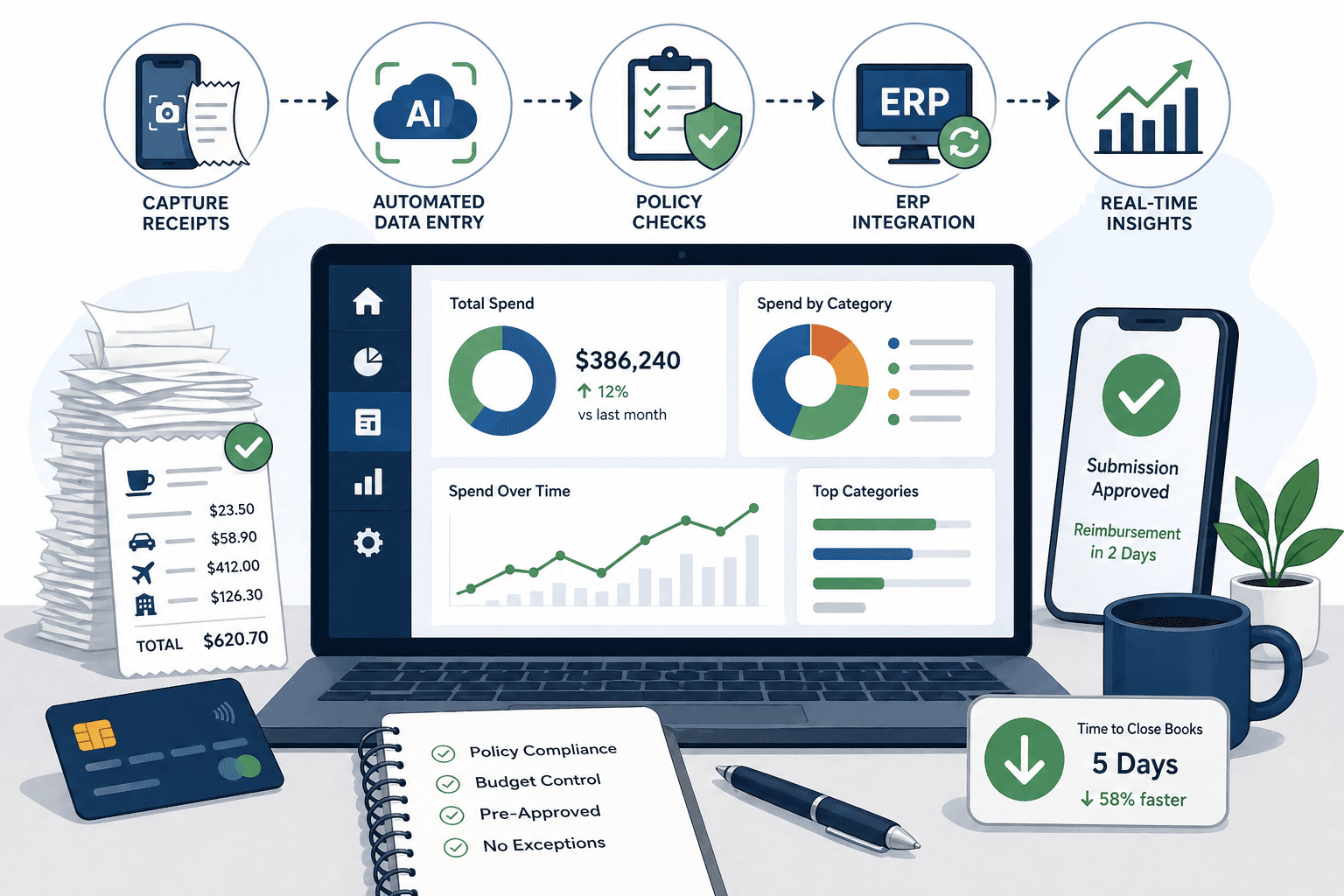
Author: Girish Songirkar, Delivery Manager, Enterprise Software Engineering, Arionerp
Expense management is now an $8.48 billion software market growing at over 10% annually, according to Mordor Intelligence’s 2026 forecast, and the reason is straightforward: companies finally figured out how much manual receipt processing was costing them. SAP Concur’s data shows finance teams that automate close their books 50% faster and cut manual data entry by 43%. The companies that haven’t made the move are the ones still operating in what finance leaders quietly call the expense management black hole.
This is not a technology problem dressed up as a finance problem. It is a system design problem with a finance bill attached. Every paper receipt, every manually keyed expense line, every reimbursement that takes three weeks to clear is a small drag on operating margin that compounds across thousands of transactions per quarter. Most CFOs know the costs exist. Few have a precise number for them, which is exactly the issue.
Fintechbits analysis
Why manual expense management quietly burns operating margin
Manual data entry is the most visible cost. It is also the easiest to underestimate. A finance analyst keying expense reports for two hours a day at a $90,000 fully-loaded annual cost is burning roughly $22,000 per year on a process that modern OCR completes in seconds. Multiply that across the AP team and the labour drag adds up to six figures fast. The Mordor Intelligence data shows automation cuts manual entry time by 43% and IT operating costs by up to 40%. Those are not marginal gains. They are the difference between a finance function that scales and one that needs another headcount every time the business grows.
The errors that come with manual entry are the second cost layer. Typos, duplicate submissions, and miscategorised expenses all need correction work that compounds. Each correction touches at least two people, breaks the linear processing flow, and delays reimbursement for an employee who is now slightly less happy with the company. Expense management vendors that integrate validation at the receipt-capture stage catch these errors before they enter the workflow, which is structurally cheaper than catching them after.
Real-time visibility changes the CFO’s job
Traditional expense management surfaces problems at month-end, which is exactly when there is no time to do anything about them. By the time finance sees that a department has burned through its travel budget, the trips are already taken and the cards are already swiped. Real-time dashboards change this dynamic by surfacing spend patterns as they happen, which means budget owners can intervene before commitments become commitments.
This shift turns expense management from a reactive accounting function into a forward-looking control surface. The 2025 AFP Payments Fraud and Control Report and parallel SAP Concur data show that companies running real-time visibility close their books in five days versus twelve days for manual peers. FintechBits’ breakdown of the late payment crisis CFO guide makes the same point about cash flow generally: visibility is the lever, and the cost of not having it shows up in places that look like operational problems but are really information problems. The companies that close this gap typically pair real-time dashboards with monthly variance reviews where department heads explain spend deviations to finance leadership. The combination of automated visibility plus accountable conversation is what shifts behaviour, not the dashboard alone.
Policy enforcement only works when it’s automated
Every company has an expense policy. Most policies sit in a PDF that nobody reads. The gap between policy and practice is where compliance risk lives, and manual enforcement is the wrong tool to close it. Asking finance reviewers to catch every policy violation across thousands of submissions per month is a setup for inconsistency at best and audit problems at worst.
Modern expense management platforms enforce policies at the submission stage. An employee who tries to submit a $400 dinner against a $75 per-head meal cap gets blocked at entry, with the system explaining what happened and what the right path forward looks like. This is structurally different from catching the violation three weeks later in a review queue. The block is preventative. The review is retrospective. Companies that automate policy enforcement see a 48% drop in policy violations because the friction sits at the front of the workflow rather than the back.
Card programmes and ERP integration close the loop
The biggest operational shift in expense management over the past two years has been the rise of embedded-finance corporate card programmes that stream enriched transaction data directly into approval workflows. Instead of an employee paying out of pocket and chasing reimbursement, the company’s card runs the transaction and the data flows into the expense system automatically. Reimbursement cycles collapse. Receipt-matching automates. The cost classification arrives pre-tagged.
FintechBits’ analysis of the hidden costs of B2B virtual cards at scale covers the trade-offs that come with this model, because the virtual card layer also introduces fee structures and fraud surface that have to be managed. The point is not that virtual cards are universally cheaper. It is that the data-flow integration they enable is what unlocks the next tier of expense management efficiency. Without that integration, the rest of the automation stack runs on incomplete information.
Anomaly detection catches what humans miss
AI-driven anomaly detection is the layer that turns expense management from a control function into an intelligence function. Pattern recognition across transaction history flags the receipts that look fine in isolation but anomalous in context: duplicate hotel bookings on the same date, unusual mileage claims relative to the employee’s historical pattern, dinners submitted on dates the employee was on PTO. Manual review never catches these reliably. Machine learning catches them at scale.
The implementation challenge is data quality. Models need clean transaction history, consistent vendor coding, and complete metadata to operate without noisy false positives. FintechBits’ piece on AI-driven fraud prevention systems lays out the calibration discipline that separates platforms catching real signal from platforms generating alert fatigue. The same principle applies to expense management anomaly detection: the model is only as good as the data feeding it, and the data is only as good as the underlying integration.
Expense management is no longer a back-office function that finance teams tolerate. It is a strategic surface where automation, real-time visibility, and policy enforcement compound into operating leverage that traditional manual processes cannot match. Companies still running on paper receipts and month-end reconciliation are not just inefficient. They are paying for that inefficiency every quarter in labour costs, reimbursement delays, policy violations, and missed anomalies. The technology to close the gap exists. The remaining question is implementation discipline.