6 mins read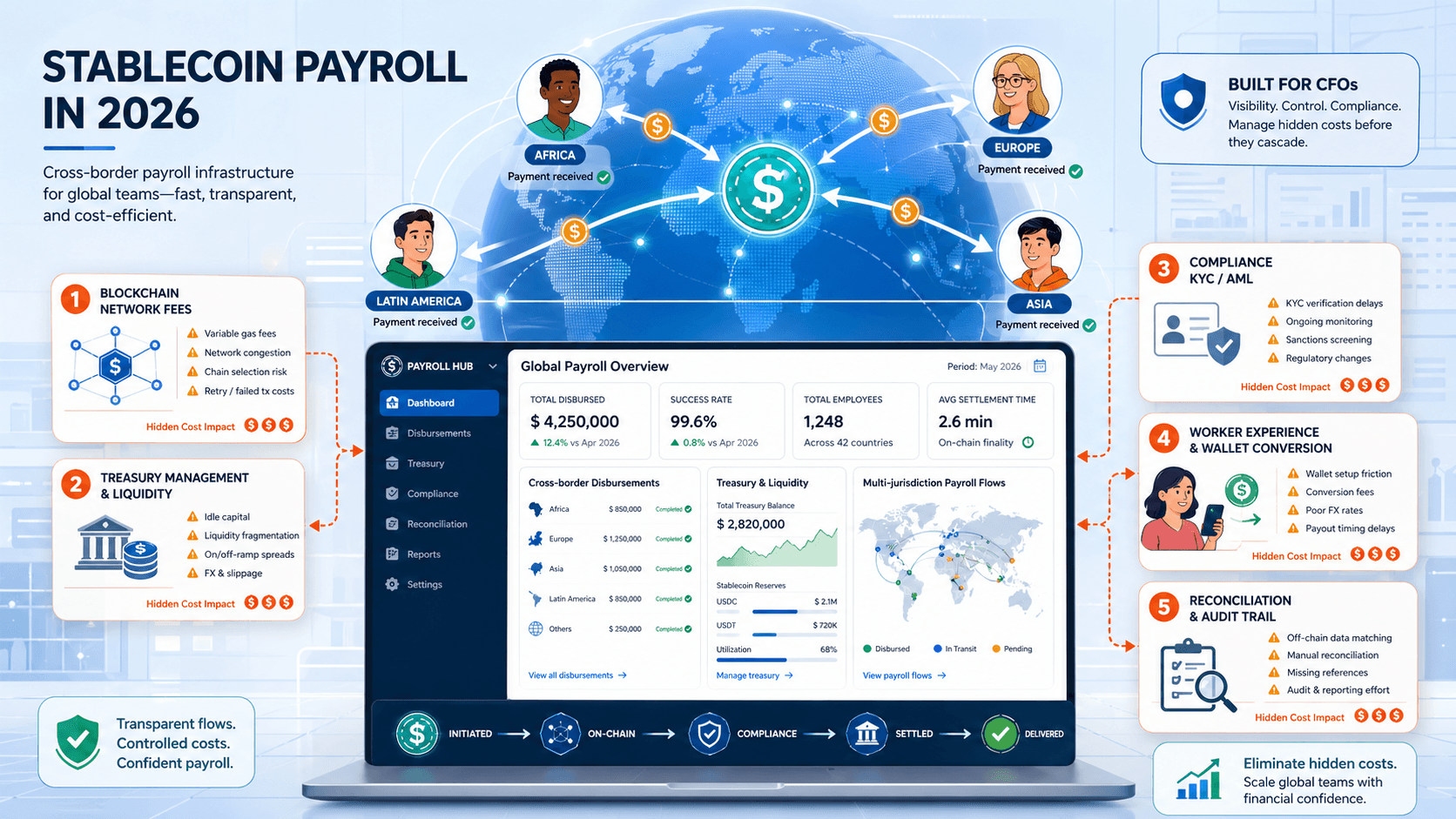
Author: Sudhanshu Dubey, Delivery Manager, Enterprise Solutions Architect, Errna
Stablecoin payroll has crossed from speculative experiment to operating infrastructure. Mastercard’s $1.8 billion acquisition of BVNK in March 2026 confirmed what global finance teams had been seeing in their treasury reports for months. Deel, Rippling, Remote, and Payoneer each rolled out stablecoin disbursement capabilities since early 2026, and the question facing CFOs is no longer whether to evaluate this rail but how to operationalise it without hidden cost cascades downstream.
The pitch is familiar. Settlement in seconds rather than days. Fees measured in cents rather than percentage points. The World Bank’s Q1 2025 data still shows the global average cost of sending $200 across borders sitting at 6.49%, virtually unchanged across five years. A contractor in Lagos earning $3,000 monthly loses roughly $195 to intermediary fees, FX spreads, and correspondent banking overhead. That maths is what makes stablecoin payroll genuinely interesting, and what makes the implementation details worth sweating.
Infrastructure choices that decide unit economics
The blockchain network you settle on shapes every subsequent cost. Ethereum mainnet leads on liquidity but throws fee variance into payroll runs that finance teams cannot forecast. Most stablecoin payroll platforms have migrated to Layer 2 networks. Roughly 80% of Rise’s on-chain withdrawal volume runs through Arbitrum as of Q1 2026, with Solana and Polygon handling most of the rest. Choosing the wrong rail can wipe out the cost advantage that justified the move.
Smart contracts handle the disbursement logic. Schedule the run, fund the payroll wallet, and the contract executes payments to each employee address based on rules set in advance. The benefit is not novelty. It is the elimination of manual reconciliation that consumes finance team hours during traditional payroll cycles. API integration with HR systems keeps employee records, salary changes, and tax data flowing without anyone retyping numbers between platforms. Companies that bolt stablecoin payroll onto existing workflows tend to discover the operational savings exist only on paper.
Treasury reality and the settlement cycle
Acquiring stablecoins ahead of payroll runs is the new working capital question. Holding too little USDC or USDT means scrambling at conversion windows when prices and fees move against you. Holding too much creates idle capital that earns nothing unless your platform supports yield on payroll balances. Rise has shipped this through Rise Earn on Arbitrum, powered by Aave; most platforms haven’t caught up.
Disbursement runs in minutes once funds are in place. Employees see wages land in their wallets the same hour the run executes, regardless of corridor. Cross-border friction effectively disappears at the protocol layer. The Federal Reserve’s March 2026 working paper on payment stablecoins acknowledged that this rail could disrupt the correspondent banking model by reducing the institutional cost of maintaining foreign branches, though large international banks may still handle compliance checks and stablecoin inventory management. For companies running stablecoin payroll across more than five jurisdictions, cash flow visibility alone tends to justify the migration.
Reconciliation looks different too. Every transaction settles to a public ledger, which means audit trails build themselves. You stop waiting three weeks to confirm whether a SWIFT wire reached the recipient bank. The transparency is genuinely useful, though it raises new questions about which addresses get linked to which entities, and that is a privacy conversation worth having before launch.
Worker experience is where stablecoin payroll adoption breaks or holds
Employers want dashboards. Employees want their money to work like money. The platforms that have succeeded built employee interfaces that hide the blockchain plumbing. Workers see a balance, choose to convert to local currency or hold in USDC, and move on. Pantera Capital research across 1,600 crypto professionals found USDC dominates with 63% of crypto payroll market share, but USDT remains the dominant stablecoin in LATAM, Africa, and parts of APAC. Stablecoin payroll platforms without USDT support cannot fully serve the corridors where banking friction is highest.
Conversion options matter most for workers in volatile economies. A Brazilian freelancer paid in USDC who can convert to BRL on receipt has effectively been paid in dollars without holding a US bank account. A Lagos-based developer whose local currency lost 30% of its value in a year can hold wages in dollars until needed. This is the practical advantage that drives adoption, and it has nothing to do with crypto ideology. It has to do with predictable purchasing power.
Compliance is the operational cost most teams underestimate
KYC and AML procedures apply to stablecoin payroll exactly as they apply to traditional payroll, plus the additional scrutiny that comes with crypto rails. Verification on both employer and employee sides is non-negotiable, and documentation requirements vary by jurisdiction. AI-driven monitoring tools have become standard for flagging suspicious transaction patterns and have meaningfully reduced manual review hours. Practical AI-driven fraud prevention systems now handle pattern detection at a level no human reviewer could match.
Cross-border compliance is where the work concentrates. Each country regulates stablecoins differently. The EU’s MiCA framework, the GENIUS Act in the United States, and emerging regimes across Singapore, the UAE, and Brazil all impose distinct reporting and tax obligations. Companies running stablecoin payroll across multiple jurisdictions need either internal counsel familiar with each regime or a platform partner that handles the local registration and reporting layer. The transparency of blockchain records helps with reporting requirements, but raw transaction data is not a substitute for proper tax documentation in any jurisdiction.
Data privacy adds another layer to any stablecoin payroll program. Employee wallet addresses, even when pseudonymous, link back to identities through KYC records. Toku’s January 2026 partnership with Aleo and Paxos Labs introduced zero-knowledge proof private payroll, the first solution to combine compliant global payroll with on-chain privacy. Expect more platforms to ship privacy-preserving features as regulators clarify what they will and will not accept.
What early adopters have figured out
Pilot programs work better than full migrations. Companies that run stablecoin payroll in one corridor for three to six months before scaling tend to catch the operational gaps that finance teams missed in planning. Building internal expertise matters more than choosing the best technology partner, because the partner ecosystem is shifting faster than any contract can keep up with. The rise of DeFi infrastructure for institutional banking shows how quickly the underlying rails are evolving.
Communication with employees deserves more time than most rollouts give it. Workers who understand why they are being paid in stablecoins and what their options are will adopt the system without friction. Workers who feel the change was imposed on them will create the support tickets that erase the operational savings. Companies expanding into new cross-border payment systems face the same dynamic, and the lessons transfer.
Stablecoin payroll is no longer the speculative future of payments. It is one of the operating options on the table for any company employing workers across multiple jurisdictions. The infrastructure works. The cost savings are real. The compliance load is manageable with the right partners. What remains is the implementation discipline to capture those benefits without paying them back in hidden cascades.