

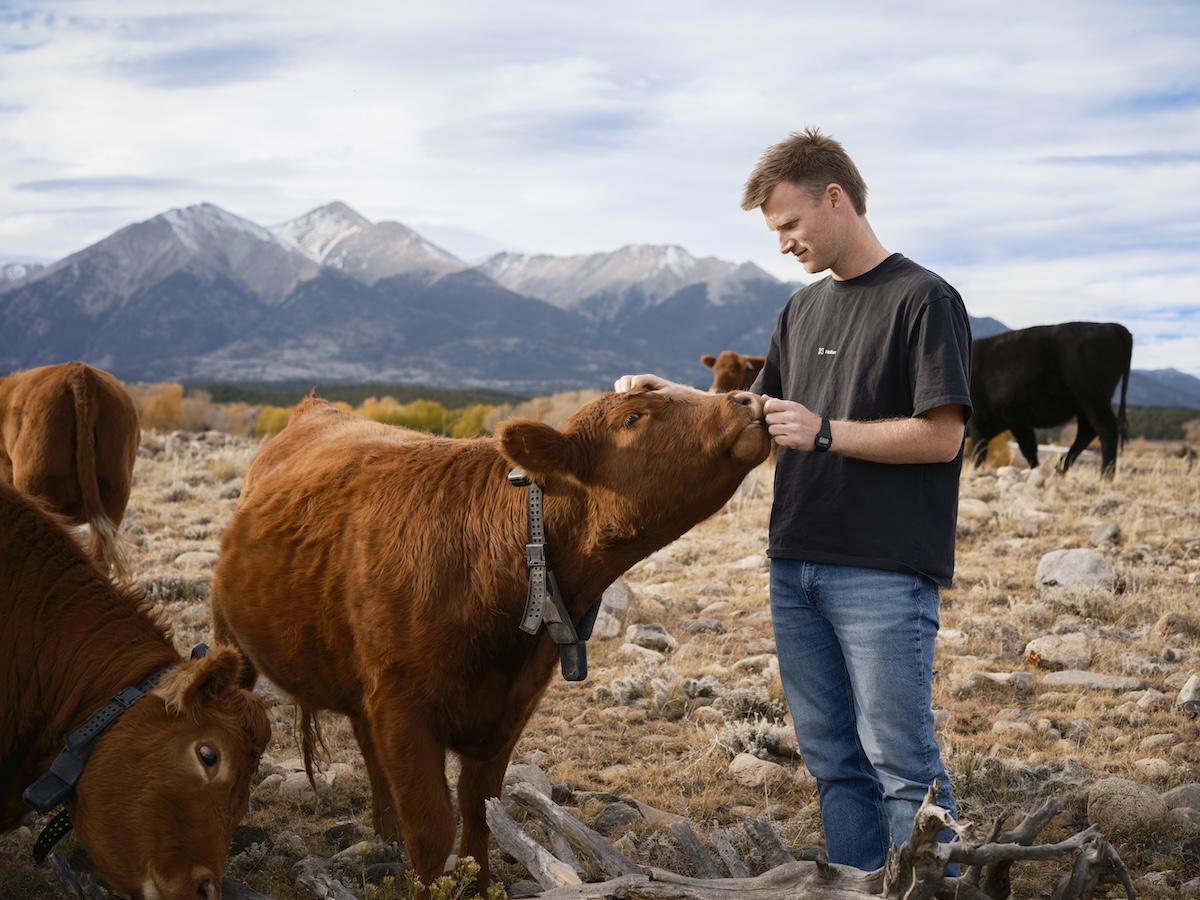
Solar powered cow collars are reshaping the way farmers manage vast herds across some of the most remote terrain on Earth. In fact, Peter Thiel’s Founders Fund just led a $220 million Series E round into Halter, the New Zealand startup behind this groundbreaking technology. The deal values Halter at $2 billion and signals one of the largest agtech investments in recent memory.
Why Founders Fund Chose Solar Powered Cow Collars
Founders Fund has built its reputation on backing companies that create entirely new markets. Its portfolio includes household names like Facebook, SpaceX, and Palantir. However, its latest bet veers far from the world of AI chatbots and humanoid robots.
Instead, the firm is doubling down on a challenge that has plagued ranchers for centuries. Managing cattle spread across thousands of acres requires dogs, horses, motorbikes, or helicopters. As a result, operational costs pile up, and efficiency suffers. Halter’s solar powered cow collars offer a compelling alternative by replacing all of that physical infrastructure with a digital solution. Similarly, other high-profile Series E rounds in recent years have signalled investor appetite for companies tackling entrenched industry problems at scale.
Moreover, Founders Fund partner Amin Mirzadegan framed the thesis clearly. Agriculture is a multitrillion-dollar industry that feeds the world, yet it remains one of the least digitized sectors on the planet. Consequently, solar powered cow collars represent exactly the kind of “zero to one” opportunity that Thiel has long championed.
How Halter’s Virtual Fencing System Works
At its core, Halter’s system combines three components: a solar powered collar, a network of low-frequency towers, and a smartphone app. Together, these elements allow farmers to draw virtual boundaries on a map. The collars then guide cattle using audio cues and gentle vibrations, much like a car beeping as it nears an obstacle.
What makes this approach so effective is how quickly livestock adapt. According to CEO Craig Piggott, most cattle learn to respond to a virtual fence after just three encounters. Furthermore, the collars operate continuously thanks to their solar charging capability, which eliminates the need for battery swaps across large herds.
In addition, the app creates a digital twin of the entire ranch. Farmers can therefore check herd positions, adjust grazing zones, and move cattle with a few taps on their phone. This level of remote control was previously unimaginable for pasture-based operations. As a result, solar powered cow collars are not just a convenience tool. They represent a fundamental shift in how land productivity is managed.
Solar Powered Cow Collars and Data-Driven Animal Health
Beyond herding, these collars continuously collect behavioural data that opens up entirely new possibilities for livestock management. The technology tracks animal health patterns, monitors fertility cycles, and flags when individual animals may be sick. Consequently, ranchers can intervene earlier and reduce losses that would otherwise go unnoticed until it is too late.
Piggott has noted that Halter’s dataset is likely the largest of its kind anywhere in the world. Meanwhile, the company is now on its fifth generation of hardware, with each iteration improving sensor accuracy and durability. Its reproductive health product is currently in beta testing with customers in the United States, further expanding what solar powered cow collars can do.
This data layer also explains why Founders Fund sees long-term platform value in Halter. The collars are the entry point, but the proprietary algorithm that Inc. Magazine dubbed the “Cowgorithm” is trained on seven billion hours of cattle behaviour data. As a result, the system grows smarter with every collar deployed, creating a powerful feedback loop.
Adoption Rates and Financial Returns for Ranchers
Numbers tell a compelling story. In just nine years, Halter’s solar powered cow collars are now on more than one million cattle across over 2,000 farms. These farms span New Zealand, Australia, and 22 U.S. states. Since launching in the U.S. in 2024, American ranchers have built over 60,000 miles of virtual fencing through the platform.
The financial case is equally strong. By giving ranchers precise control over grazing patterns, Halter can boost land productivity by up to 20 percent. In some cases, customers report doubling the output from their land. This return on investment is what separates solar powered cow collars from other agtech products that have struggled with adoption.
Piggott has been clear about this from the start. Halter was built around delivering a strong financial ROI from day one. Unlike many tech startups that prioritize growth over profitability, the company focused on making sure every dollar a farmer spends on solar powered cow collars comes back with measurable gains. That approach has been critical in winning over an inherently conservative industry.
Navigating the Competitive Landscape
Halter is not alone in the virtual fencing space. Pharmaceutical giant Merck offers a competing system called Vence. Additionally, newer entrants are exploring alternative approaches. At Y Combinator’s most recent demo day, a startup called Grazemate proposed using autonomous drones for herding instead of collars.
Nevertheless, Piggott remains confident in Halter’s position. He points to the sheer engineering difficulty of maintaining reliability at scale. A system managing a thousand animals needs many nines of uptime, because even a one percent failure rate means ten animals uncontained at any given time. Chasing that reliability has taken nine years of iteration, and it represents a moat that competitors cannot easily replicate.
Furthermore, Piggott questions whether drones can provide the constant, mission-critical presence that fencing demands. Solar powered cow collars are always on and always collecting data. That persistent connection is what makes the system trustworthy enough for ranchers to depend on day after day. The agtech sector has seen many startups struggle with high operational costs and farmer resistance, which makes Halter’s proven track record all the more significant.
Global Expansion Beyond the U.S. Market
Unlike many tech companies, Halter does not view the United States as its primary or sole market. Agriculture is a global industry, and Piggott has emphasized the need for broad geographic reach. With total funding now approaching $400 million, the company plans to expand into South America and Europe in the near term.
Ireland and the United Kingdom are expected to come online later this year. Meanwhile, early ranch deployments are already underway in Canada. The company is also planning its largest-ever hiring push, with more than 200 new roles focused on product, engineering, and customer-facing positions at its Auckland headquarters.
The potential for growth is staggering when you consider the numbers. Solar powered cow collars are currently on just one million cattle. There are roughly one billion cattle worldwide. Even Halter’s penetration in its home New Zealand market remains under 10 percent. In other words, the company has barely scratched the surface. This kind of runway is exactly what venture firms like Founders Fund look for when writing nine-figure cheques.
What Solar Powered Cow Collars Mean for Agtech’s Future
Halter’s rise carries broader implications for the agricultural technology sector. For years, agtech attracted billions in venture capital during the early 2020s, with much of that funding directed at indoor farming, food delivery logistics, and biotech approaches. Many of those bets have since struggled to scale. In contrast, solar powered cow collars solve an immediate, tangible problem that farmers face every day.
The broader trend of frontier technology reshaping traditional industries is also gaining momentum across other sectors. Similarly, the financial dynamics of energy infrastructure meeting rural industry needs continue to create new investment narratives. Solar powered cow collars sit squarely at this intersection of proven hardware, scalable software, and real-world ROI.
Piggott has summed up the road ahead in characteristically measured terms. There is a long way to go and much more product still to build. Yet with $400 million in total funding, a $2 billion valuation, and one million collars already deployed, Halter is no longer a scrappy startup testing an idea. It is a category leader that Founders Fund is betting will define how the livestock industry operates for decades to come. Solar powered cow collars may have started as an unusual venture bet, but they are quickly becoming one of agtech’s most consequential success stories.
