7 mins read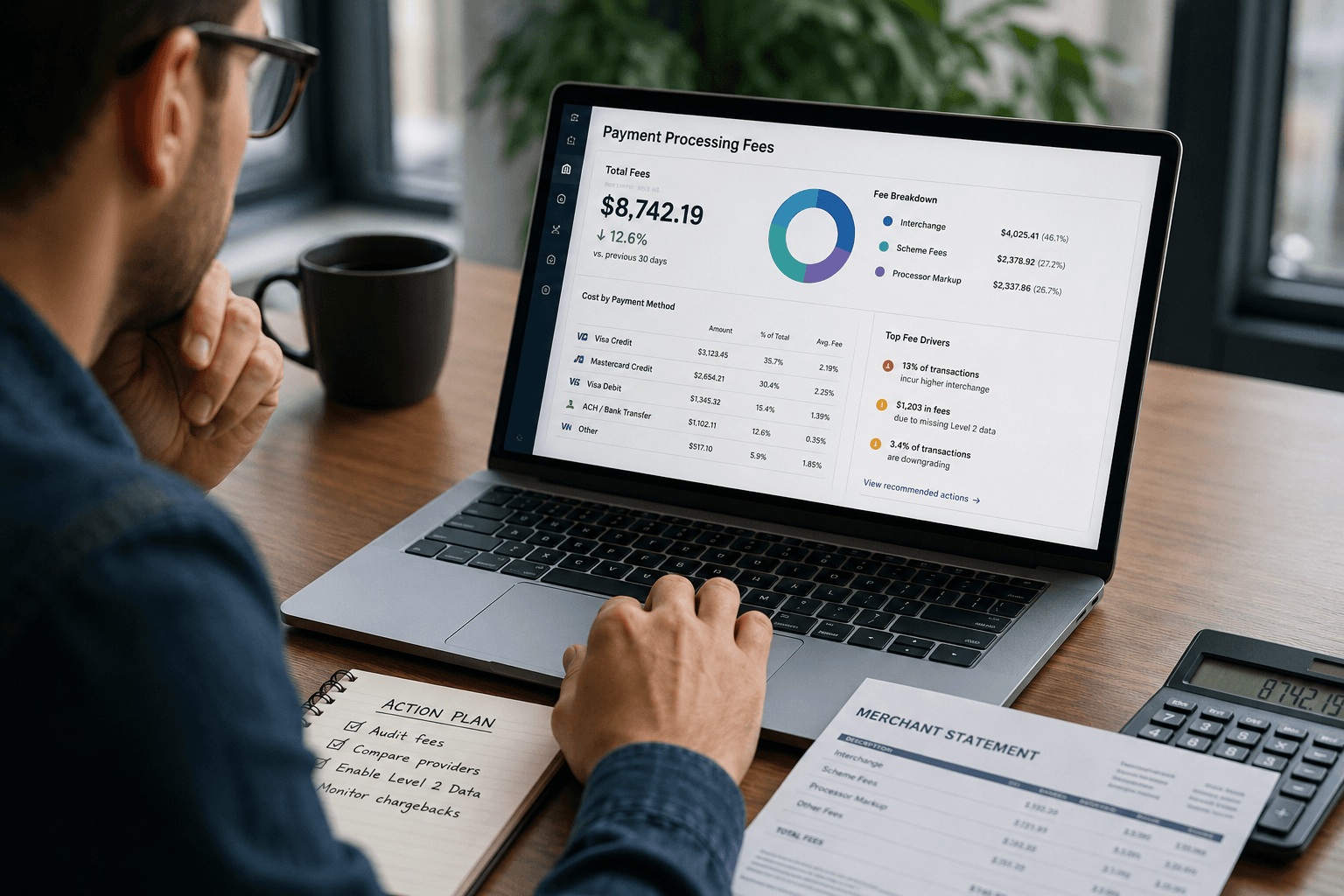
Author: Charitarth Sindhu, Fractional Business & AI Workflow Consultant
Payment processing fees keep climbing for small businesses in 2026, even as the headlines promise relief. The raw numbers are sobering. US merchants paid more than $187 billion in card fees during 2024, a rise of almost 9% in a single year. Across the Atlantic, regulators delivered a blunt verdict. The UK Payment Systems Regulator found that Visa and Mastercard face little real competition, while small firms struggle to read what they owe.
So we asked three industry leaders one question. How are fintechs helping SMEs fight rising interchange and payment processing fees this year? Their answers landed on three practical fixes.
The payments industry is so opaque that it is incredibly hard for the largest merchants to understand their true cost of accepting transactions, let alone SMEs that lack the data, resource and knowledge to make an impact. At Opt-ic, we frequently see fees charged to SMEs as a “passthrough” fee, when often the fees apply at an individual business level, such as network or scheme fees. Often it is the SMEs subsidising discounts for the larger businesses. Fintech helps some merchants by providing data and visibility to SMEs, or even by circumventing the Visa and Mastercard rails altogether. A comprehensive payments strategy, led by real data and the right fintech solution, can create a competitive advantage.
George Willis, Co-founder and Director of Growth & Strategy, Opt-ic
Fix one: cut through opaque payment processing fees
Opacity sits at the root of the problem, and it is not your imagination. Scheme fees and interchange get bundled, relabeled, and passed down a chain of acquirers until the line items stop making sense. As a result, the smallest merchants usually pay rates closest to the legal caps, because they hold no leverage to negotiate. Australia’s central bank reached that same conclusion in March 2026, noting that small businesses should gain the most from reform because they pay the most today. The gap is widest in the United States, where merchants face the highest acceptance costs in the world. In capped markets like the EU, the UK and Australia, the squeeze shifts toward scheme fees rather than interchange, yet the visibility problem stays the same.
Visibility tools flip that dynamic. A good dashboard splits one transaction into three parts: interchange, scheme assessment, and processor markup. A first audit usually surfaces downgraded transactions, padded statement charges, and rates that crept up without notice. Once an owner can see the markup, they can challenge it, the first real step to controlling payment processing fees. This mirrors the logic behind the wave of SMB digital banking platforms that now fold fee analytics into everyday accounts. Regulators are pushing the same way, with the UK preparing rules that force card networks to spell out how their fees are set. These tools turn payment processing fees from a black box into a line item an owner can manage. Knowledge, in this market, becomes leverage.
Fix two: switch processors and feed them better data
The fastest win is often the dullest one. Many small firms still sit on flat-rate plans that quietly inflate their payment processing fees on every sale. Moving to an interchange-plus provider exposes the wholesale cost and caps the markup, which is where the headline savings appear. Providers like Helcim and Stax built their entire pitch on this transparency, publishing the wholesale rate and charging a fixed margin on top. For a business turning over a few million a year, that single switch can recover tens of thousands, since the premium baked into flat pricing compounds with every transaction.
A year ago, when one of our portfolio companies transitioned from their legacy processor to a newer fintech provider, the gains went far beyond simply lowering the transaction rates from 2.9% + $0.30 per transaction to 2.2% + $0.25 per transaction. For $3 million in annual volume, that means over $20,000 stays in the business’s pocket each year. Even more impactful is the interchange-optimized technology that automatically determines the lowest cost route for each transaction. The new processors provide something not available to SMEs in the past: complete transparency into the true cost of payment processing. For example, one of our clients found they were losing $800 per month because they weren’t capturing Level 2 data for their B2B transactions.
Ace Zhuo, CEO, Sales and Marketing, Tech & Finance Expert, TradingFXVPS
Zhuo’s Level 2 point deserves a 2026 footnote. Visa is retiring its standalone Level 2 program in April 2026 and folding the incentives into a new Commercial Enhanced Data Program. Merchants who submit full, validated data on B2B sales still earn lower interchange and lighter payment processing fees, yet the rules now reward accuracy over guesswork. For any firm running commercial cards, getting those data fields right is no longer optional. The same orchestration tools also route each sale down the cheapest rail available, a feature that simply did not exist for small merchants five years ago, and a core promise of today’s embedded finance platforms.
Fix three: dodge chargebacks and lean on bank payments
Card rates are only one slice of total payment processing fees. Disputes drain the rest, and the damage runs well past the refund itself.
Every time a chargeback occurs there is typically a fee, which can vary from 25 to 50 dollars per chargeback. When we are running 1 to 2 million in volume and many transactions, these do add up. Outside of alerts, non-credit card payment solutions have been crucial to reducing payment processing fees. Usually we pay 2.5 to 3.5 percent on credit cards. This makes a huge difference, because instead of paying 3 or 3.5 percent, we can cut our costs to 1 percent, which when we are talking 1 to 2 million in volume adds up to 30 to 40 thousand monthly in savings.
Raymond Gong, Senior Partner, Profitability Partners
Gong has the math right. Mastercard estimates that the true cost of a chargeback climbs far beyond the flat fee once you add lost goods, shipping, and staff hours. Alert networks such as Ethoca and Visa’s Verifi let a merchant refund a disputed sale before it hardens into a formal chargeback, and they usually cost less than the fee they head off. Used well, alerts trim a stubborn source of payment processing fees that most owners overlook.
Bank payments attack the other side of the same problem. Pay-by-bank and ACH rails skip card interchange entirely, so home-services firms with large average tickets see the biggest gains. Specialists such as GoCardless have built whole businesses on this shift, and some merchants report cutting card-related costs by more than half after steering customers toward direct bank debit. The Federal Reserve urges some caution here, since the savings hinge on ticket size and return rates. Real-time bank rails have scaled fast, with US networks now moving record volumes each quarter. Even so, on a $1,500 service call the gap between 3% on a card and a flat bank transfer is real money. These rails sit beside the mobile wallets and account-to-account options now reshaping checkout, and they pair neatly with tighter B2B payment terms that protect cash flow.
What SMEs should do about payment processing fees now
Control is the thread running through all three answers. Owners who audit their statements, question the markup, and offer a cheaper way to pay keep more of every dollar. Start small, with one statement and one question about payment processing fees: what am I paying, and to whom? Rising payment processing fees are not a fixed cost of doing business. They are a negotiation most small firms have not yet entered, and 2026 hands them more tools to win it than any year before. The owners who treat payments as a managed line item, not a fixed tax, are the ones pulling ahead.