

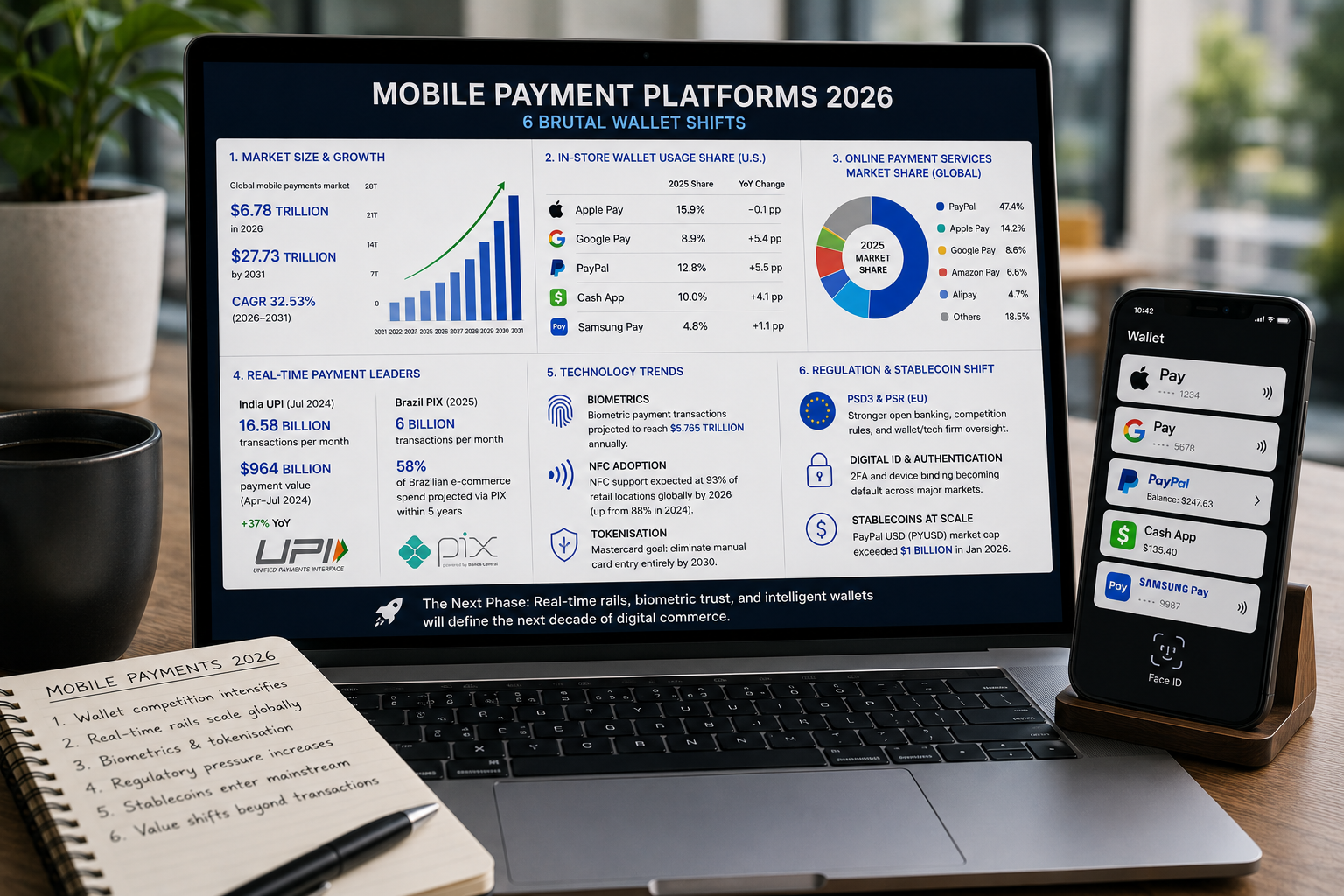
Mobile payment platforms 2026 have crossed from innovation into infrastructure, with payments shifting from a tap-to-pay feature into the dominant transaction mechanism for a growing share of the global economy. According to a January 21, 2026 Mordor Intelligence report, the global mobile payments market is projected to grow from $6.78 trillion in 2026 to $27.73 trillion by 2031, a CAGR of 32.53%. Government-backed real-time payment systems, super-app ecosystems, and emerging economy mobile-first transitions are driving the expansion.
Mobile Payment Platforms 2026 at Market Scale
Apple Pay maintains 34% of US adult usage and a 15.9% in-store usage share, with acceptance at over 90% of US retailers and operations across 95 countries. However, rival platforms are gaining velocity. Google Pay in-store usage rose to 8.9% from 3.5% year-on-year. PayPal moved to 12.8% from 7.3%, and Cash App climbed to 10% from 5.9%.
The result is a more mature wallet market across mobile payment platforms 2026. Apple still commands the largest in-store share, but rivals have a more credible shot at the checkout relationship than at any prior point. Google Pay brings Android distribution and the widest multi-platform reach across Android, iOS, web, and ChromeOS. Cash App brings stored balances and P2P habits. PayPal brings online checkout dominance and account-based payment flows.
Apple Pay Leads but Rivals Close the Gap
Apple helped build a market that competitors can now enter with sharper hooks. Specifically, Apple’s hardware integration and biometric authentication produce frictionless tap experiences that rivals struggle to match at point of sale. By contrast, account-based platforms compete on stored balances, instalment options, and online checkout. The mobile payment platforms 2026 landscape now rewards specialisation across these competing models rather than a single winner-take-all dynamic.
PayPal Holds the Online Channel Edge
PayPal’s position is frequently underestimated in contactless discussions because its primary strength sits in the online channel. Specifically, PayPal holds 47.4% of global online payment services market share, more than three times Apple Pay’s 14.2% online share. The 210 million users PayPal serves outside Asia represent the world’s largest account-based digital payments network not built on a domestic rail.
Furthermore, Venmo, owned by PayPal, processes approximately $342 billion in annual payment volume. The challenge for PayPal is converting that social payments behaviour into a checkout relationship at the point of sale, where Apple and Google’s hardware integration advantages are most acute.
UPI and PIX Reshape Mobile Payment Platforms 2026
The more consequential disruption is happening outside the US contactless market. Specifically, India’s Unified Payments Interface processed 16.58 billion transactions monthly and $964 billion in payment value between April and July 2024, representing a 37% year-on-year increase that outpaces Alipay, PayPal, and PIX in raw transaction volume. The Reserve Bank of India implemented two-factor authentication for all digital payments from April 1, 2026.
UPI’s architecture connects directly between bank accounts without a stored-value intermediary, eliminating intermediary fees entirely. Brazil’s PIX processed 6 billion monthly transactions in 2025, with 58% of Brazilian e-commerce spend projected to route through PIX within five years. Government subsidies, including India’s INR 1,500 crore UPI incentive allocation for FY 2024-25, demonstrate that emerging market governments treat mobile payment platforms 2026 adoption as strategic economic infrastructure rather than consumer convenience.
Biometrics and Tokenisation Drive the Next Phase
The technology trends underpinning the next phase of mobile payment platforms 2026 are biometric authentication and tokenisation. Biometric payment transactions are projected to reach $5.765 trillion annually. Furthermore, NFC support is expected to reach 93% of retail locations globally by 2026, up from 88% in 2024.
Mastercard’s goal of eliminating manual card entry entirely by 2030 reflects the direction. By the end of the decade, every payment will be either a biometric tap or a tokenised credential, with no manual PAN entry in the flow. However, fragmented tokenisation standards remain the key friction, with disparate token formats raising integration costs and complicating cross-wallet acceptance.
Regulatory Pressure Reshapes Mobile Payment Platforms 2026
The regulatory environment is shifting rapidly across mobile payment platforms 2026. In Europe, the Payment Services Regulation PSD3 was approved in November 2025, updating rules for enhanced payee verification and strong customer authentication for credit transfers. Furthermore, PSD3 tightens the liability framework for push payment fraud, which has accelerated as real-time rails have made fraudulent transactions harder to reverse.
The Apple Pay EU antitrust settlement, which requires Apple to open its NFC chip to competing wallet providers in European markets, is the most significant structural change to the contactless payments competitive landscape in the region. The settlement creates an opening for banks and third-party wallet providers to access the tap-to-pay relationship that Apple previously controlled on iOS devices. For listing market context affecting cross-border platform providers, see Fintechbits coverage of the Wise Nasdaq listing.
Stablecoin Rails and the Cross-Border Frontier
The stablecoin dimension of mobile payment platforms 2026 is growing faster than most market observers anticipated. Specifically, PayPal’s PYUSD stablecoin has reached a $3.95 billion market capitalisation, making it the first stablecoin issued by a major consumer payments platform to achieve meaningful scale. The ability to transfer value across borders instantly and at near-zero cost is directly competitive with traditional international transfer fee structures.
As covered in Fintechbits analysis of Ramp, Mercury, and Limited and business banking on stablecoin rails, the infrastructure layer is forming. For regulatory framework context, see Fintechbits coverage of the CLARITY Act and digital asset regulation. The competitive race for the remainder of the decade will hinge on AI fraud detection integration, account-to-account architecture reach, and stablecoin cross-border capability. US platform leaders hold strong AI positions, while the account-to-account and stablecoin layers remain genuinely open across mobile payment platforms 2026.
