

Author: Kriszta Grenyo, Chief Operating Officer, Suff Digital
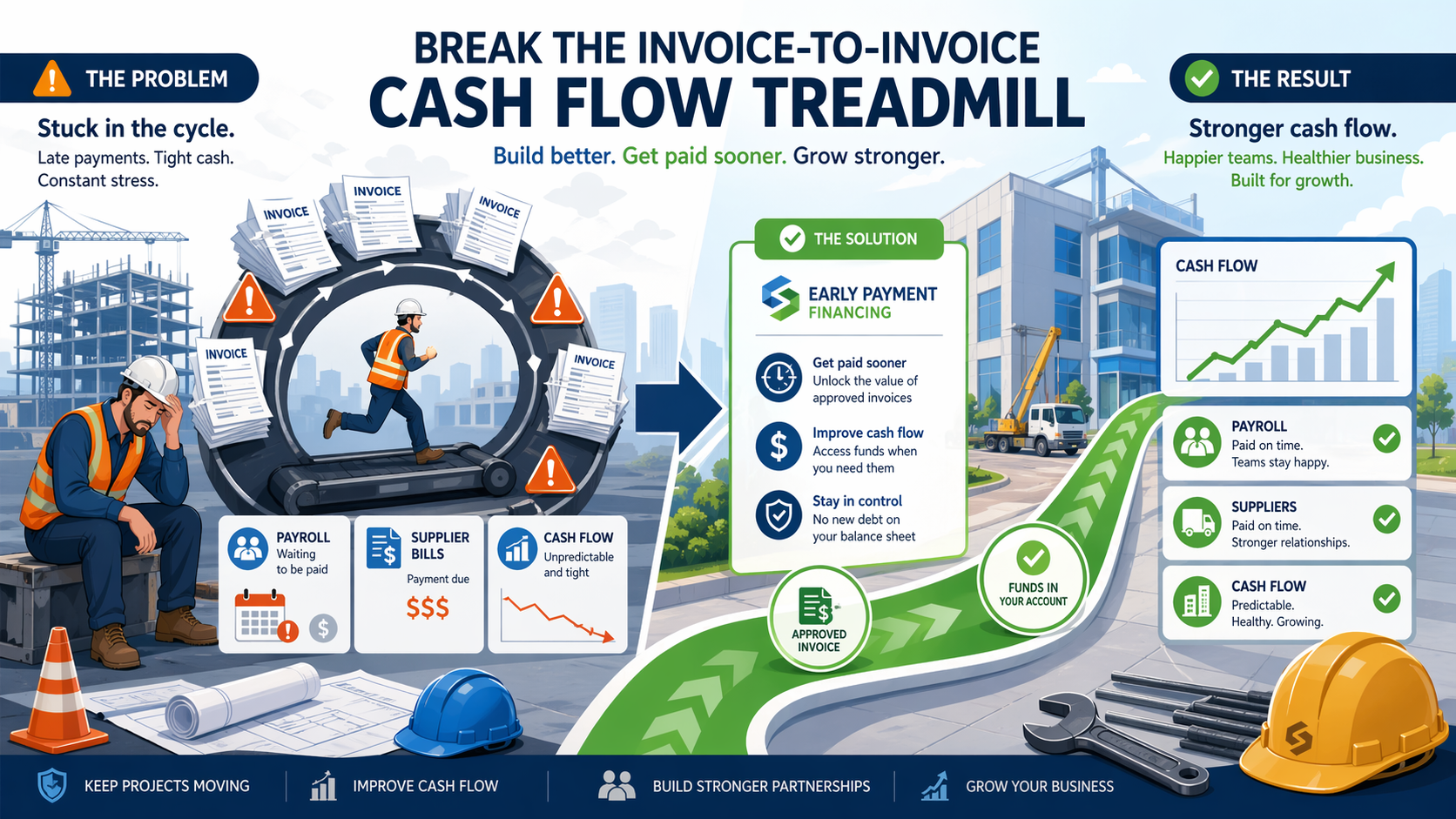
Construction supply chain finance is one of the least-used tools that can end the invoice-to-invoice cycle most trades businesses live in. If you work in construction or the skilled trades, you already know the story. You win a contract, you front the materials and labour costs, and then you wait, sometimes 30 days, sometimes 60, sometimes longer, for the invoice to clear. Meanwhile, you have payroll to meet, suppliers to pay, and the next job to fund.
Living invoice to invoice is exhausting and risky. One delayed payment from a developer or main contractor can create a cash crisis that ripples through your entire operation. Construction supply chain finance offers a way out of that cycle, but many trades businesses have never explored it because it sounds like something built for large corporations, not a 20-person plumbing firm or a specialist fit-out contractor.
It is not. Here is how construction supply chain finance actually works, and how to use it.
The core cash flow problem
The construction industry has a structural cash flow problem that is unlike most other sectors. Projects require significant upfront investment in materials and labour, payment terms from clients are typically long, and variations and disputes can push settlement dates out even further.
The data confirms what every contractor already feels. According to the 2024 Construction Payments Report covered by PBMares, 82 percent of contractors now face payment waits of over 30 days, up from 49 percent two years ago PBMares, with the cost to the industry running at roughly $280 billion a year. A PYMNTS analysis of construction payment trends goes further, finding that 64% of subcontractors experience slow pay from general contractors, forcing 75% of smaller firms to front the cost of materials themselves PYMNTS.
Subcontractors and specialists are often the most exposed. Main contractors pass payment risk down the chain, and by the time a dispute at the top of the project resolves, the people at the bottom have been waiting months for money they have already earned. This is exactly the gap that construction supply chain finance is built to close.
What construction supply chain finance actually is
Construction supply chain finance, also called reverse factoring, works by allowing a supplier to get paid early on an approved invoice, with a third-party financier providing the cash and the buyer settling on their normal terms.
In practice, this might work as follows. You complete a phase of work, raise an invoice, and the main contractor or developer approves it. Once approved, you have the option to receive payment immediately from a financing platform, typically at a small discount. The financier collects from the client when the invoice falls due.
The key difference from traditional invoice factoring is that the financing cost sits on the buyer’s credit rating, not yours. If you are working with a large, creditworthy main contractor, the discount rate can be very low, often lower than what you would pay on an overdraft or business loan. That makes construction supply chain finance one of the cheapest forms of working capital available to subcontractors and specialists.
Why the timing is right
Contractors are ready to change how they get paid. The Rabbet 2025 State of Construction Finance data reported by PYMNTS shows that 82% of contractors would embrace digital payment systems to accelerate cash flow, and 76% would offer discounts for guaranteed faster payments PYMNTS. Translating that into plain language: your upstream customers are more open to early-payment arrangements than they were even two years ago, and the platforms to support them have matured.
Fintech infrastructure is catching up quickly. The broader fintech funding environment now supports smaller SMB lenders and payment platforms, with deals like Flex’s acquisition of Maza reflecting how much capital is flowing into small business financing infrastructure, and Uala’s Series E at a $2.75 billion valuation showing how far SMB-focused fintech has moved from niche to core infrastructure. The practical effect for you is simpler platforms, cleaner onboarding, and better rates than what was on offer even two years ago.
Practical steps for trades businesses
The first step is to understand which of your clients would qualify for a construction supply chain finance programme. Larger developers, housing associations, and main contractors are the most likely candidates, because they have the credit profile that makes the financing attractive for lenders.
Once you have identified a target client, raise the conversation with their finance team. Many larger buyers already run construction supply chain finance programmes that their suppliers can access. They simply have not told you about them. Ask directly whether they offer early-payment options, and which platform they use.
If they do not run an in-house programme, there are independent platforms that facilitate construction supply chain finance without requiring the buyer to be on board. These work closer to invoice discounting, but with competitive rates for approved receivables from creditworthy clients. The bar to entry is lower than most trades businesses assume. You typically need clean accounting records, a track record with the specific client, and approved (not disputed) invoices.
A few practical checks before you sign up. First, look at the effective annualised cost, not the headline discount. A “small” discount on a 60-day invoice can translate into a high effective rate if you draw early every cycle. Second, check what happens if the client disputes the invoice after you have drawn funds. Some platforms have recourse provisions that pass the risk back to you, and that changes the calculus completely. Third, confirm that taking part will not damage the commercial relationship. Most modern programmes are designed to be invisible to the buyer’s project team, but it is worth verifying.
Getting off the invoice-to-invoice treadmill
Construction supply chain finance will not solve every cash flow challenge. You still need to price your jobs correctly, manage your costs, and chase disputed payments. But for the specific problem of waiting too long to receive money you have already earned, it is one of the most effective tools available. The data on industry-wide payment delays is not going to improve on its own, and waiting for main contractors to voluntarily shorten their payment terms is not a strategy.
The construction and trades businesses that are growing steadily tend to have figured out their working capital cycle. They know their gap, they have tools in place to bridge it, and they are not dependent on any single client paying on time. That stability is what lets them take on larger jobs, invest in equipment, and hire ahead of demand.
Construction supply chain finance is one piece of that puzzle. If you have not looked at it yet, it is worth an hour of your time this week. Map your top five clients, check which ones already run a programme, and shortlist one or two independent platforms as a backup. That is enough to stress-test whether the numbers work for your business, without committing to anything.
Kriszta Grenyo is the Chief Operating Officer at Suff Digital, a performance-driven digital marketing agency. She works with growth-focused businesses across multiple industries, helping them scale efficiently and deliver results.