

Author: Blake Smith, Marketing Manager, ClockOn
Stablecoins for payroll solve a real problem in cross-border payments. But they also shift complexity into places most payroll teams cannot handle. Right now, the technology is moving faster than the regulatory and operational systems payroll depends on, and the case for and against stablecoins for payroll deserves a closer look before you pilot anything.
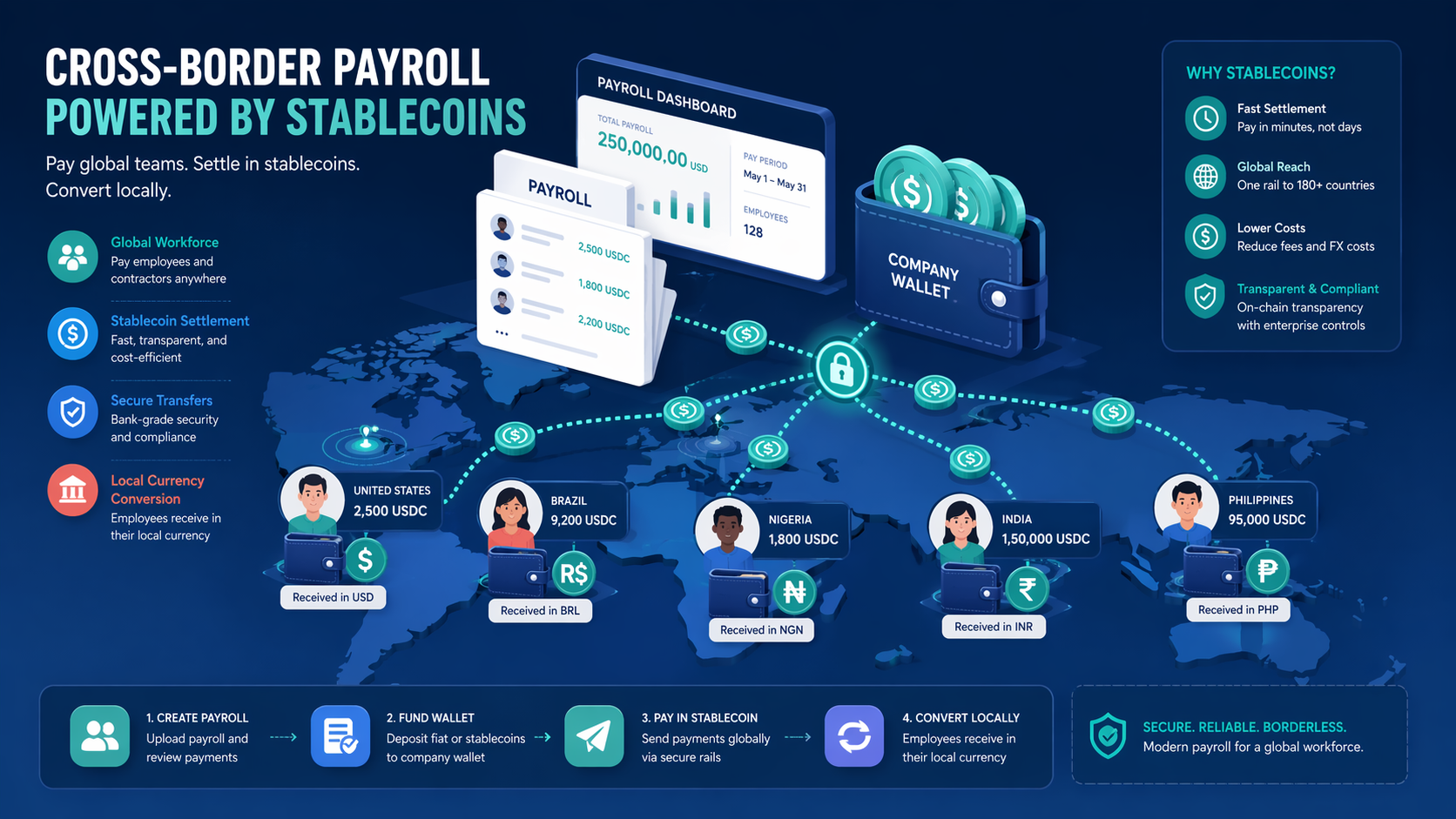
The strongest argument for stablecoins for payroll is settlement speed. Traditional cross-border payroll relies on correspondent banking networks. Payments can take two to five business days, with FX spreads and intermediary fees stacked in. A USD-pegged stablecoin settles in minutes, with a known face value at the point of transfer. That is a genuine improvement.
The friction starts after the payment lands. Payroll is not just about sending money. It covers recording the correct value, reporting it properly, and making sure both sides meet their tax obligations. Stablecoins do not remove that work. They push more of it onto both the employer and the worker. The momentum is real, with $2 billion-scale acquisition talks around BVNK reported by Fortune and Stripe’s earlier acquisition of Bridge showing the stakes, but momentum and fit are different questions.
The speed case for stablecoins for payroll
The pitch starts with settlement time. Correspondent banking adds days of delay, layered FX spreads, and opaque intermediary fees. A USD-pegged stablecoin side-steps most of that. Value lands in minutes. On-chain confirmation gives both parties a visible record. The face value at the point of transfer stays pegged to the underlying dollar.
For international contractors, that matters. Someone in Manila receiving pay from Sydney typically waits three to five business days and loses two to four percent in combined FX and fees. A stablecoin rail can compress that window to under an hour at materially lower cost. BVNK, for example, powers global contractor payments for payroll platform Deel and, per PYMNTS reporting, processes over $30 billion annually PYMNTS.com. Much of that volume sits in exactly the kind of use case where stablecoins for payroll show the clearest value.
Recent cross-border infrastructure moves reinforce the thesis. Stripe’s partnership with Luckin Coffee on cross-border settlement sits in the same family: reduce intermediary friction, compress settlement, and make the payment itself boring. Policy momentum is pointing the same way, with the UK and Singapore formalising cooperation on cross-border payments connectivity.
Where friction hits once the money lands
Take a straightforward case. An Australian business pays a contractor in the Philippines 2,000 AUD per month but uses a USD-backed stablecoin instead of a bank transfer. The operational reality of stablecoins for payroll surfaces here, not in the settlement window.
The first issue is valuation. What number goes into the payroll records? The AUD value at the time payroll runs, the moment the transaction hits the blockchain, or when the contractor converts it into pesos? Those can all differ. Even small timing gaps introduce FX variance.
From the employer’s side, the obligation is clear. The employer must record the payment in Australian dollars with a defensible conversion method. If the business converts AUD to USD stablecoin at the point of payment, the team needs to capture and store that FX rate. Miss that step and the audit trail breaks. That is where risk shows up, not in the payment itself but in the documentation around it.
On the worker’s side, the experience becomes more involved. Instead of receiving pesos into a bank account, they receive a digital token. In many jurisdictions, the worker still has to declare the income at its fiat value on receipt. If the contractor holds the stablecoin and converts it later, any price movement, even small, can trigger a gain or loss for tax purposes.
So a single pay cycle now creates multiple reporting points. Value at receipt. Value at conversion. Fees paid to move or off-ramp the funds. For someone without crypto accounting experience, that is a material lift in effort. Payroll works best when it feels predictable, and stablecoins for payroll break that predictability exactly where the worker expects it to hold.
Regulation and infrastructure gaps around stablecoins for payroll
Regulation is the other limiting factor. Most payroll systems run on clear rules. How to value income. When to recognise it. How to report it. Stablecoins sit in a grey area in many jurisdictions. Some treat them as cash equivalents. Others treat them as digital assets. The difference changes how companies record and report payroll.
Without standardised rules, businesses have to interpret guidance that predates this use case. That creates inconsistency. Two companies paying the same contractor in the same country could report the same payment differently depending on how they handle timing and valuation.
The US GENIUS Act and the EU’s MiCA framework have brought more clarity at the issuer level, but payroll-specific tax guidance for stablecoins for payroll still varies widely. The broader integration of blockchain into global trade finance is progressing, but compliance at the payroll layer remains patchy.
There are also practical infrastructure constraints. Running stablecoins for payroll assumes the worker has a compatible wallet, access to an exchange or off-ramp, and the ability to navigate both. In regions with limited banking access, that can be an advantage. In others, it adds a step to something that already works.
Payroll platforms handle structured data by design. Hours worked, pay rates, tax calculations, superannuation. They exist to ensure compliance and produce a clean audit trail. Systems like ClockOn focus on connecting those inputs end-to-end, from timesheets through to payroll reporting, because that is where the real risk sits.
Where stablecoins for payroll earn their place
Adoption concentrates in specific use cases. Stablecoins for payroll tend to work where speed of settlement matters more than payroll complexity. Paying international contractors in regions with unstable banking systems, for example, or where access to USD is restricted. In those cases, receiving a USD-pegged asset quickly can outweigh the added reporting burden.
In a standard employment context, especially in countries with established payroll compliance frameworks, the trade-off is harder to justify. Faster payment is valuable. But not if it introduces uncertainty in tax reporting or increases the risk of getting payroll wrong.
The more realistic path forward is not stablecoins replacing payroll systems but slotting into them. If a payroll platform can handle valuation at the point of payment, capture FX rates automatically, and generate compliant reports in local currency, the complexity becomes manageable. The worker experience would also need to improve, ideally with automated off-ramps into local bank accounts so the end result feels no different from a standard pay run.
Until that integration layer exists, stablecoins for payroll remain a partial solution. They fix settlement, but leave the rest of the payroll process fragmented. For most finance teams, the practical move today is to pilot stablecoin rails with a small number of international contractors where traditional banking is the bottleneck, then expand only as tax guidance and integration maturity catch up.