

Author: Kriszta Grenyo, Chief Operating Officer, Suff Digital
Open banking B2B payments are quietly solving some of the most persistent friction points in business finance, and most operators have not looked closely enough. Most coverage of open banking focuses on the consumer side. Budgeting apps that pull personal transaction data. Mortgage comparison tools that scan spending history. What gets far less attention is the B2B side, and honestly, it matters more.
The infrastructure regulators built into open banking is already reshaping how businesses pay suppliers, collect from customers, and move money across borders. According to a B2B Payments Global Report published on Yahoo Finance, the B2B payments market reached USD 11.69 trillion in 2024 and is projected to hit USD 15.88 trillion by 2030 Yahoo Finance, and open banking sits near the centre of that shift. If you run a growing business and have not examined what open banking B2B payments can do for your operations lately, a closer look is worth your time.
The core problem open banking B2B payments solve
B2B payments have been slow, expensive, and opaque for decades. Bank transfers take days to settle. Reconciliation eats finance hours. International transfers carry unpredictable fees and exchange rates. For suppliers, there is often no easy way to know whether a payment has even been initiated, let alone when it will land.
These are not abstract annoyances. They carry real operating costs. Finance teams burn hours chasing confirmations. Cash flow forecasts become unreliable when settlement times swing. At scale, the admin load can push smaller businesses into hiring they cannot justify.
Meanwhile, the cost of staying with legacy rails keeps climbing. Card interchange fees squeeze margins, wire costs stack at volume, and late payments quietly drain working capital. That is exactly where open banking B2B payments earn their keep.
How account-to-account rails change the equation
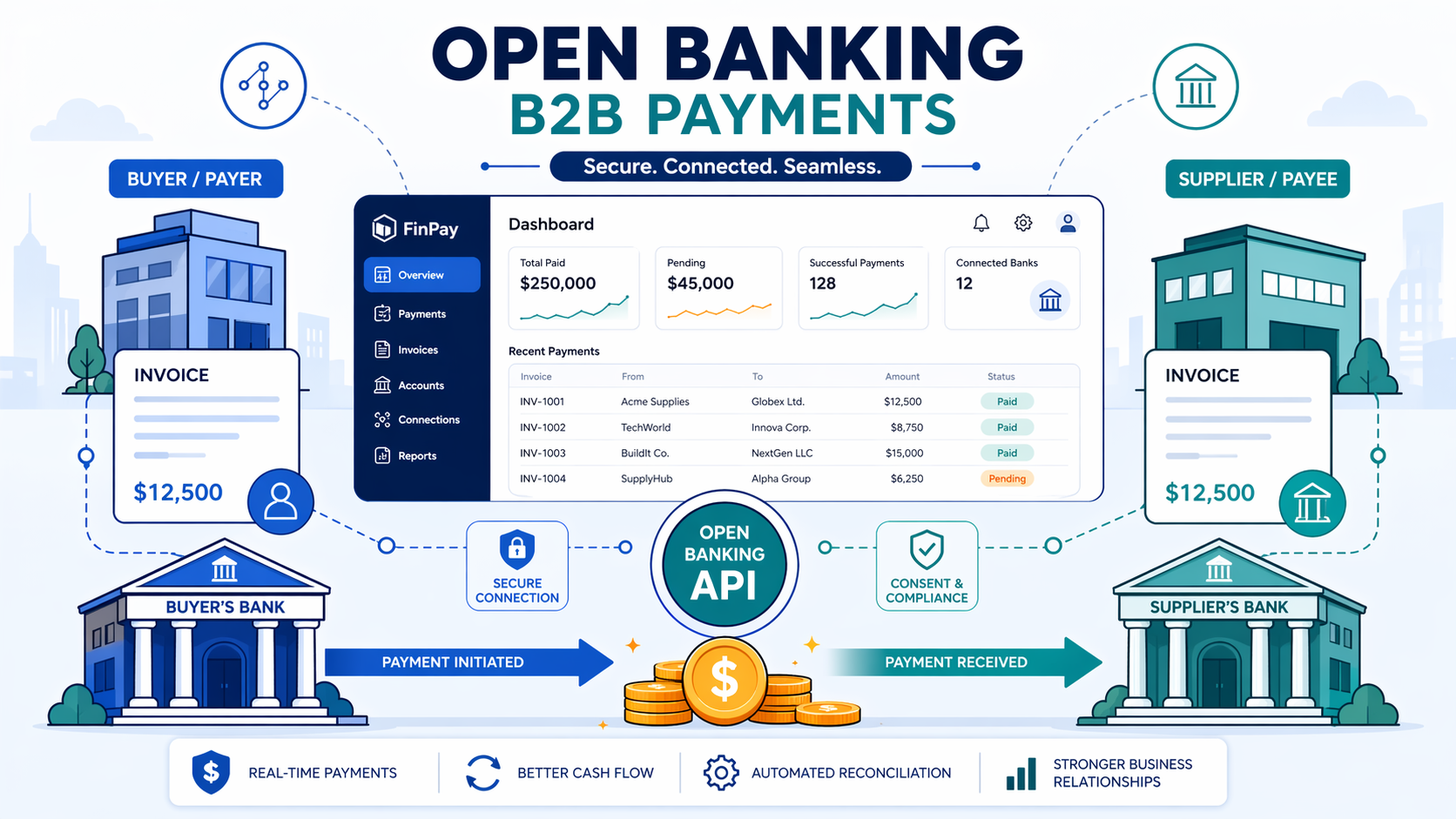
Open banking infrastructure, specifically the standardised APIs that let businesses connect directly to banking data and initiate payments, cuts friction at several points in the B2B flow. Open banking B2B payments work because those APIs turn manual handoffs into programmable events.
Account-to-account payments initiated through open banking rails settle faster than traditional bank transfers in many markets, and they carry a lower cost than card alternatives. According to Future Market Insights, the UK Payment Systems Regulator noted in August 2024 that the card scheme services market “isn’t working well,” and merchants are actively seeking lower-cost rails to improve margins Future Market Insights. For high-volume B2B transactions, the cost delta compounds quickly.
Real-time banking data also lets businesses pipe banking information directly into their accounting and ERP systems. Instead of manual reconciliation, software can match incoming payments to invoices as soon as they clear. This trims admin time and sharpens cash position accuracy at any given moment.
For businesses operating internationally, open banking B2B payments have enabled a new wave of cross-border platforms with faster settlement, sharper FX, and better visibility into where a payment sits in the chain. Recent moves like Stripe’s partnership with Luckin Coffee on cross-border payments show how quickly cross-border infrastructure is maturing, and the UK-Singapore collaboration on payments connectivity has pushed the topic firmly onto the policy agenda.
Where adoption still hits friction
Honestly, B2B adoption has moved slower than many expected. Part of the reason is technical. Switching payment processes in an established business means plugging new systems into old ones, and that takes engineering time most finance teams do not have on tap.
There is also a trust gap. Finance leaders who have relied on the same banking relationships for years move carefully, particularly on high-value transactions. Nobody wants to be the one who routed a seven-figure payment through a new rail and watched it sit in a queue.
Then there is platform variance. Not all open banking providers are equal. API reliability, settlement consistency, and reconciliation depth differ widely. Picking the wrong partner can burn the trust you need to expand the use case later.
Still, the direction is clear. Per Mordor Intelligence market data, Payment Initiation Services accounted for 37.80% of the open banking market in 2025, driven by merchant demand for cost-efficient account-to-account payment solutions Mordor Intelligence. Regulatory momentum keeps building, too. The CFPB finalized Section 1033 in October 2024, banning data blocking and requiring US banks to implement secure API systems Future Market Insights. That removes one of the biggest structural barriers to open banking B2B payments gaining traction in the world’s largest market.
Where to start with open banking B2B payments
For most growing businesses, accounts receivable is the cleanest entry point. Find a platform that lets your customers pay invoices directly from their bank account via open banking, with automatic reconciliation back to your accounting software.
This tackles the most common pain point, which is simply getting paid, without forcing a wholesale infrastructure change. Once you see how open banking B2B payments perform in production, the case for extending them into payables and cross-border transfers gets much easier to make internally.
A few practical checks before you pick a provider. First, look at settlement times in your specific corridors, not the marketing averages. Second, check how the platform handles partial payments and failed transactions, because that is where reconciliation breaks down. Third, ask about ERP integration depth. A rail that dumps data into your accounting software but cannot map it to invoices automatically is only half a solution. Similar considerations apply when evaluating payment infrastructure for small business customers, where margin sensitivity is high and volume scales fast.
The shift is already underway. Businesses folding open banking B2B payments into their finance stack now will hold a real structural edge as the technology matures and as their customers, suppliers, and banking partners come online behind them. Waiting for the market to settle is tempting, but settling usually happens after the early adopters have taken the best vendor relationships and the cleanest integration paths.
Kriszta Grenyo is the Chief Operating Officer at Suff Digital, a performance-driven digital marketing agency helping businesses grow through web development, CRO, and digital marketing.