

Author: Callum Gracie, Founder, Gia AI
Failed SaaS payments represent the single largest preventable source of subscriber loss in the subscription economy. These failed SaaS payments could cost subscription businesses over $129 billion in 2025 alone, according to Recurly. That number should terrify every SaaS founder reading this.
Here is the uncomfortable truth. Between 20% and 40% of all SaaS churn has nothing to do with product quality or competitor pricing. Instead, it comes from expired cards, insufficient funds, and silent bank declines. These are customers who wanted to stay. Their payments just broke.
So why do most SaaS companies still pour 90% of their retention budget into reducing voluntary churn while ignoring the payment stack underneath?
Failed SaaS Payments Cost More Than You Think
The average SaaS business loses roughly 9% of recurring revenue to failed SaaS payments each year. That effectively wipes out a full month of growth. Churnkey’s 2025 analysis of 5.4 million payment failures across 25 million subscriptions found that involuntary churn accounts for 22% of total SaaS churn, with an 8% annual involuntary churn rate.
Price point makes a massive difference too. Subscriptions under $10 per month experience 35% involuntary churn as a share of total churn because lower-priced plans attract more debit and prepaid card users. Prepaid cards carry a 23% involuntary churn rate compared to just 6% for credit cards.
Meanwhile, the compounding math is brutal. A 2% monthly payment failure rate erodes 22% of annual revenue when left unchecked. For a $10 million ARR company, that translates to $130,000 to over $1 million in preventable annual losses depending on overall churn rate. Every single one of those payment failures destroys lifetime value that cost real money to acquire.
Why Payments Fail (and Most Reasons Are Fixable)
Insufficient funds dominate the decline code breakdown at 40.6% of all failures. However, this figure swings wildly by geography. It reaches 81.4% in Australia but drops to 25% in Indonesia.
Bank and issuer declines come next at roughly 22%, including opaque “Do Not Honor” codes that reflect issuer-side risk decisions rather than real customer problems. Fraud-related flags account for about 11%, many of them false positives. Recurly’s data shows fraud-related declines rose 29% in 2024.
The critical insight is this: four of the top five decline reasons are soft declines. That means they are potentially recoverable through retries, updated payment info, or better timing. Only “Invalid Card Number” among common codes represents a hard decline requiring customer action. Most failed SaaS payments do not have to stay failed.
Cross-border transactions amplify the problem. Merchants with significant international sales face an 11% average payment failure rate, and in emerging markets, card failure rates hit 40%. Europe’s SCA requirements under PSD2 pushed average transaction failures to 29% after enforcement.
The Recovery Stack That Gets 85% Back
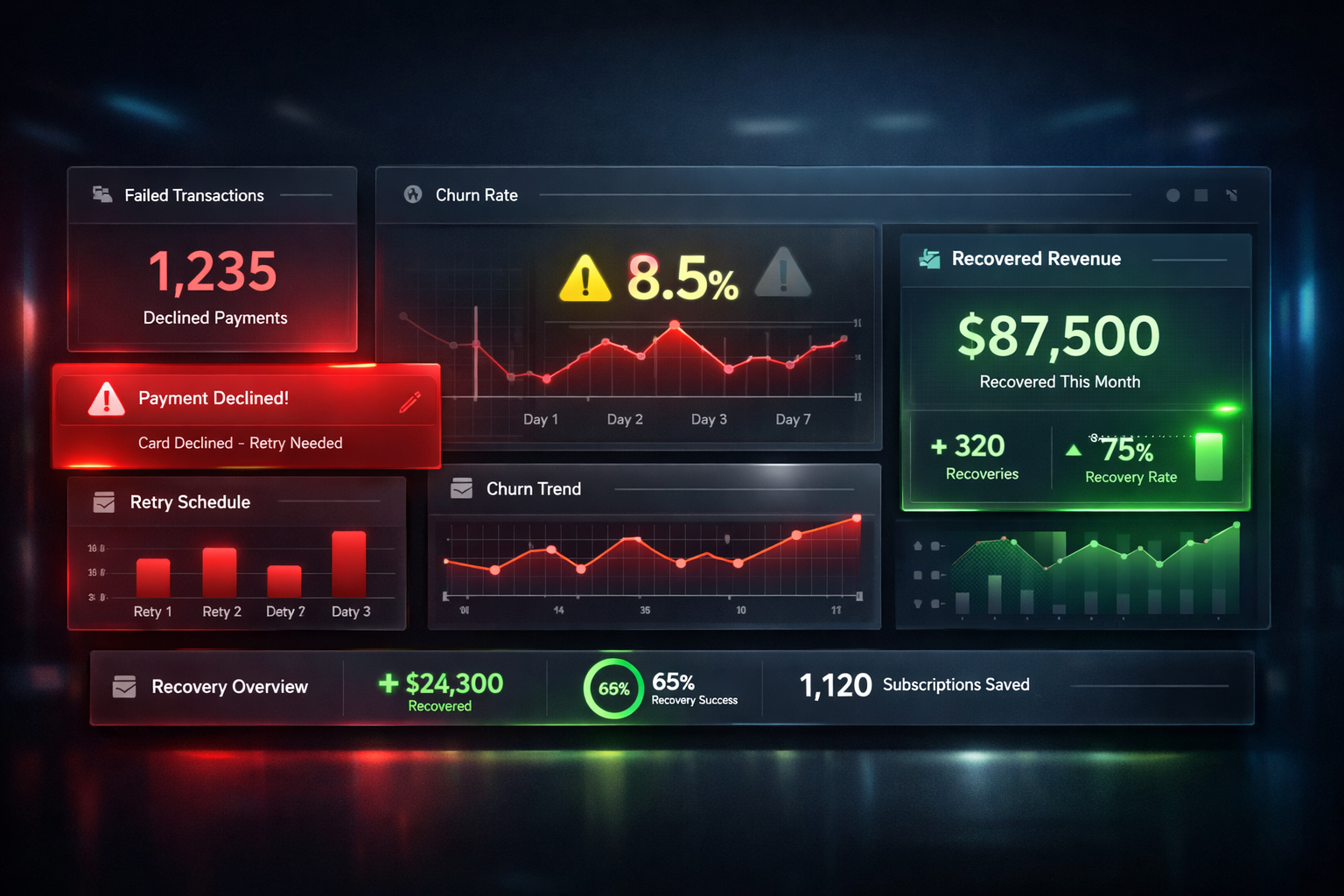
Without intelligent retry or dunning systems, the baseline payment recovery rate sits at about 38%. With a full modern recovery stack, best-in-class companies recover 75% to 85% of failed SaaS payments.
Stripe’s Smart Retries use machine learning across 500+ attributes to find optimal retry windows. They recovered $6.5 billion for merchants in 2024, returning $9.39 for every $1 spent. GoCardless’s Success+ product doubles the baseline to 70% to 76% recovery, with a single optimally timed retry recovering 32% of originally failed payments.
Recurly saved 72% of at-risk subscribers in 2023, recovering $1.2 billion in subscription revenue. Their most striking finding is that 38% of a subscriber’s total lifetime occurs after a recovery event. Churnkey reported that 70% of all involuntary churn from payment failures was recovered in 2024 across $3 billion in subscription revenue.
Dunning email timing matters enormously. Same-day emails achieve a 41.3% open rate and 13.3% recovery rate. By day 15, that drops to 28.2% and 4.2% respectively. SMS achieves 98% open rates compared to roughly 20% for email. Smart recovery of failed SaaS payments requires layering retries, emails, SMS, and in-app prompts together.
What Comes Next: Tokenization and AI Close the Gap
Three converging trends suggest involuntary churn from failed SaaS payments could become a largely solved problem within a few years.
Network tokenization replaces static card numbers with dynamic tokens that never expire. Visa reports a 4.6% authorization rate uplift for tokenized transactions alongside a 30% fraud reduction. Subscription renewals saw expired card declines drop 18% after tokenization rollout. This technology directly addresses false positive fraud flags that block legitimate recurring charges.
AI-powered retry optimization is accelerating rapidly. Companies using intelligent retry logic recover 68% of failed SaaS payments compared to just 23% with basic single retries. Stripe’s Adaptive Acceptance recovered $6 billion in falsely declined transactions in 2024. Smart payment routing delivers 10% to 15% improvement in approval rates by dynamically selecting the best processor based on location, currency, and card type.
PSD3 will clarify that only the first transaction in a subscription needs SCA authentication. Open banking may eventually enable account-to-account payments that bypass card networks and their failure modes entirely.
Stop Bleeding Revenue From Your Payment Stack
The ROI case for addressing failed SaaS payments is overwhelming. Acquiring a new SaaS customer costs 5 to 10 times more than recovering an existing one. Recovered subscribers stay for an average of 7 additional months, so recovering one $50 per month subscription protects $350 in future revenue, not $50.
Patrick Campbell, co-founder of ProfitWell (acquired by Paddle for $200 million), noted that 20% to 40% of churn stems from expired and delinquent cards. He called it pointless money loss and advised starting with the payment stack because the fix is purely mechanical.
A Forrester study commissioned by Recurly found that 100% of surveyed businesses acknowledged the detrimental impact of failed SaaS payments. Yet 59% lack the tools to tackle involuntary churn effectively.
The next wave of churn will not come from bad products. It is already here, hiding in the payment stack. The companies that fix it will compound a quiet advantage every single billing cycle.