

By Jesse Fowler, Founder of J&J Renovations and J&J Plumbing Services
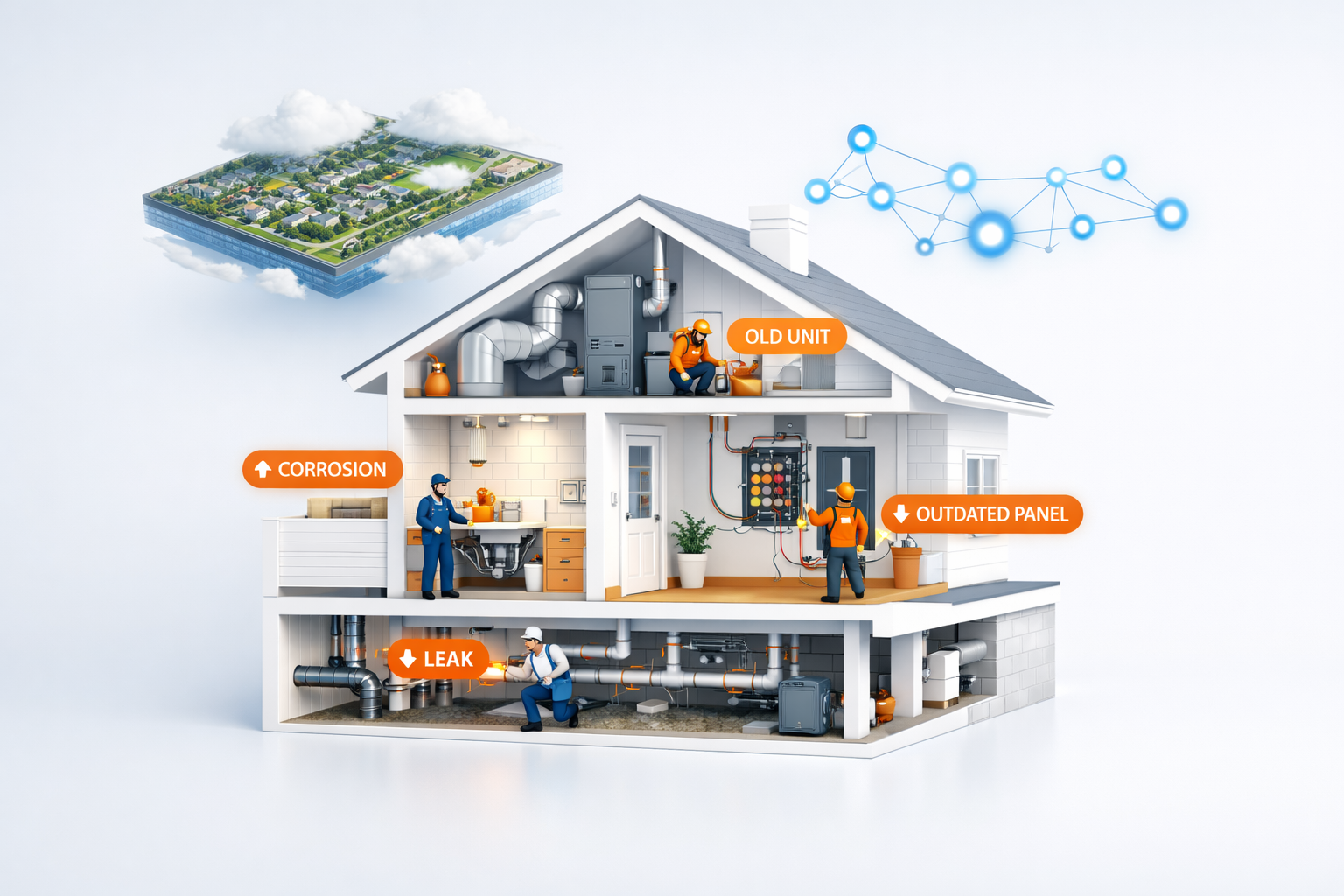
Every time a plumber crawls under a house, they see things no insurer, no appraiser, and no algorithm can see. Pipe materials hidden inside walls. Moisture stains behind cabinets. Wiring that should have been replaced a decade ago. Sump pumps held together by hope. This information gets written on a job sheet, maybe entered into a field service app, and then it disappears.
Meanwhile, the insurance industry spends over $15 billion a year on water damage claims alone. The average claim costs $12,500. And the failures causing those claims are exactly the failures a tradesperson could have flagged weeks or months earlier.
The global home services industry is worth roughly $425 billion. Millions of trained professionals walk through millions of homes every year. They generate the most granular, technically accurate interior property data available anywhere. And almost none of it gets used.
The data gap is enormous
Property appraisals happen once every seven to ten years, at the point of sale. Public records miss every renovation done without a permit, which is most of them. Satellite imagery covers roofs and driveways but cannot tell you whether the hot water system is copper or polybutylene.
Even the best AI-powered property platforms are working with exterior data. Moody’s acquired CAPE Analytics in early 2025 for its geospatial intelligence covering 110 million structures. Impressive. But it is still a view from above. It cannot see a corroded pressure valve or a Federal Pacific electrical panel, both of which are ticking clocks for insurance claims.
Compare that to what a single service call produces. A plumber replacing a water heater can identify pipe materials, water pressure readings, moisture damage, foundation cracks visible from the crawl space, and whether the existing installation was done to code. An electrician opening a panel can tell you the wiring type, the panel brand, circuit capacity, and whether the homeowner has been doing their own work. An HVAC technician reads serial numbers to determine exact manufacture dates and measures system efficiency. This data is instrument-verified, technically precise, and repeated across millions of addresses every year.
Insurers are starting to pay attention
The smartest insurance companies have figured this out. Hippo Insurance deployed trained home pros for twice-annual property checkups and found that more than 50% of items discovered could lead to major claims. That is not a marginal insight. That means routine tradesperson observations can predict half the claims an insurer will eventually pay.
IoT devices are proving the economic case from the sensor side. Flo by Moen’s smart water shutoff has been shown to decrease water damage claims by 96%. Whisker Labs’ Ting electrical sensor, deployed across more than a million homes through its State Farm partnership, reduced fire claims by 63% by Year 3 of monitoring. Those numbers make prevention far cheaper than paying claims.
But sensors provide continuity. Tradespeople provide diagnosis. A leak detector tells you water is flowing where it should not. A plumber tells you why, what material failed, whether the installation was compliant, and how long you have before the next failure. Those are different kinds of intelligence, and the combination is worth more than either alone.
Field service platforms are sitting on a goldmine
The platforms processing all these service visits already have the data. ServiceTitan, which went public in late 2024 at roughly a $9 billion valuation, has processed $62 billion in gross transaction volume. Housecall Pro has facilitated over 100 million jobs across 30 million households. Jobber serves 100,000 customers.
Porch Group has gone furthest in turning this into a product, building a Home Factors platform that provides property intelligence on roughly 90% of U.S. properties. Their water intrusion data showed that properties with water damage history have 40%+ higher claims frequency, and testing with insurance carriers delivered ROI greater than 20x.
The rest of the industry has not caught up. Most field service platforms treat job data as an operational byproduct, not a strategic asset. The subjective observations that make tradesperson data uniquely valuable remain largely uncaptured institutional knowledge.
The question for fintech
Embedded insurance is projected to reach $703 billion in gross written premiums by 2029. The home services sector touches more residential properties more frequently than any other industry. The regulatory and privacy questions around using tradesperson-collected data for underwriting are real and unresolved, particularly under GDPR and the NAIC’s AI model bulletin.
But the opportunity is straightforward. The company that structures tradesperson observations into a reliable, scalable property intelligence product will unlock what may be the largest untapped dataset in residential real estate.
Right now, that data walks out the door in steel-capped boots every afternoon. Someone is going to figure out how to keep it.
