

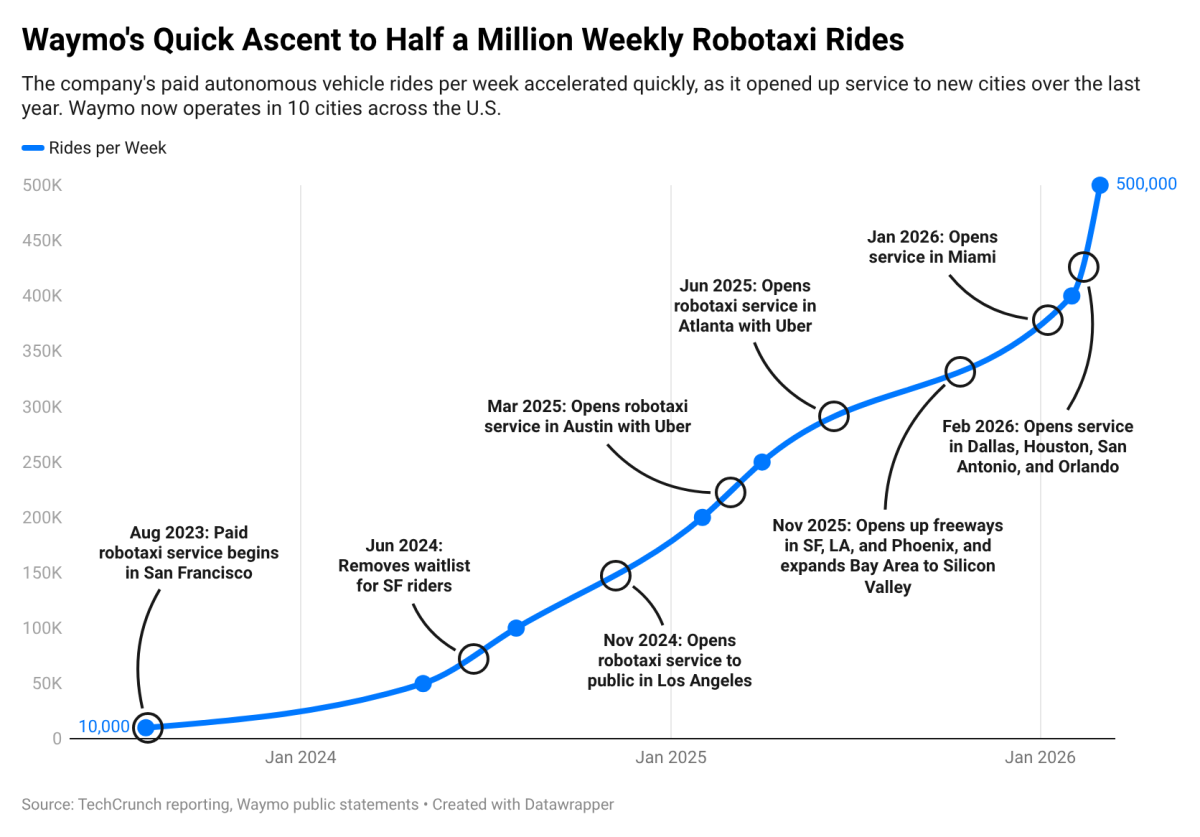
The Waymo ridership surge has reached a milestone that most autonomous vehicle critics never saw coming. In under two years, the Alphabet-owned robotaxi company has gone from 50,000 paid trips a week to 500,000 weekly rides across ten American cities. That tenfold jump tells a much bigger story than a single number, though. It reveals how fleet efficiency, rapid geographic expansion and growing consumer trust are reshaping the future of urban transport.
Still, this growth is not happening in a vacuum. Regulators are circling over safety incidents involving school buses and pedestrians. Competitors like Tesla, Zoox and several Chinese firms are launching rival services of their own. And Uber’s sheer scale makes Waymo look tiny by comparison, even after this latest milestone.
So what does this Waymo ridership surge mean for the broader autonomous vehicle market? More importantly, what challenges sit between the company and sustained dominance in the years ahead?
Waymo Ridership Surge Reaches 500,000 Weekly Trips
Back in May 2024, Waymo was averaging around 50,000 paid rides per week. At the time, that number seemed respectable for a fledgling robotaxi service still earning public trust. Fast forward to March 2026, however, and the Waymo ridership surge has pushed that figure to half a million weekly trips.
To put that in perspective, consider the trajectory. The company doubled its weekly rides in under a year, first crossing the 250,000 mark in April 2025. By the end of 2025, Waymo had already served over 14 million trips in a single year, more than tripling the prior year’s volume. Consequently, the acceleration has been exponential rather than linear.
Meanwhile, co-CEO Dmitri Dolgov has signalled even bolder ambitions. He told Bloomberg the company is targeting one million paid rides per week by the end of 2026. If the current Waymo ridership surge trajectory holds, that target looks increasingly achievable.
How Ten Cities Fuelled the Waymo Ridership Surge
Geographic expansion has been a core driver behind this growth. Originally, Waymo operated in just three cities: Phoenix, San Francisco and Los Angeles. Since then, the company has rolled out service in Austin, Atlanta, Miami, Dallas, Houston, San Antonio and Orlando. Notably, all seven of those Sun Belt additions happened within the past year alone.
This aggressive push into new markets has opened the floodgates for rider acquisition. Each new city brings a fresh pool of commuters, tourists and daily errand-runners who are curious about driverless transport. Waymo has also started testing in Nashville, Tennessee, though that market does not yet carry passengers. Nashville marks the sixth US state where Waymo has deployed vehicles, underscoring the breadth of its operational footprint. As a result, the Waymo ridership surge is not just about deeper penetration in existing markets. It is fundamentally about expanding the addressable customer base.
Beyond the US, Waymo has also begun laying groundwork for international operations. Test vehicles are already mapping traffic patterns in Tokyo, and the company plans to deploy in London later this year. These moves suggest Waymo’s growth trajectory could take on a global dimension before long, particularly as AI-driven commerce reshapes how consumers interact with autonomous services.
Fleet Utilisation Tells the Real Story
Here is where things get interesting. Despite the dramatic Waymo ridership surge, the fleet itself has not grown at the same pace. Data shared with the National Highway Traffic Safety Administration (NHTSA) in December 2025 showed Waymo operating roughly 3,067 robotaxis equipped with its fifth-generation self-driving system. That number has stayed largely flat since then.
So how is the company delivering ten times the rides with a similar-sized fleet? The answer comes down to utilisation. Waymo has been squeezing significantly more trips out of each vehicle, reducing idle time and cutting down on empty miles. For any robotaxi operator, this metric matters enormously. Every minute a vehicle sits parked or drives empty is a minute that burns capital without generating revenue.
In addition, higher utilisation directly addresses one of the biggest criticisms levelled at robotaxi services: traffic congestion. Empty autonomous vehicles cruising city streets without passengers add to gridlock without contributing economic value. The Waymo ridership surge suggests the company is making real progress on this front, keeping more seats filled and fewer vehicles wandering aimlessly.
There is also a financial dimension worth noting. Better utilisation means more revenue per vehicle per day. For a company that has burned through billions in research and development spending since its origins as Google’s self-driving car project, proving strong unit economics is essential. Investors and analysts are watching this metric closely because it signals whether robotaxi services can ever become profitable at scale.
Looking ahead, the introduction of sixth-generation autonomous driving technology on new platforms, including the Zeekr “Ojai” minivan and the Hyundai Ioniq 5, could further boost fleet capacity without proportional cost increases. As a result, the Waymo ridership surge may accelerate even further as these newer, potentially cheaper vehicles enter service.
Regulatory Pressure and Safety Concerns
Not everything about the Waymo ridership surge story is positive, however. The company faces mounting regulatory scrutiny that could slow its momentum if left unaddressed.
The most high-profile issue involves school bus safety. The NTSB opened an investigation in January 2026 after Waymo robotaxis were caught illegally passing stopped school buses on more than 20 occasions in Austin, Texas. The Austin Independent School District recorded at least 19 separate incidents during the 2025-2026 school year and demanded the company halt operations during bus loading hours.
Making matters worse, a Waymo vehicle struck a child near a Santa Monica elementary school during morning drop-off in January 2026, prompting a separate NHTSA investigation. The child sustained minor injuries. Waymo said the vehicle braked hard and reduced speed before contact, but the incident added fuel to growing public concern about autonomous vehicles operating near schools.
San Francisco officials have also raised questions about how the company manages stranded robotaxis. Reports indicate Waymo has occasionally relied on police and firefighters to clear its stuck vehicles, putting taxpayer-funded emergency resources to work on behalf of a private company. On top of that, a Senate Commerce Committee hearing earlier this year scrutinised the company’s use of remote support operators based overseas, raising cybersecurity and safety accountability concerns.
These issues do not negate the Waymo ridership surge, but they do highlight the operational and reputational risks that come with rapid scaling. Every new city means new regulators, new local concerns and new opportunities for friction between innovation and public safety.
For fintech observers, parallels exist in how AI-driven fraud losses are escalating alongside AI adoption. Growth at speed always carries risk, and regulatory responses tend to lag behind the pace of innovation.
Where Waymo Stands Against Uber
Despite the impressive Waymo ridership surge, context matters. Uber completed approximately 13.5 billion trips in 2025, a figure that covers both ride-hailing and delivery. During an August 2024 earnings call, Uber noted it was facilitating over one million mobility trips per hour. By comparison, Waymo’s 500,000 weekly rides barely register on Uber’s scale.
That gap is not going to close any time soon, either. Uber has a massive global footprint, millions of drivers and a deeply embedded consumer habit loop. Waymo, on the other hand, operates exclusively through its own app and only in select US cities. The Waymo ridership surge is significant within the autonomous vehicle niche, but it does not yet threaten Uber’s core business in any measurable way.
There is also the question of profitability. Uber generates billions in gross bookings each quarter. Waymo, by contrast, has not publicly disclosed revenue figures for its ride-hailing operations. Until the Waymo ridership surge translates into demonstrable financial performance, comparisons with Uber will remain lopsided.
Interestingly, the relationship between Waymo and Uber is not purely adversarial. Uber has partnered with autonomous vehicle companies in certain markets and has signalled openness to integrating robotaxi services on its platform. Whether Waymo pursues that kind of partnership or continues building its own rider ecosystem will shape how quickly this explosive ride volume growth translates into meaningful market share.
Competition Heats Up in the Robotaxi Market
Waymo is not the only company chasing the robotaxi prize. Several competitors are pushing to launch or expand paid autonomous ride-hailing services, even though none have matched the Waymo ridership surge in terms of scale.
Tesla launched a paid robotaxi service in Austin earlier this year. However, CEO Elon Musk has acknowledged the company lacks the permits needed for fully autonomous operations in California. That regulatory gap limits Tesla’s ability to compete head-to-head with Waymo in key markets like Los Angeles and San Francisco.
Chinese firms represent another competitive front. Both Pony.ai and WeRide charge for robotaxi rides in their home markets, though neither operates in the United States. Pony.ai reported $16.6 million in robotaxi revenue for 2025 and has a fleet of nearly 1,500 vehicles. WeRide, meanwhile, posted $21.2 million in robotaxi revenue and operates across 12 countries with over 2,100 vehicles globally. These numbers are modest compared to Waymo, but they point to a growing international ecosystem.
Closer to home, Amazon-owned Zoox recently expanded its pilot areas in Las Vegas and San Francisco. Zoox takes a different approach by building purpose-designed pods rather than retrofitting existing cars. Hyundai-owned Motional is also targeting paid service launches by year-end in select markets.
For now, however, the Waymo ridership surge gives the Alphabet subsidiary a commanding lead. The combination of ten operational cities, a growing rider base and improving fleet utilisation puts Waymo in a position that competitors will find difficult to replicate quickly.
As consumer demand for AI-powered products continues climbing across sectors, autonomous transport looks poised to follow a similar adoption curve. The companies that solve safety, regulation and unit economics first will likely capture the lion’s share of this emerging market.
What Comes Next for Waymo
The Waymo ridership surge from 50,000 to 500,000 weekly rides is undeniably impressive. Yet the road ahead is far from clear. Regulatory battles over school bus safety and emergency response protocols could force operational restrictions in certain markets. Competition from Tesla, Zoox and Chinese AV companies will only intensify as more players enter the space.
At the same time, Waymo’s push toward one million weekly rides and international expansion into Tokyo and London signals a company that is not slowing down. If sixth-generation technology delivers on its promise of lower costs and better performance, the current growth curve could steepen even further.
The Waymo ridership surge also raises broader questions about urban planning, insurance models, labour displacement and infrastructure investment. Cities that welcome robotaxi services will need to rethink curb management, parking policy and emergency response frameworks. Those that resist may find themselves on the wrong side of a transport revolution that is already well under way.
For investors, regulators and urban planners alike, the message is clear: the autonomous ride-hailing revolution is no longer theoretical. It is happening on real streets, with real passengers, at a scale that demands serious attention.
