5 mins read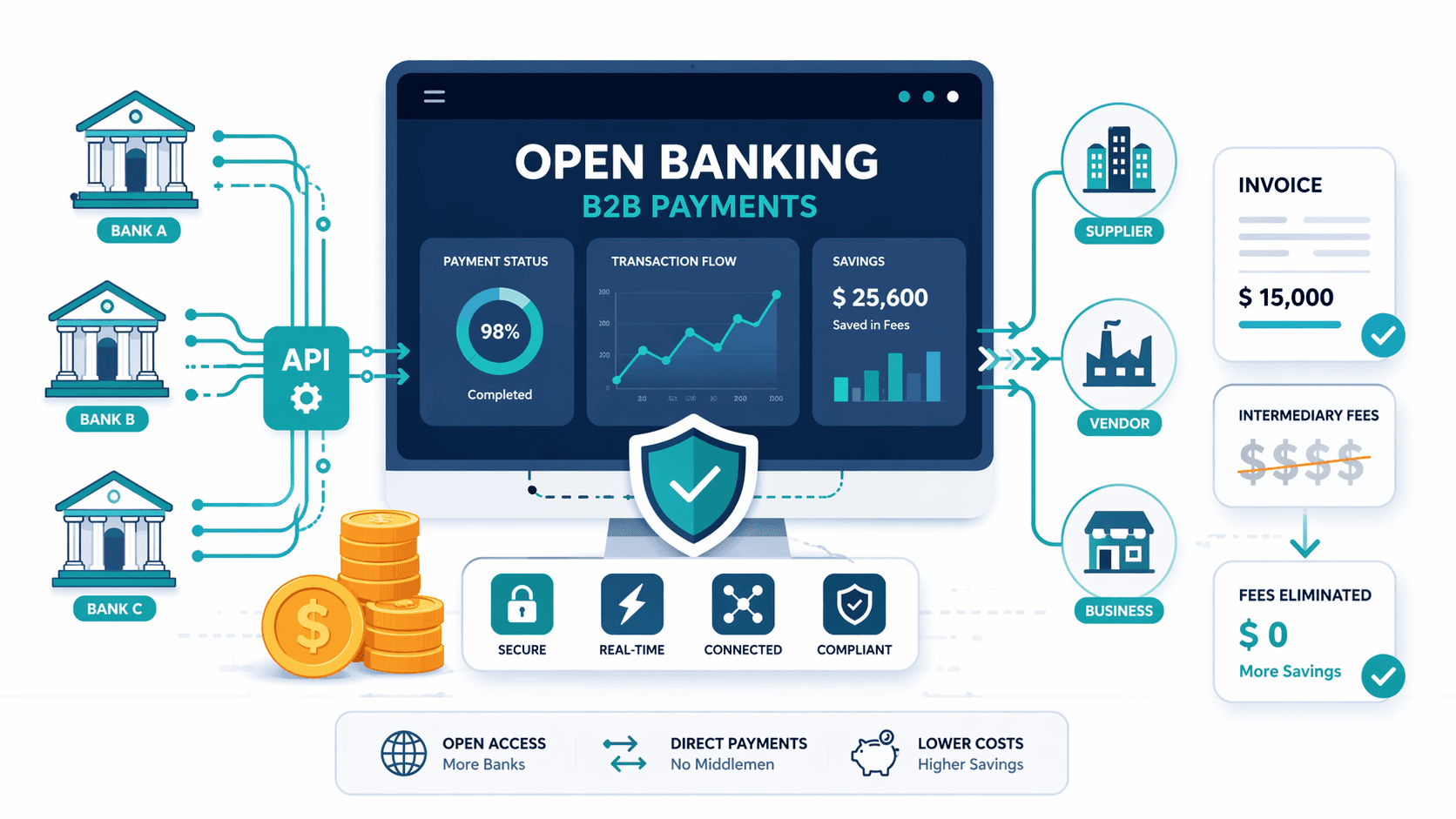
Author: Sudhanshu Dubey, Delivery Manager, Enterprise Solutions Architect, Errna
Open banking B2B payments are rewriting the rules of commercial transactions, yet most businesses still ignore the margin leakage hiding inside their legacy payment rails. Traditional B2B payment infrastructure relies on multiple intermediaries that add layers of cost and complexity to every transaction. Consequently, the cumulative impact of these inefficiencies goes unaudited and unchallenged. The global open banking market is projected to grow from $42.1 billion in 2026 to $190.9 billion by 2034, which signals just how aggressively the industry is moving away from these outdated rails. This article breaks down where that margin leakage occurs and how open banking B2B payments infrastructure can recover it.
How Open Banking B2B Payments Bypass Legacy Rails
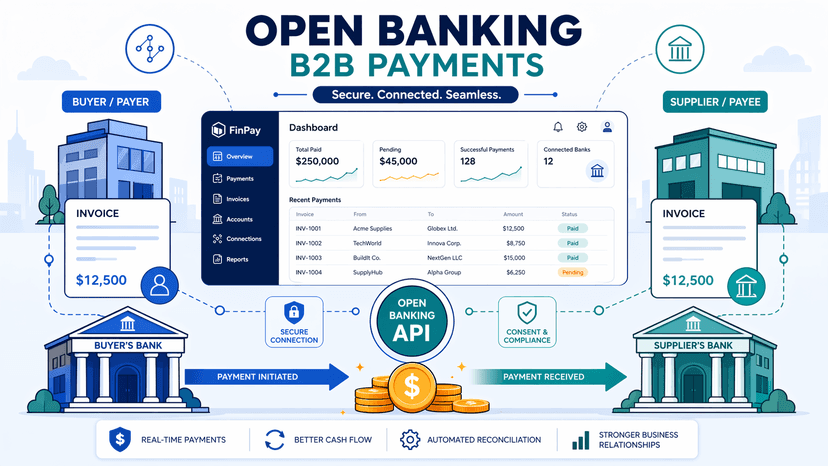
Open banking relies on Application Programming Interfaces that act as secure conduits between financial systems. For B2B transactions, these APIs allow businesses to initiate payments directly from their own accounting software, bypassing traditional bank portals entirely. Standardized data protocols ensure seamless information exchange, while authentication methods like OAuth 2.0 verify identities and authorize each transaction.
This architectural shift is profound because it decouples payments from intermediaries. Traditional processing involves correspondent banks and payment processors that each take a cut and introduce delays. By contrast, open banking B2B payments flow directly between business accounts, eliminating legacy middlemen. The reduction in steps translates immediately to lower per-transaction fees. According to SQ Magazine’s 2026 adoption data, the global market now surpasses $48 billion and continues double-digit annual growth, confirming that businesses are voting with their wallets.
The Fintech Infrastructure Powering the Shift
Fintech companies are building the infrastructure that enables open banking B2B payments at scale. They develop payment gateways that leverage API technology, focus on speed and compliance, and cater to the unique demands of commercial transactions. These platforms are becoming more intelligent with every iteration. They route payments efficiently and offer value-added services such as fraud prevention and FX management.
The implications for supply chain finance are especially significant. Faster payment cycles improve supplier relationships and can unlock early payment discounts that go straight to the bottom line. Embedded finance solutions for manufacturers are already demonstrating how virtual cards and integrated financial tools compress payment timelines. Meanwhile, modern payment gateways connect directly to open banking APIs, aggregate data from multiple sources, and provide a unified view of payment activity that simplifies management considerably.
Hidden Margin Leakage: The Audit Gap
The core issue is that most companies never audit their payment processes deeply enough to spot the leakage. Incremental fees, time burned on manual reconciliation, and missed discount windows all bleed margin quietly. The PO-to-payment chasm that many CEOs overlook represents exactly this kind of invisible cost. Without a structured review of open banking B2B payments integration opportunities, these losses compound month after month.
Transaction cost reductions alone make the case compelling. Removing intermediaries lowers per-transaction fees, and for a company processing thousands of payments monthly, even small savings compound rapidly. Beyond fees, manual reconciliation is a major drain on accounting resources. Open banking facilitates richer data exchange where transaction details travel alongside payments, including beneficiary information and payment purpose. This level of detail makes automated reconciliation achievable and frees finance teams for strategic work instead of matching entries line by line.
Missed early payment discounts represent yet another layer of leakage. Without efficient processing, businesses forfeit discounts that often exceed the cost of short-term borrowing. Early payment discount financing can recapture this lost value, but only when open banking B2B payments infrastructure provides the speed required to act within discount windows.
Integrating Open Banking into Payment Workflows
Integrating open banking B2B payments requires a strategic approach that begins with assessing current workflows and identifying connection points. Companies should evaluate their existing ERP and treasury management systems to determine where APIs can plug in. The process often involves collaboration with fintech partners who bring the expertise to design and implement the integration effectively.
At the technical level, businesses connect internal systems to banking APIs for direct payment initiation. This supports single payments, batch processing, and scheduled disbursements, all embedded within the company’s own software. Standardized data protocols ensure compatibility across different banking partners, which simplifies the technical overhead and makes integrations scalable. The enhanced data transparency also transforms reconciliation. Transaction details travel alongside payments, so accounts departments spend less time matching entries and more time analyzing spending patterns for strategic savings. On top of that, secure authentication through OAuth 2.0 ensures only authorized parties can initiate transactions, building confidence in the new infrastructure and protecting against fraud.
The Strategic Imperative for CFOs
Ignoring the open banking B2B payments evolution is a strategic misstep that leaves money on the table and cedes competitive advantage to faster-moving rivals. Companies that proactively audit their payment workflows can identify specific pain points and target them with API-driven solutions. This transforms a cost center into a measurable profit driver.
APIs, standardized protocols, and secure authentication are the building blocks of a more efficient payment ecosystem. They allow for direct integration, facilitate automation, and generate the transparency needed for data-driven decision-making. Enhanced reporting reveals which customers consistently delay payments, enabling proactive risk assessment before problems escalate. By embracing these technologies, businesses recover lost margins and reinvest those savings into growth. The open banking B2B payments reckoning is not a future event. It is happening now, and the companies that audit their margin leakage today will be the ones that lead tomorrow.
“The future of B2B payments hinges on leveraging technology to eliminate friction. Open banking provides the foundational architecture for this essential evolution.”
– Sudhanshu Dubey, Errna