

For the past seven decades, Germany has stood as a prime example of postwar recovery, characterized by economic growth, political stability, and international admiration. This trajectory began with the leadership of Konrad Adenauer and continued through figures like Willy Brandt, Helmut Schmidt, Helmut Kohl, and Angela Merkel, whose lengthy tenure further solidified the nation’s robust political landscape. Germany’s swift integration of East Germany following the Berlin Wall’s collapse illustrated its perceived resilience and stability.
However, the nation now confronts significant challenges, with its export-driven economic model struggling against rising competition from China. A growing anti-immigrant sentiment has emerged, reaching a peak since Merkel’s controversial 2015 decision to permit over a million migrants into the country. This discontent has fueled the rise of far-right populism, particularly with the Alternative für Deutschland party questioning long-standing political norms that have governed Germany since its establishment in 1949.
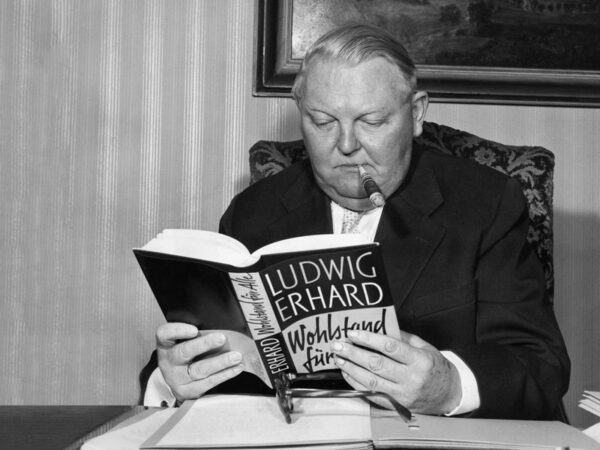
Examining these current dilemmas requires revisiting the origins of the “Wirtschaftswunder,” or economic miracle, that propelled West Germany’s recovery post-World War II. Traditional narratives attribute this rapid growth to initiatives like the currency reform orchestrated by Ludwig Erhard and the Marshall Plan, enacted on April 3, 1948, by U.S. President Harry Truman. The plan’s stipulations mandated fiscal responsibility, the dismantling of rationing, and a liberalized market, establishing the groundwork for Germany’s subsequent economic success.
Central to this transformation was Erhard’s introduction of the Deutsche Mark, which replaced the devalued Reichsmark in the Bizone, occupied by American and British forces. By replacing the old currency, Erhard aimed to stabilize the economy and make it competitive, a policy shift that included the immediate removal of price controls and rationing.
The results were significant: with the market restored, goods became available, agricultural production surged as farmers capitalized on new monetary opportunities, and German firms began exporting, igniting job creation and investment. Over the next twenty-five years, West Germany recorded an astonishing annual growth rate of six percent, emerging as the world’s third-largest economy by 1973.
Recent literature by Carl-Ludwig Holtfrerich and Tobias Straumann challenges the prevailing narratives surrounding these events. Holtfrerich contends that Erhard’s contributions to the currency reform were overstated, while Straumann posits that the prosperity of the post-reform era was contingent on the 1953 London Debt Agreement, which alleviated Germany from substantial reparation debts.
This agreement was the culmination of negotiations between a German delegation, led by Deutsche Bank’s Hermann Josef Abs, and several creditor nations, including the United States, United Kingdom, and France. Straumann suggests that these discussions were heavily influenced by historical lessons learned from the punitive reparations imposed after World War I, which many believed had contributed to the rise of Adolf Hitler and the Nazi Party.
The Cold War dynamics further shaped this landscape, as Western allies recognized the importance of stabilizing the West German economy in the face of a Soviet threat. Success in integrating West Germany into the global economy became paramount, thus necessitating leniency in debt reparations.
Under the London Debt Agreement, the new German government dedicated itself to repaying pre-war loans but exempted wartime debts, delaying reparation obligations until a potential reunification with East Germany. Concurrently, negotiations paved the way for the establishment of the European Coal and Steel Community, fostering economic collaboration and ensuring that Germany’s industrial capabilities would not pose a threat to its neighbors in the future.
The agreement also led to the normalization of relations with Israel, allowing Germany to aid the country with necessary imports, despite the dark history of the Holocaust. Holtfrerich, in his detailed biography of Edward Tenenbaum, argues that Tenenbaum was the true architect of the currency reform but received little credit due to his modest nature and Erhard’s aggressive self-promotion.
Tenenbaum’s postwar career followed an interesting trajectory, with his foundations laid during the war and subsequent advisory roles shaping the monetary policy that underpinned Germany’s recovery. In contrast, Erhard’s adaptability in economic policy reflected broader historical demands, helping him secure a lasting legacy as a pioneer of West Germany’s monetary reform.
Despite the successes of the postwar years, Germany finds itself at a crossroads once again. The economic landscape is shifting, and the legacy of the Wirtschaftswunder can only be maintained through strategic overhaul and leadership capable of navigating new realities. Without significant reform, the hard-earned gains of the postwar era may become imperiled.