German economic miracle history explains more about today’s crisis than any quarterly forecast. Germany has stood as a prime example of postwar recovery for seven decades, built on economic growth, political stability, and international credibility. The trajectory began with Konrad Adenauer and ran through Willy Brandt, Helmut Schmidt, Helmut Kohl, and Angela Merkel. Germany’s swift integration of East Germany after the Berlin Wall fell reinforced that reputation for resilience.
However, the German Economic Miracle now faces serious headwinds. The export-driven model has struggled against Chinese competition, and anti-immigrant sentiment has returned to levels unseen since Merkel’s 2015 decision to admit more than a million migrants. That discontent has fuelled Alternative für Deutschland (AfD) and its challenge to political norms dating back to 1949.
How the German Economic Miracle Began
Understanding current pressures requires revisiting the Wirtschaftswunder itself. The German economic miracle that rebuilt West Germany after World War II rested on three foundations: Ludwig Erhard’s currency reform, the Marshall Plan (enacted by U.S. President Harry Truman on April 3, 1948), and the later 1953 London Debt Agreement. Those three pillars together forced fiscal discipline, dismantled rationing, and liberalised the market.
Now, traditional accounts credit Erhard and the Marshall Plan almost exclusively. Still, the real story runs deeper. Recent scholarship by Carl-Ludwig Holtfrerich and Tobias Straumann challenges that simpler narrative, arguing that the debt settlement mattered as much as the currency reform.
Ludwig Erhard and the Deutsche Mark Revolution
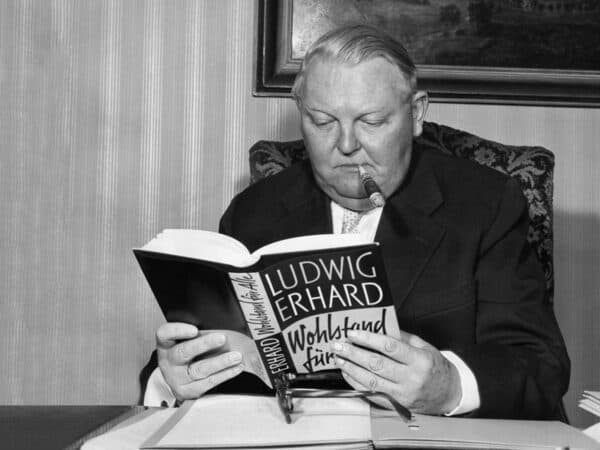
Erhard’s signature move introduced the Deutsche Mark, which replaced the devalued Reichsmark in the Bizone controlled by American and British forces. The reform did two things at once. It stabilised the monetary base, and it removed price controls and rationing overnight.
The results moved fast. Goods returned to shelves. Agricultural output jumped as farmers responded to real prices. German firms started exporting again, which triggered job creation and fresh investment. Over the following 25 years, West Germany averaged six percent annual growth, reaching the world’s third-largest economy by 1973.
That growth rate would look extraordinary even today. By comparison, Goldman Sachs forecasts just 1.1% growth for Germany in 2026, ending six years of near-stagnation. The postwar German economic miracle delivered performance that current forecasters would consider fantasy.
The Hidden Architect of Postwar Germany
Holtfrerich’s biography of Edward Tenenbaum argues that Tenenbaum, not Erhard, designed the currency reform. As a young American economist attached to the occupation authority, Tenenbaum laid the technical groundwork during the war and through subsequent advisory roles. He received little public credit due to his modest personality and Erhard’s aggressive self-promotion.
Erhard’s strength was adaptability. He read the historical moment, pushed the reform through politically, and secured a lasting legacy as a pioneer of West Germany’s monetary policy. Tenenbaum did the engineering. Erhard did the politics. Both mattered.
Meanwhile, Straumann argues that the post-reform prosperity hinged less on the Deutsche Mark itself than on what came five years later. He points to the 1953 London Debt Agreement as the unsung catalyst of the German economic miracle.
The 1953 London Debt Agreement Changed Everything
The agreement emerged from negotiations between a German delegation led by Deutsche Bank’s Hermann Josef Abs and creditor nations including the United States, United Kingdom, and France. The discussions drew heavily on lessons from World War I, when punitive reparations had arguably contributed to the rise of Adolf Hitler and the Nazi Party. Western powers wanted to avoid repeating that mistake.
Cold War logic sharpened the case. As Soviet pressure mounted across Europe, Western allies recognised they needed a stable West German economy. Leniency on reparations became strategic necessity rather than charity. That calculation enabled the commercial recovery that historians later labelled the German economic miracle.
Under the agreement, the new German government committed to repaying pre-war loans while suspending wartime debts until a potential reunification with East Germany. In effect, West Germany got a clean balance sheet at the very moment its productive capacity was ramping up.
Cold War Economics and European Integration
The London settlement did more than clear debts. It paved the way for the European Coal and Steel Community, which locked German industrial capacity into cross-border cooperation and removed the threat that a rebuilt Germany could pose to its neighbours. Relations with Israel normalised in parallel, allowing Germany to support the country through imports despite the Holocaust’s shadow.
Those structural moves built the integration architecture that still shapes European commerce today. European fintech funding rounds of $100 million or more now flow across the same borders that the 1953 agreement first opened. The story was never just a German one. It became a European reconstruction blueprint.
The German Economic Miracle at a 2026 Crossroads
Fast forward to today and the contrast is stark. Germany’s manufacturing sector has seen industrial production fall almost 15% from its peak, with value added down 7% since 2017. Chinese competition keeps displacing German exports across autos, machinery, and chemicals. Meanwhile, KPMG’s economic brief on Germany notes that leading research institutes cut 2026 growth forecasts to just 0.6% after the Iran war drove energy prices higher.
Politically, the strain shows. The Atlantic Council has called 2026 Germany’s Superwahljahr, with five state elections testing Chancellor Friedrich Merz’s CDU-CSU-SPD coalition. CNN reported from the AfD’s April 2026 party congress in Magdeburg that the far-right party could win its first absolute majority in Saxony-Anhalt this September. The postwar consensus built during the German economic miracle is visibly fraying.
Additionally, China’s growing footprint has reshaped global trade maps. China’s inland connectivity push with ASEAN signals that Germany’s old export destinations are being rewired in ways the Wirtschaftswunder generation never had to navigate.
Defence Spending and the New Fiscal Pivot
So what’s the playbook now? Merz’s government has amended the constitutional debt brake to unlock higher defence and infrastructure spending. Goldman Sachs expects defence to reach 3.3% of GDP by 2029, up sharply from historical norms. That fiscal turn resembles the postwar era in one important way: public capital is doing the heavy lifting while private demand recovers.
The Bundesbank forecasts growth of about 0.6% in 2026, rising to 1.3% in 2027 and 1.1% in 2028. Those numbers fall well short of the six percent averages that defined West Germany’s postwar rise. Still, they mark a break from the stagnation that followed the COVID shock.
Lessons From the Postwar Recovery
Three lessons travel well from 1948 into 2026. First, the German economic miracle proved that decisive currency and debt action can reset growth expectations when politically aligned. Second, the reform worked because external partners gave Germany fiscal room at a critical moment. Third, trade integration with neighbours turned a national recovery into a continental one.
None of those conditions exist automatically today. Germany now faces a fragmented political landscape, slower global demand, and a debt-brake legacy that must be unwound carefully. Still, the German economic miracle shows that structural pessimism has been wrong before. Financial markets have a pattern of underestimating reform pivots, a point reinforced by coverage of modern investing and financial markets worldwide.
The question facing Merz is whether Germany can repeat the conditions that made the German economic miracle possible, or whether the country has entered a slower, more contested era. Without serious reform, the hard-won gains of the postwar economy may erode. With reform, another version of the German economic miracle is at least imaginable.