AI-resistant fintech skills now decide who builds a long career in finance and who watches their role get automated. The wave of AI tools moving into trading desks, compliance teams, and back offices has changed the math for entry-level and mid-career professionals. So the conversation has shifted. It is no longer about whether finance roles will change. The real question is which human capabilities still hold value when models can read filings, draft memos, and screen resumes faster than any analyst can.
Why AI-Resistant Fintech Skills Matter More Than Ever
The pace of AI deployment in financial services has compressed timelines that used to span decades. According to the World Economic Forum’s 2026 outlook on AI and talent, the most profound impact on financial services workflows will come from a collision between AI commercialisation, a shifting talent landscape, and fragmenting geoeconomics. So the question for any junior banker, fintech analyst, or product manager is direct. What capabilities will still be in demand once routine analytical work runs on models? AI-resistant fintech skills like leadership, judgment, persuasive communication, and ethical reasoning are exactly that hedge.
What Northeastern’s London Society Got Right Early
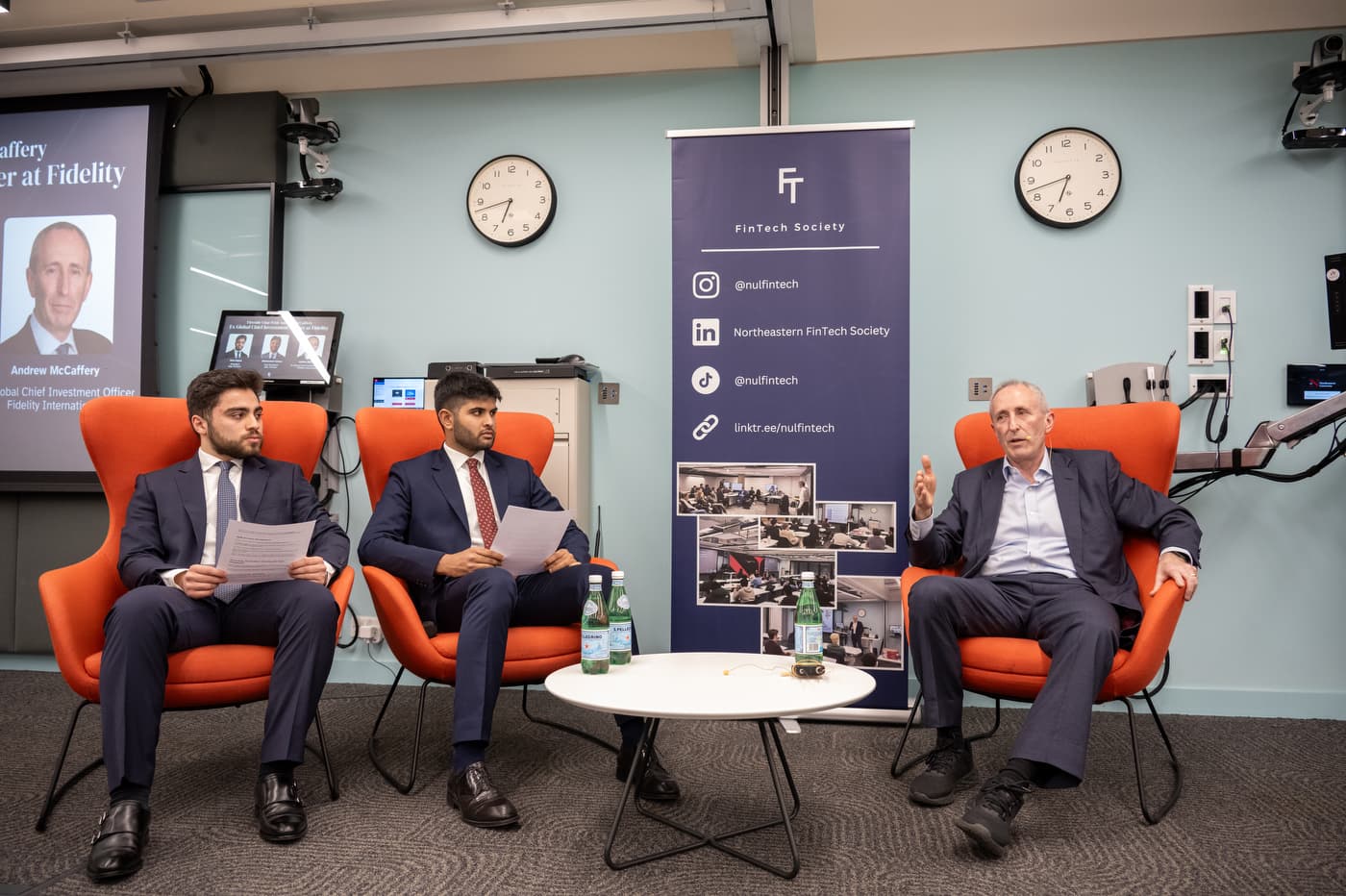
Long before AI panic became a campus topic, the FinTech Society at Northeastern University’s London campus was quietly building the right curriculum. The group started in fall 2023 with twenty attendees who came mostly because friends asked them to. Three years later, the society has grown to over 750 members across the global campus network.
So the trajectory matters. The early focus was on lectures, simulations, and workshops, not on chasing technical certifications. That choice ended up future-proofing members because the AI-resistant fintech skills the society emphasised, public speaking, networking, leadership, and live deal simulation, are exactly what hiring managers say they cannot get from a model.
Soft Skills Are Now the Real Differentiator
Mohammed Vahora, a former senior vice president at the society, framed it well by quoting Goldman Sachs CEO David Solomon. The technical 95 percent of the job has become a commodity, while the remaining 5 percent of judgment, leadership, and persuasion is where careers are made. So that 5 percent is exactly the territory where AI-resistant fintech skills sit.
Furthermore, this is no longer a soft assertion. The IMF’s 2026 analysis on AI and the future of work emphasises that workers and firms set to thrive are those investing in adaptability, lifelong learning, and the human capabilities that AI cannot replicate. That advice maps directly onto what fintech employers now screen for.
Public Speaking and Confidence Drive Career Outcomes
Dara Hejazi, the outgoing president of the society, credits his time leading the group with reshaping his entire career trajectory. After a stint at JP Morgan as an intern, he landed a permanent role on the asset and wealth management team in Geneva. He attributes much of that to confidence built through public speaking and the willingness to ask questions in front of senior people.
So the lesson is concrete. AI-resistant fintech skills like the ability to walk into a room, present a thesis, and defend it under pressure cannot be outsourced to a model. Our coverage of why fractional and embedded executive roles are reshaping fintech leadership shows the same dynamic at the senior level.
Networking Still Beats Algorithms in Finance Hiring
Sofia Rendon, the society’s two-year treasurer, recalls that the early days were about persuading friends to show up. So the group’s first lesson was about building the room before building the program. That same logic now drives how members land internships and full-time roles.
The society regularly hosts senior executives from the Bank of England, Google, and partner firms like AmplifyMe. As a result, members get face time with hiring managers years before formal recruiting cycles begin. AI-resistant fintech skills like trust-building and follow-through still drive the bulk of internship offers, especially in tier-one banks and fintech scale-ups where pattern-matching by algorithm only gets candidates to the first screen.
Industry Simulations Build Judgment AI Cannot Copy
Working through a live deal scenario, defending a recommendation, and watching it get torn apart by a senior partner builds judgment that no online course can replicate. So the society’s collaboration with AmplifyMe on investment banking and asset management simulations sits at the centre of its value.
Equally, judgment is the capability that hiring managers cite most when explaining why some candidates clear the bar. AI-resistant fintech skills like reading a room, weighting incomplete information, and choosing when to push back on a model’s output are exactly what those simulations train. Our piece on AI super-apps reshaping bank infrastructure shows where that judgment now sits in the workflow.
Mentorship Opens Doors That Resumes Cannot
The society’s network with Bank of England leaders and Google executives gives members something resumes cannot replicate. Direct mentorship from people one or two career steps ahead is one of the most reliable accelerators in finance. So members who build those relationships during their study programme often skip the painful early-career stall that catches most graduates.
By contrast, the candidates who lean entirely on cold applications and AI-optimised resumes face a brutal funnel. Generative tools have flooded recruiter inboxes with high-quality cover letters, which means human signal matters more than ever. AI-resistant fintech skills like cultivating a real mentor and earning a warm introduction now cut through noise that resume-screening software was never built to filter.
Leadership Visibility in Male-Dominated Fields
Sofia Rendon noted that her leadership role at the society opened doors for her in Mexico, partly because employers could see the work that went into running the organisation. That visibility matters more in fields where women remain underrepresented at senior levels. So a track record of leading a 750-member operation reads as concrete evidence rather than a resume line.
Meanwhile, fintech employers explicitly screen for inclusive leadership at all levels. As Yahoo Finance reported on AI-resistant $100K roles in 2026, the highest-paying roles least likely to be replaced by AI rely on judgment, leadership, and interpersonal skills. AI-resistant fintech skills built through real leadership experience translate directly into that compensation tier.
How to Build Your Own AI-Resistant Skill Stack
Most students do not have a Northeastern London FinTech Society on their campus. So the playbook needs to be portable. The strongest moves involve joining or co-founding a finance club, taking on a visible leadership role, and securing one mentor outside your immediate department.
Equally, candidates can build AI-resistant fintech skills by writing publicly on a niche fintech topic, presenting at student or community events, and shadowing professionals during informational interviews. Our coverage of agentic commerce and AI-driven finance and our breakdown of fintech jobs and salary patterns show where the market is heading.
Ultimately, AI-resistant fintech skills are not soft luxuries. They are the durable layer that decides who keeps a seat when the next wave of model deployment hits. The students at Northeastern London figured that out early. The same logic now applies to anyone serious about a long finance career.