

Author: Charitarth Sindhu, Fractional Business & AI Workflow Consultant
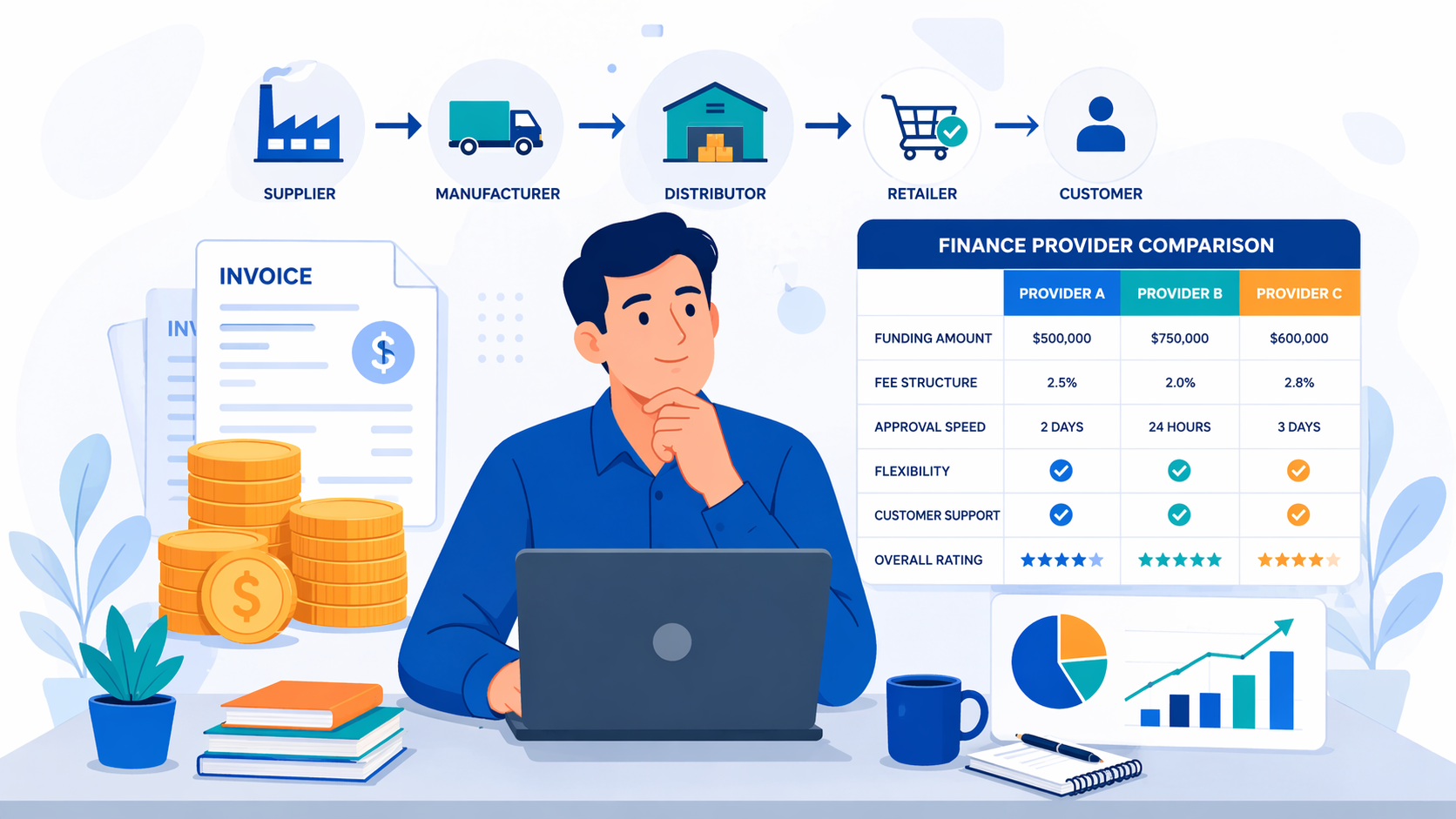
Supply chain finance has become one of the fastest-growing working capital tools for small and mid-sized businesses. However, not every provider deserves your trust. The global SCF market now processes over $2.5 trillion in annual flows, and more than 60% of new adopters since 2023 have been SMEs. Yet a string of high-profile collapses shows that choosing the wrong provider can be devastating.
We asked industry leaders to share what SMEs should look for when selecting a supply chain finance provider. Their answers reveal common themes around fee transparency, software integration, and industry-specific expertise. More importantly, they highlight warning signs that too many businesses overlook until it is too late.
What to Look for in a Supply Chain Finance Provider
The most consistent advice from our experts centres on one priority. SMEs need full visibility into what they are paying and why. A headline discount rate means very little when hidden charges inflate the total cost by 10 to 35%, according to research from Resolve. Arrangement fees, facility fees, drawdown charges, and currency conversion costs often make up more than half of the total expense.
Albert Richer, who has evaluated thousands of platforms for a SaaS comparison site, puts it bluntly.
“After evaluating thousands of financial platforms for our SaaS comparison site, the biggest red flag I see is opaque fee structures. Specifically, providers who quote a ‘discount rate’ without clearly breaking down whether that includes platform fees, transaction fees, or early payment premiums. The rate that looks competitive in the pitch deck often isn’t once you factor in the full cost stack. What SMEs should prioritize is integration simplicity with their existing accounting software. A supply chain finance provider that requires manual invoice uploads or doesn’t sync with your ERP is going to create more operational friction than the financing is worth. The best providers offer direct integrations with platforms like QuickBooks, Xero, or NetSuite and provide real-time visibility into which invoices are financed, at what rate, and when funds will arrive. If a provider can’t show you a live dashboard, keep looking.”
- Albert Richer, Founder & Editor, WhatAreTheBest.com
Richer’s point about integration deserves emphasis. Traditional bank-led supply chain finance programs often require 12 months or more for onboarding, and many demand significant IT capacity for ERP connections. In contrast, fintech platforms like Resolve, C2FO, and Fundbox offer pre-built connectors and onboarding in as little as three weeks. For SMEs already struggling with cash flow management, adding manual processes defeats the purpose entirely. The best practice when evaluating any provider is to request a total cost of financing calculation expressed as an effective APR rather than relying on the headline discount rate alone.
Red Flags That Signal Supply Chain Finance Trouble
Fee opacity is just the starting point. The collapse of Greensill Capital in 2021 demonstrated what happens when a supply chain finance provider strays from fundamentals. Greensill moved from financing confirmed invoices to speculating on future receivables that did not yet exist. When its credit insurance was pulled, the entire structure crumbled. Credit Suisse investors faced losses up to $3 billion, and thousands of SME suppliers were left exposed.
Then in December 2024, London-based Stenn International collapsed after fictitious invoices were discovered. The firm had $978 million in invoice-financed notes outstanding. Roughly 50 alleged corporate partners denied any relationship with Stenn when contacted. Even major banks like Citigroup, HSBC, and Barclays had provided funding without catching the fraud. These failures share common patterns that SMEs can watch for, including unusually high investor yields, auditor resignations, heavy client concentration, and opaque corporate structures spread across multiple jurisdictions.
Daniel Vasilerski sees these risks play out in the trades sector every day.
“From our experience running an electrical business, the biggest factor is clarity around cash flow impact, not just access to funding. SMEs should look for transparent fee structures, including hidden or variable costs, flexible repayment terms that align with project timelines, providers that understand the industry, especially trade and construction cycles, and clear visibility on how financing affects margins on each job. Red flags include complex contracts that are difficult to interpret, fees that scale unpredictably with usage, providers pushing volume over suitability, and lack of flexibility if project timelines shift. A practical example is materials procurement. Electrical projects often require upfront purchasing of components. If financing terms are unclear, margins can quickly erode without the business realising until later. The key is to treat finance as part of project planning, not a separate decision.”
- Daniel Vasilerski, Founder, Bright Force Electrical
Vasilerski raises a point that the research supports strongly. Construction and trades businesses face some of the most acute supply chain finance challenges. More than half of all invoices sent to construction firms were paid late in 2022, and contractors typically wait up to three months for payment while fronting large sums for materials. Retention payments of 5 to 10% withheld until project completion add further strain. Contract flexibility matters just as much as pricing in these sectors. S&P Global has warned that the financial institution running a supply chain finance program can reduce funding or increase pricing at any time, so SMEs should negotiate clear exit provisions and multi-funder arrangements as insurance against provider withdrawal.
Why Industry Expertise Matters for SCF Selection
One factor that separates effective supply chain finance providers from generic ones is sector knowledge. PwC’s Working Capital Study 25/26 found that net working capital days for small businesses have deteriorated by 13.5% since 2015. Large companies have maintained their position largely by pushing longer payment terms onto suppliers. This means SMEs need financing partners who understand their specific industry cycles, not just providers chasing volume.
Michael Kazula reinforces this from the digital marketing perspective.
“In affiliate marketing, SMEs should select an SCF provider that understands the industry’s unique cash flow dynamics, particularly related to commission payments. Key considerations include experience with affiliate marketing, flexibility in financing solutions, and responsiveness. It is also important to watch for red flags such as lack of transparency, hidden fees, or inadequate support, which could hinder cash flow management and supplier relationships.”
- Michael Kazula, Director of Marketing, Olavivo
The emphasis on responsiveness and flexibility runs through all three expert perspectives. Whether the business operates in construction, SaaS comparison, or affiliate marketing, the core needs remain the same. SMEs want providers who communicate clearly, price honestly, and adapt when project timelines or revenue cycles shift.
Beyond provider selection, SMEs should also understand the regulatory changes reshaping supply chain finance. FASB and IASB now require buyers in SCF programs to disclose key terms and outstanding amounts. These transparency rules give SMEs leverage when negotiating with providers, because any partner resistant to disclosure is signalling a problem.
Meanwhile, AI-driven credit assessment is expanding access for businesses that traditional underwriting models have historically excluded. The IFC tripled its Global Supply Chain Finance Program to $3 billion in 2025, recognising that scaling SCF could unlock billions in working capital for smaller businesses globally.
The bottom line is straightforward. Supply chain finance can transform cash flow for SMEs when the provider is transparent, well-integrated, and genuinely understands the business. The experts we spoke with all agree on one thing. If a provider cannot clearly explain every fee, show you a live dashboard, and adapt to your industry’s payment cycles, keep looking. There are too many good options to settle for a risky one, and as Greensill and Stenn proved, the consequences of choosing poorly extend far beyond a bad rate. Businesses exploring early payment strategies should apply the same scrutiny to every financing partner they consider.