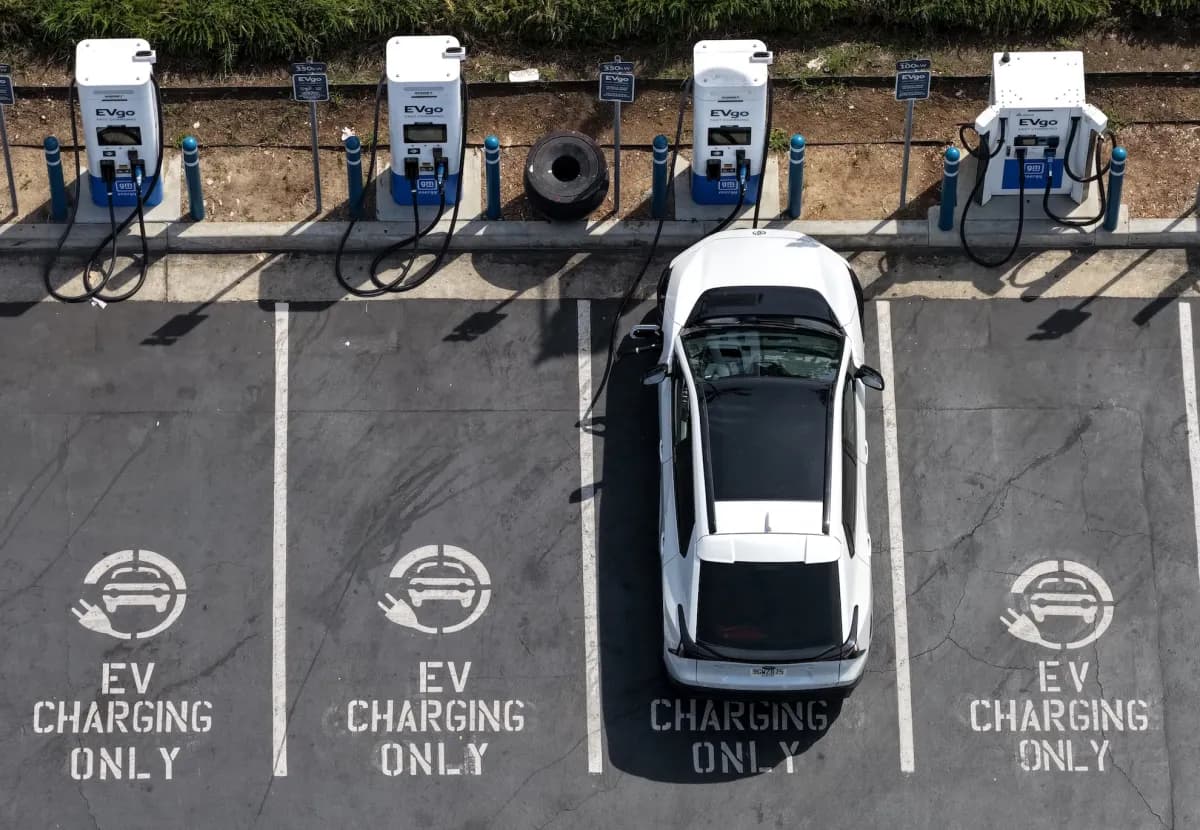
The American electric vehicle market has split into two very different stories in 2026. On one side, new EV purchases are falling sharply. On the other, used electric vehicle sales are climbing at a pace that few analysts predicted just a year ago.
That contrast raises an obvious question. What exactly is pushing used electric vehicle sales higher, and why is the trend accelerating right now?
New Electric Vehicle Sales Decline Amid Policy Shifts
First-quarter data from Cox Automotive tells a sobering story for the new-car side of the market. Americans purchased roughly 212,600 new battery-electric vehicles between January and March, representing a 28% year-over-year drop. That decline followed the expiration of the $7,500 federal consumer tax credit on September 30, 2025.
Before that date, the incentive had been a powerful demand lever. It helped EV market share peak at 7.5% in Q3 2025, when buyers rushed to lock in the credit before it disappeared. Since then, however, share has settled back to around 5.8% of total new vehicle registrations.
The consequences extend beyond sales volume, too. Ford reported that its EV deliveries plunged nearly 70% year over year in Q1 2026. Meanwhile, total US vehicle sales are forecast at 15.8 million for the full year, down 2.6% from 2025, with affordability remaining the central constraint across every powertrain. That affordability gap is reshaping payment dynamics across industries, and the automotive sector is no exception.
Used Electric Vehicle Sales Tell a Different Story
Against that backdrop, used electric vehicle sales are thriving. Cox Automotive data shows that 93,500 pre-owned EVs changed hands in Q1 2026. That figure represents a 12% increase compared with the same quarter last year and a 17% jump from Q4 2025.
More importantly, the velocity of these transactions signals genuine consumer demand rather than a supply glut. Used EVs now sit on dealer lots for an average of 42 days, just four days longer than gasoline-powered equivalents. Dealers are moving them quickly, in other words, because shoppers are eager to buy.
The pricing shift behind used electric vehicle sales is equally striking. Average transaction prices for pre-owned EVs fell 8.5% year over year to $34,821 in February 2026. That brings them within $1,300 of the $33,487 average for comparable gasoline models. For context, the gap between used EVs and combustion equivalents exceeded $10,000 as recently as early 2023. Near price parity has arrived far faster than most forecasters expected.
Rising Fuel Costs Accelerate the Shift
Gasoline prices have become one of the clearest accelerants for used electric vehicle sales in early 2026. The national average surpassed $4 per gallon in late March for the first time since 2022, according to AAA. Prices have jumped more than 30% since the escalation of the Middle East conflict in late February, with diesel climbing past $5 per gallon.
Those increases are not abstract numbers for household budgets. Filling a standard 15-gallon tank now costs roughly $55 to $60 depending on the state. Diesel-driven freight costs are also pushing up grocery and delivery prices, compounding the pain for consumers who rely on combustion vehicles. The ripple effects mirror the kind of supply chain finance pressures that SMEs face across other sectors when input costs spike.
Cox Automotive’s consumer shopping data reflects the response. Its Hybrid and Plug-In Index spiked well above baseline in February and March, while the EV Index also climbed. EV consideration hit 23.8% on Edmunds during the week of March 9 to 15. For price-sensitive buyers motivated by fuel savings, the used EV market offers a compelling path forward.
The Lease Return Wave Reshapes Inventory
Beyond gas prices, a massive structural shift is feeding the growth in used electric vehicle sales. Hundreds of thousands of EVs leased between 2023 and 2025 are now returning to dealer lots as those lease terms expire.
The backstory matters here. During the IRA-era “leasing loophole,” automakers leaned heavily on lease agreements because they allowed dealers to pass the $7,500 tax credit directly to lessees. Nearly half of all franchise EV sales in 2023 were leases, according to J.D. Power data. That wave of originations is now producing a corresponding wave of returns.
Roughly 123,000 EVs came back from leases in 2025. Projections for 2026 range from 215,000 to as many as 330,000, depending on the source. That represents a surge of more than 200% year over year. By the end of 2026, electric vehicles are expected to constitute around 15% of all off-lease inventory, up from under 8% at the start of the year.
These returning vehicles are not worn-out hand-me-downs, either. Most carry fewer than 30,000 miles and still sit within manufacturer battery warranties. A three-year-old Hyundai Ioniq 5, Tesla Model 3, or Chevrolet Bolt coming off lease represents considerable value at current used electric vehicle sales prices.
Supply and Demand Drive Price Compression
The economics of supply and demand remain central to the growth in used electric vehicle sales. As off-lease EVs flood into dealer inventory and auction channels, downward pressure on prices follows naturally. That pressure is precisely what has closed the gap between used EVs and their gasoline-powered equivalents.
According to Recurrent’s Q1 2026 market report, 56% of used EV inventory now sits below $30,000. Of those lower-priced vehicles, 30% are from 2023 or newer model years. The combination of recent models at accessible price points is drawing a broader range of buyers than the used EV market has attracted before.
Model variety has also expanded dramatically. Just a few years ago, budget-conscious shoppers choosing a secondhand EV were largely limited to the Chevrolet Bolt, Nissan Leaf, or Tesla Model 3. Today the selection includes discounted BMW plug-in hybrids, Ford Mustang Mach-Es averaging under $29,000, Kia EV6s, and Volkswagen ID.4s. That breadth of choice matters for used electric vehicle sales because it lets consumers match their needs to a specific vehicle rather than settling for whatever happens to be available.
A Broader Range of Consumers Enters the Market
The convergence of competitive pricing, fuel cost pressures, and growing inventory is pulling new segments of buyers toward used electric vehicle sales. Many of these consumers would never have considered a new EV at $55,000. They do, however, respond to a well-equipped pre-owned model at $28,000 to $34,000 with lower running costs than the gasoline alternative parked beside it on the lot.
Infrastructure improvements also support the transition. The US had more than 77,000 publicly accessible charging stations hosting over 236,000 ports as of February 2026, according to Prism News reporting. That network is roughly six times larger than it was a decade ago.
Battery durability concerns, long cited as a barrier to used electric vehicle sales, are fading as well. Multiple studies confirm that modern EV batteries retain 85% to 90% of their original capacity past 100,000 miles. For a lease return with around 30,000 miles on the odometer, meaningful degradation is unlikely for years.
What This Means for the Broader EV Market
The trajectory of used electric vehicle sales in 2026 carries implications that extend well beyond the secondhand car lot. The lease return wave is only getting started. Cox Automotive projects that off-lease EV volumes will continue ramping through 2027 and 2028, with monthly return volumes potentially reaching 50,000 electric units by then.
For automakers, the dynamic creates a strategic tension. General Motors recently idled its Factory Zero plant for the second time in three months, sidelining 1,300 workers. The entry-level EV segment is being absorbed by lease returns that dealers can price competitively, while new production increasingly focuses on higher-margin models.
For consumers, however, the outlook is encouraging. Used electric vehicle sales have reached a point where price, reliability, infrastructure, and model choice all align in the buyer’s favor. As fintech-driven payment innovations continue lowering transaction friction across industries, the automotive resale market stands to benefit from smoother financing and faster settlement. If millions of Americans get their first taste of electric driving through a used purchase, that pipeline eventually feeds back into new EV demand as well.
The question is no longer whether secondhand EVs can compete with gasoline alternatives on cost. They already do. The question now is how quickly the rest of the market catches up to what used EV buyers have already figured out.