Close Menu
Fintechbits
  • News
  • AI
  • Acquisitions
  • Trends
  • Insights
  • Rumors
  • Startups
  • finjobsly

Subscribe to Updates

Get the latest news from Fintechbits.

Trending Now

Wedding Data Privacy: 5 Essential Risks Every Vendor Must Know in 2026

March 30, 2026

We Asked 4 Industry Leaders: How Does Supply Chain Finance Prevent SME Supplier Failures?

March 30, 2026

Uber Acquires Blacklane: 5 Essential Reasons This Deal Reshapes Luxury Mobility

March 30, 2026

Essential Actions for Filers to Undertake Before 2027

March 30, 2026
Facebook X (Twitter) Instagram
Trending
  • Wedding Data Privacy: 5 Essential Risks Every Vendor Must Know in 2026
  • We Asked 4 Industry Leaders: How Does Supply Chain Finance Prevent SME Supplier Failures?
  • Uber Acquires Blacklane: 5 Essential Reasons This Deal Reshapes Luxury Mobility
  • Essential Actions for Filers to Undertake Before 2027
  • Space Data Centers: 7 Essential Facts About Starcloud’s $170M Unicorn Surge
  • FCA Streamlines Priorities to Modernize the UK Payments Sector
  • UAE Wealth Ecosystem Experiences Growth in New Participants and Emphasis on Digital Assets
  • TechCrunch Mobility: The Implications of Robotaxis Needing Emergency Assistance
Facebook X (Twitter) Instagram Pinterest Vimeo
Fintechbits
  • News

    Essential Actions for Filers to Undertake Before 2027

    March 30, 2026

    FCA Streamlines Priorities to Modernize the UK Payments Sector

    March 30, 2026

    California Solidifies Its Status as the Leading U.S. FinTech Hub with 35% of All Q4 Deals

    March 30, 2026

    The Fintech Ecosystem of Bangladesh: A 2026 Perspective

    March 30, 2026

    Cashflows Collaborates with BDIA to Modernize Legacy Payment Systems in the UK Dental Industry

    March 29, 2026
  • AI

    Central African Republic’s Fintech Developments and Broader Digital Initiatives in 2026

    March 24, 2026

    The Fintech Ecosystem of Cabo Verde in 2026: Insights from an African Nation

    March 22, 2026

    Your Next Customer Might Not Be Human. Is Your Business Ready?

    March 3, 2026

    Why AI Quoting Will Split the Trades Industry in Two

    February 26, 2026

    How Fintech Companies Balance AI Automation With Human Expertise in Regulated Finance

    February 25, 2026
  • Acquisitions

    Regnology Expands Portfolio with Addition of Invoke to Strengthen RegTech Presence

    March 25, 2026

    FinTech Acquisition Activity Declines More Than Other Sectors in the First Half of 2023

    March 24, 2026

    LATAM FinTech Investments Decrease 31% Year-over-Year Amid Growing Investor Caution

    March 23, 2026

    UK FinTech Deal Activity Declines by 61% Amid Five-Year Low in Investment

    March 22, 2026

    European FinTech Transactions Exceeding $100 Million Rise by 2.6 Times Quarter-over-Quarter as Funding Rebounds in Q1 2025

    March 22, 2026
  • Trends

    Solar Panel Ownership: 5 Proven Ways It Derails Australian Home Sales

    March 28, 2026

    How Is the EU Late Payment Regulation Reshaping Supply Chain Finance for SMEs in 2026?

    March 27, 2026

    Brazil Maintains Leadership in LatAm FinTech Market in Q2 Despite 77% Year-over-Year Decline in Deal Activity

    March 22, 2026

    We Asked 9 Industry Leaders: What Fintech Tool Made the Biggest Difference to Your Accounts Receivable?

    March 21, 2026

    Client Churn Data Is a Better Default Predictor Than a Balance Sheet

    March 20, 2026
  • Insights

    Wedding Data Privacy: 5 Essential Risks Every Vendor Must Know in 2026

    March 30, 2026

    We Asked 4 Industry Leaders: How Does Supply Chain Finance Prevent SME Supplier Failures?

    March 30, 2026

    Tradie Vehicle Finance: 5 Proven Gaps Lenders Refuse to Close

    March 29, 2026

    Fintech Compliance in 2026: Why Bootstrapped Founders Hold the Edge Over VC-Funded Rivals

    March 29, 2026

    SEO Predicts Business Failure: 5 Proven Signals Lenders Are Sitting On

    March 28, 2026
  • Rumors

    Gilead Snaps Up Arcellx in $7.8B Most cancers Drug Deal

    March 14, 2026

    Tilly’s Inventory Pops After This autumn Earnings Shock

    March 14, 2026

    Elliott and Jana Take Recent Actions Alongside Other Speculations

    February 22, 2026

    Hank Payments (TSX) Rises to CAD 0.26 on February 18, 2026: Catalyst Analysis

    February 19, 2026

    Abivax CEO refers to Eli Lilly acquisition speculation as a diversion.

    February 8, 2026
  • Startups

    Uber Acquires Blacklane: 5 Essential Reasons This Deal Reshapes Luxury Mobility

    March 30, 2026

    Space Data Centers: 7 Essential Facts About Starcloud’s $170M Unicorn Surge

    March 30, 2026

    TechCrunch Mobility: The Implications of Robotaxis Needing Emergency Assistance

    March 30, 2026

    The Reasons Behind OpenAI’s Decision to Discontinue Sora

    March 30, 2026

    YouTube CEO Asserts That Top Creators Will Remain Home-Based

    March 30, 2026
  • finjobsly
Fintechbits
Home ยป We Asked 4 Industry Leaders: How Does Supply Chain Finance Prevent SME Supplier Failures?
Market Insights

We Asked 4 Industry Leaders: How Does Supply Chain Finance Prevent SME Supplier Failures?

7 Mins Read
Facebook Twitter Pinterest Telegram LinkedIn Tumblr Email Reddit
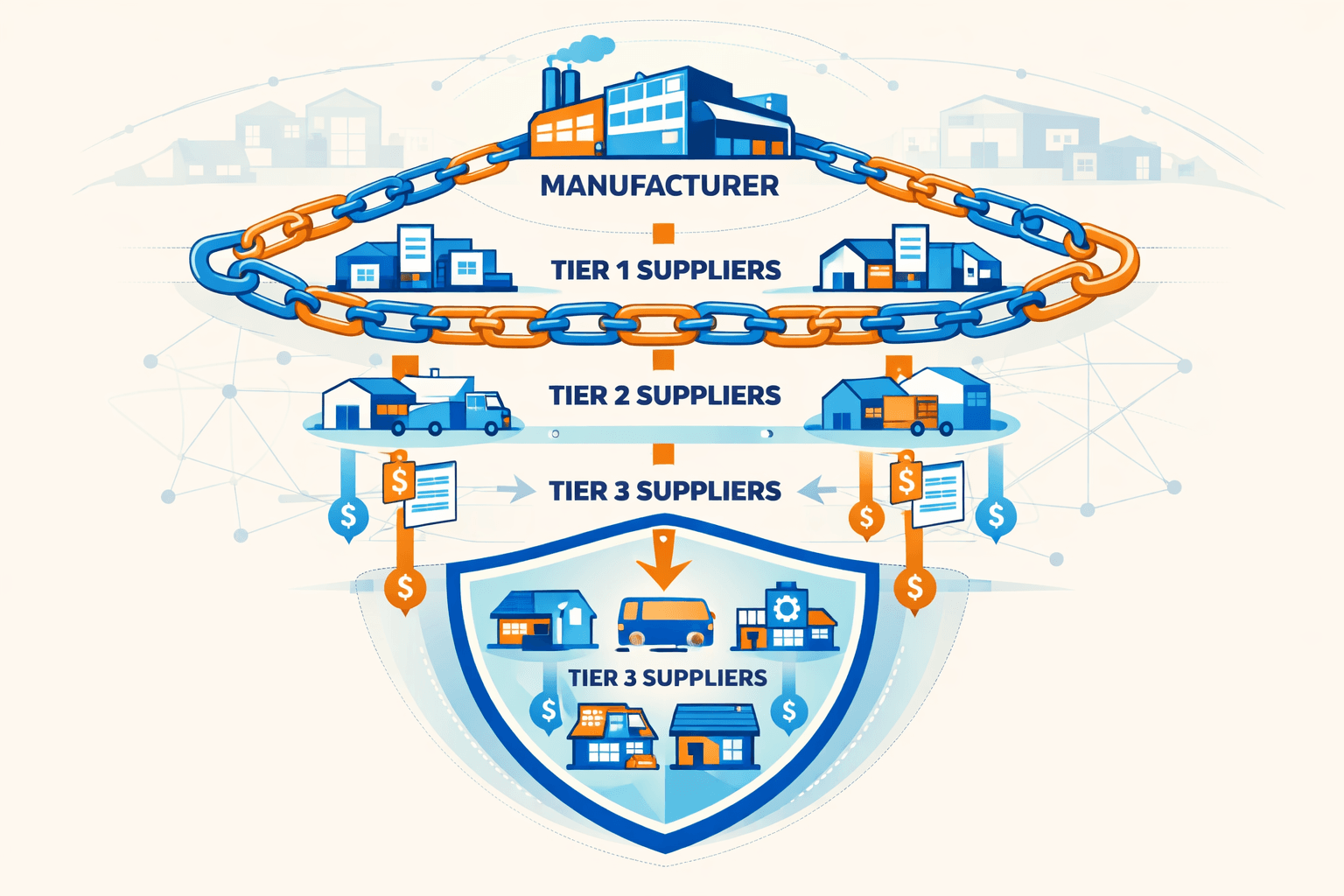
Supply chain finance protecting SME suppliers across multiple tiers
Deep-tier supply chain finance extends liquidity beyond tier-1 suppliers to reach the SMEs that need it most.
Share
Facebook Twitter LinkedIn Pinterest Email Copy Link

Supply chain finance keeps small suppliers alive by closing the gap between delivering goods and getting paid. Yet most supply chain finance programs only reach tier-1 suppliers, leaving the deeper tiers to fend for themselves. So we asked four industry leaders a straightforward question: what role does deep-tier supply chain finance play in preventing SME supplier failures?

Their answers point to a consistent theme. The biggest risk in any supply chain is not at the top, where everyone is watching. Instead, it hides three or four levels down. That is where small businesses front tens of thousands in materials and then wait months for payment. Consequently, when one of those invisible suppliers fails, the ripple effect can take down entire production lines. Often, the anchor buyer does not even realise something went wrong until shipments stop.

The Invisible Fragility Below Tier 1

In fact, most companies have no idea who supplies their suppliers. According to McKinsey, only 30% of businesses have supply chain transparency beyond their direct partners. Meanwhile, Dun & Bradstreet reports that 85% of major supply chain disruptions originate at tier-2 or below.

This blindness creates a ticking clock. Consider a $500,000-per-year supplier operating on 90-day payment terms. That business has roughly $125,000 locked in receivables at any given moment. In other words, a quarter of annual revenue sits idle. Then one late payment or unexpected expense forces a choice between payroll and raw materials. In the US alone, 55% of all B2B invoiced sales are overdue. Worse still, 64% of small businesses carry invoices more than 90 days past due.

Joe Spisak, CEO of Fulfill.com, has watched this play out firsthand across hundreds of eCommerce supply chains.

“Here’s what most people miss about supply chain finance: the fragility isn’t at the top tier where everyone’s watching. It’s three levels down where a small injection molding shop in Ohio is fronting $50K in materials to fulfill an order, then waiting 60-90 days to get paid while their own rent is due in 30.

Deep-tier supply chain finance essentially moves payment speed down the chain. Instead of that small supplier waiting 90 days, they get paid in 10-15 days through a financing mechanism where a bank or fintech advances the cash based on the purchase order from the larger buyer upstream. The bigger company still pays on their normal terms, but the small supplier gets liquidity immediately.

The math is simple but powerful. A $500K annual revenue supplier operating on 90-day terms needs roughly $125K in working capital just sitting there doing nothing. Most SMEs don’t have that cushion. One late payment or unexpected expense and they’re choosing between payroll and materials. I’ve seen it kill businesses that were otherwise healthy.”

Joe Spisak, CEO, Fulfill.com

Supply Chain Finance Depends on Data, Not Just Capital

Of course, throwing money at the problem is not enough. Effective supply chain finance requires real-time operational data to flow between procurement systems and financing partners. Without that connectivity, lenders cannot identify which suppliers need liquidity. As a result, capital never reaches the businesses that need it most.

Accordingly, Girish Songirkar, Delivery Manager at ArionERP, argues that the data infrastructure matters more than the financing itself.

“Some people look at deep-tier supply chain finance as just financing from banks. However, there can be a misunderstanding because the main issue is really one of operational data. When ERP systems do not provide real-time visibility of multi-tier procurements, financing platforms don’t know where SMEs are that most need liquidity.

The companies that are best at reducing SME failures are the ones that are able to automate the flow of information between their procurement processes and their financing partners. It is not sufficient just to offer credit. You must provide verifiable data that allows the lender to offer credit.

Ultimately, the reason for the failure of an SME supplier is most often due to a lack of communication rather than just lack of cash. Therefore, we need to create systems that establish trust through transparency.”

Girish Songirkar, Delivery Manager, Enterprise Software Engineering, ArionERP

This data-first perspective aligns with what the Asian Development Bank describes in its 2024 report on deep-tier financing. Specifically, the ADB identifies three technical models for extending financing below tier 1. These are contractual assignment, negotiable instruments, and invoice tokenisation. All three depend on verified, real-time transaction data flowing across multiple parties. Notably, platforms like Linklogis have already processed over $235 billion in supply chain assets using this approach. That covers more than 380,000 SMEs. However, outside China, deep-tier adoption remains mostly in pilot stages.

Mapping the Chain Before It Breaks

Prevention beats intervention every time. As a result, the companies getting supply chain finance right map their supplier networks before a crisis hits. The BCI’s 2025 Supply Chain Resilience Report backs this up. It found that the share of organisations analysing suppliers down to tier-4 and beyond jumped from 3.7% to 17.1% in a single year. Similarly, Gartner research shows that 77% of companies now invest in deeper supplier relationships for resilience.

Rebecca Brocard Santiago is a Florida-based accounting professional with over 15 years working with SMEs. She has seen what happens when companies take a proactive approach to supply chain finance.

“I have seen supplier failures start far below the main vendor, where small businesses lack cash and visibility. At Top Legal Services, we worked with a client who lost a key supplier because deeper tier partners were financially weak. After mapping their supply chain and improving early payments, disruptions dropped noticeably. That showed me deep tier finance is not just support, it is protection. When smaller suppliers stay stable, the whole chain holds stronger. The real value is preventing problems before they reach the surface.”

Rebecca Brocard Santiago, Owner, Advanced Professional Accounting Services

Jack Nguyen brings a Southeast Asian perspective. As CEO of InCorp Vietnam, he works across one of the world’s fastest-growing manufacturing corridors. In these markets, deep-tier supplier fragility carries even heavier consequences. That is because SMEs often lack access to formal credit altogether. For context, the World Bank estimates that 65 million firms in developing economies cite inadequate financing as a major constraint.

“Deep-tier supply chain finance can make a big difference for SMEs. Many small suppliers struggle with cash flow because payments take time. This is where deep-tier financing helps by giving them access to working capital based on their invoices, so that they don’t have to wait to get paid. With better cash flow, these businesses can meet their obligations, keep operations running smoothly and avoid financial stress that could lead to bigger issues. When smaller players are financially stable, it reduces the risk of disruptions for everyone involved.”

Jack Nguyen, CEO, InCorp Vietnam

The $2.5 Trillion Gap Still Waiting to Close

The global trade finance gap sits at $2.5 trillion, according to the Asian Development Bank. Because traditional supply chain finance programmes serve mainly tier-1 suppliers, the vast majority of deeper-tier SMEs remain cut off from affordable working capital. Meanwhile, the overall market is projected to grow from $7.5 billion to roughly $15 billion by 2033. That growth is driven by regulatory pressure and supply chain finance technology adoption.

On the regulatory front, momentum is building fast. The IFC tripled its Global Supply Chain Finance Programme from $1 billion to $3 billion. New EU late payment regulations are pushing harder on payment terms. Furthermore, the UK’s March 2026 “Time to Pay Up” legislation now mandates 60-day maximum payment windows. These caps are backed by multi-million-pound penalties. Together, these regulatory shifts create stronger incentives for anchor buyers to extend financing down the chain.

Still, the core challenge remains. Deep-tier financing only works when anchor buyers commit to extending their creditworthiness downward. It also requires data systems that connect across multiple tiers and lenders who can verify supplier performance in real time. As every one of our respondents made clear, the technology and the capital exist. What is still catching up is the willingness to look past the first handshake.

FinancialTechnology Fintech fintech growth
Share. Facebook Twitter Pinterest LinkedIn Tumblr Email

Related Posts

Wedding Data Privacy: 5 Essential Risks Every Vendor Must Know in 2026

March 30, 2026

Tradie Vehicle Finance: 5 Proven Gaps Lenders Refuse to Close

March 29, 2026

Fintech Compliance in 2026: Why Bootstrapped Founders Hold the Edge Over VC-Funded Rivals

March 29, 2026
Leave A Reply Cancel Reply

Latest news

Wedding Data Privacy: 5 Essential Risks Every Vendor Must Know in 2026

March 30, 2026

We Asked 4 Industry Leaders: How Does Supply Chain Finance Prevent SME Supplier Failures?

March 30, 2026

Uber Acquires Blacklane: 5 Essential Reasons This Deal Reshapes Luxury Mobility

March 30, 2026
News
  • AI in Finance (2,159)
  • Breaking News (298)
  • Corporate Acquisitions (89)
  • Industry Trends (57)
  • Jobs Market News (338)
  • Market Insights (337)
  • Market Rumors (308)
  • Regulatory Updates (217)
  • Startup News (1,463)
  • Technology Innovations (230)
  • uncategorized (11)
  • X Feed (1)
About US
About US

FintechBits is a blog delivering the latest news and insights in fintech, finance, and technology. We cover breaking news, market trends, innovations, and expert opinions to keep you informed about the future of finance

Facebook X (Twitter) Instagram Pinterest Reddit TikTok
News
  • AI in Finance (2,159)
  • Breaking News (298)
  • Corporate Acquisitions (89)
  • Industry Trends (57)
  • Jobs Market News (338)
  • Market Insights (337)
  • Market Rumors (308)
  • Regulatory Updates (217)
  • Startup News (1,463)
  • Technology Innovations (230)
  • uncategorized (11)
  • X Feed (1)
Happening Now

November 28, 2024

“ Intentionally collaborative ”: how the Rotman school of U of T leads Innovation Fintech

February 6, 2025

‘1957 Ventures’ to Drive FinTech Innovation in Saudi Arabia

September 10, 2024
  • About FintechBits
  • Advertise With us
  • Contact us
  • Disclaimer
  • Privacy Policy
  • Terms and services
  • BUY OUR EBOOK GUIDE
© 2026 Designed by Fintechbits

Type above and press Enter to search. Press Esc to cancel.