Author: Alena Sarri, Managing Director, Aquatots Swim School
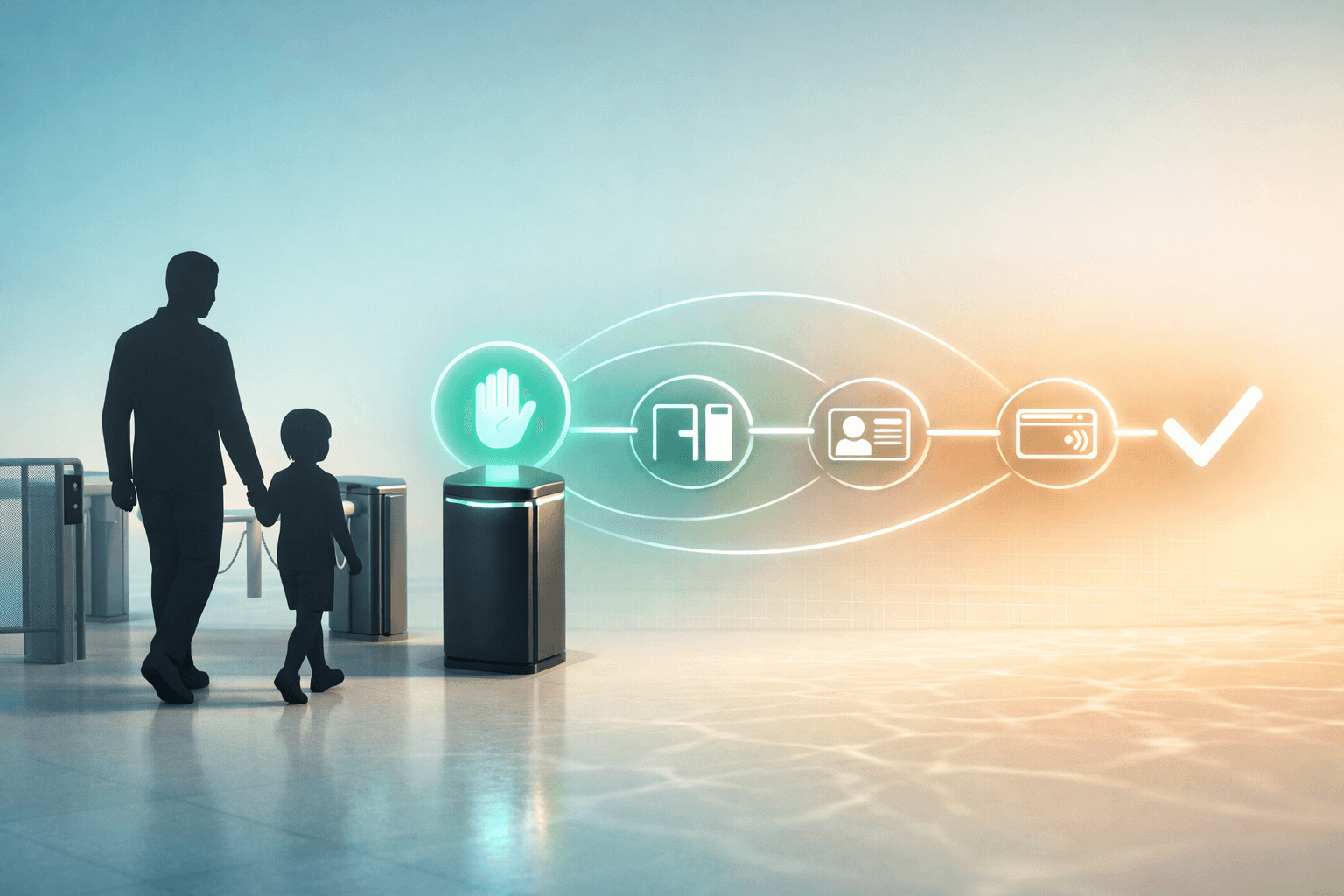
Palm scan payments are about to change how families interact with children’s service venues. Palm scan payments collapse identity verification, access authorisation, and billing into a single gesture, and that convergence matters more for child safety than it does for convenience.
Parents arrive at swim schools carrying a lot. Wallets, phones, membership cards, medical forms, photo ID for pickup authorisation. Most of it exists because the check-in desk needs to answer three questions at once: who is this person, are they authorised to be here, and how are they paying?
One palm scan could verify identity, confirm authorisation, and charge the lesson fee before a parent even reaches the change room. For children’s services, that is not a nice-to-have. It is a safety upgrade wrapped inside a payment method. And as the technology matures, the case for adopting it at children’s venues is getting harder to ignore.
Palm Scan Payments Have Left the Pilot Stage
The technology is no longer experimental. Fiserv and Clover partnered with Wink to launch face and palm payments at point of sale in January 2026. The announcement came at NRF and framed biometrics as a fusion of three functions: identity, payment, and loyalty. JPMorgan Chase is testing palm-vein payments across company facilities. In China, Tencent’s WeChat Palm Pay has passed 100 million users. Poland’s Autopay is piloting palm recognition. Singapore’s FairPrice is testing it at checkout.
Consumer adoption in Western markets is still early. Only 8% of US consumers have used palm scanning so far, compared with 45% for fingerprint and 34% for facial recognition. But the trajectory is clear. Biometric payment infrastructure is being built at scale by the same companies that process the majority of global card transactions. Amazon’s Just Walk Out stores and One palm reader have normalised the interaction for millions of shoppers. Each deployment brings palm scan payments closer to mainstream acceptance.
What most coverage misses is where palm scan payments create the most value. Retail checkout lines get faster. That is useful but unremarkable. Children’s service venues get safer. That is a different proposition entirely.
Children’s Venues Have a Verification Problem Fintech Can Solve
Every swim school, gymnastics club, and childcare centre in Australia manages a version of the same challenge. Adults drop off children. Other adults pick them up. Sometimes grandparents collect on a Tuesday. Sometimes a family friend covers pickup because both parents are stuck at work. The venue needs to confirm that every person collecting a child is authorised to do so, and the list of authorised people can change week to week.
Currently, this process runs on trust, memory, and paper lists. Staff recognise regulars. New faces get asked for a name and checked against a printed contact sheet. During busy changeover periods between classes, the system relies heavily on front-desk staff knowing hundreds of families by sight. One missed check during a chaotic Saturday morning session is all it takes for something to go wrong. Staff turnover compounds the problem. A new hire on their first weekend does not know any of the families, and the paper list only helps if they have time to use it.
Biometric check-in changes the equation. A scan at the door positively identifies every adult entering the venue. If that scan links to an authorisation record for specific children, the system confirms pickup rights without staff needing to recognise faces or check lists. If a scan returns no match, the system flags it immediately. Palm scan payments make the verification automatic rather than relying on human memory under pressure.
This is not theoretical. The same Fiserv and Wink partnership that launched at NRF 2026 specifically frames biometrics as combining identity verification, payment processing, and loyalty recognition into one interaction. For a children’s venue, substitute “loyalty” with “authorisation” and the use case writes itself.
The overlap between fraud prevention technology and child safety verification is significant. Both rely on confirming that a person is who they claim to be, in real time, with minimal friction. Tools built to stop payment fraud are the same tools that can stop an unauthorised person from collecting a child. Over the past decade, the fintech industry has spent billions perfecting identity verification for financial transactions. Children’s venues can now benefit from that investment without building anything from scratch.
How Palm Scan Payments Solve Real Operational Friction
Beyond safety, palm scan payments address practical problems that children’s service operators deal with every session.
Forgotten wallets are a constant. Parents rush from work to pickup, realise they left their card at home, and promise to pay next week. Some do. Some forget. Palm scan payments remove the dependency on carrying anything at all. Your hand is the payment method, and it is the one thing you cannot leave on the kitchen bench.
Card-on-file disputes are another headache. Parents change cards and forget to update their details. Automated term-fee charges bounce. Staff spend hours chasing failed payments instead of running programs. Because a biometric links directly to a bank account or payment credential rather than a specific card number, palm scan payments avoid the involuntary churn problem that costs subscription businesses billions globally.
Then there is speed. During peak changeover at a busy swim school, 30 to 40 families cycle through reception in under 10 minutes. Any delay at the desk creates congestion and frustration. A biometric scan that handles check-in and payment simultaneously cuts the interaction to seconds. Parents tap, confirm, and walk through. No fumbling for a card. No typing in a PIN. No signing a receipt.
Late pickups and no-shows create another layer of admin. Staff need to track which children were collected and when, often scribbling notes between classes. Palm scan payments generate a timestamped digital record of every check-in and checkout. That data feeds directly into attendance reports, billing reconciliation, and safety audits without anyone entering it manually.
The same infrastructure that supports cross-border payment innovation is now enabling identity-linked transactions at the local level. At its core, the principle is the same: reduce friction between intent and completion.
Privacy, Consent, and the Questions That Still Need Answers
Deploying palm scan payments in a children’s environment raises legitimate concerns. Biometric data for adults interacting with minors carries a higher standard of care than a retail loyalty program. Parents will want to know where their palm-vein data is stored, who can access it, and what happens if the system is breached. These are fair questions that deserve clear answers before a single scanner goes live.
Australia’s Privacy Act review is tightening requirements around biometric information, and any venue collecting it will face higher compliance obligations than standard payment data requires. This is not a reason to avoid palm scan payments. It is a reason to implement them carefully.
Consent frameworks need to be explicit. Unlike tapping a card, enrolling a biometric is a deliberate act that requires clear disclosure about data handling. Venues will need opt-in processes, alternative payment options for parents who decline, and retention policies that delete biometric templates when a family leaves the program. Transparency is not optional here. It is the foundation of trust.
The storage question matters too. Best practice in biometric security stores a mathematical template derived from the palm scan rather than an image of the palm itself. That template cannot be reverse-engineered into a usable biometric. If a database is compromised, the attacker gets a string of numbers, not a copy of someone’s hand. Venues evaluating palm scan payments should insist on this architecture and verify it with their provider before onboarding a single family.
Cost is another factor. Palm-scanning hardware and the software integration behind it remain priced for large retailers and stadium operators, not suburban swim schools. Adoption at the small-venue level depends on vertical SaaS platforms. The same software companies already handling class scheduling and billing would need to embed biometric authentication as a feature rather than a standalone investment.
The good news is that this pattern follows a familiar fintech trajectory. Payment terminals were once expensive enterprise hardware reserved for department stores and hotel chains. Now a Clover Mini sits on the counter of every second cafe. The same commoditisation will happen here. As biometric sensor costs fall and software platforms bundle the capability into existing subscriptions, the price barrier that currently locks out smaller venues will shrink year on year.
Why the Convergence of Identity and Payment Matters Most
The fintech industry spent the past decade separating identity, payment, and access into distinct problems solved by different products. Palm scan payments reunite them. For retail, that means faster checkout. For children’s services, it means a single interaction that answers the three hardest operational questions at once: who is this person, should they be here, and how do they pay?
This convergence is the same pattern reshaping broader fintech infrastructure. Separate systems are merging into unified platforms, and the venues that adopt biometric identity-linked billing early will set the standard for safety and efficiency.
Consider what a fully integrated system looks like in practice. A parent walks into a swim school, scans their palm at the front desk, and in under two seconds the system confirms their identity, verifies they are authorised to collect their child, charges the lesson fee, and logs their attendance. No wallet. No phone. No membership card. No queue. The entire interaction that currently takes 30 to 60 seconds of staff time collapses into a two-second gesture.
For venues managing hundreds of families across multiple class times, palm scan payments represent a step change in how front-desk operations work. Staff spend less time on manual verification and payment chasing and more time on what they were hired to do: teach children and keep them safe. Managers spend less time reconciling attendance against billing and more time growing the business.
Palm scan payments also open the door to smarter data. When identity, payment, and attendance sit in one system, operators can spot patterns they currently miss. Which families consistently pay late? Which children have irregular attendance that might signal a dropout risk? Which class times create the longest queues at reception? The answers sit inside the same transaction data that palm scan payments generate automatically.
Infrastructure is being built. Compliance frameworks are taking shape. And the technology is here right now. Venues that figure out palm scan payments first will set the standard. Everyone else will be catching up.
Alena Sarri is a swim school operator based in Canberra, Australia.