By Jesse Fowler, Founder of J&J Renovations and J&J Plumbing Services
Fintech for trades has quietly become the most important shift I have seen in how small contracting businesses manage money. When I started J&J Plumbing Services, my “accounting system” was a literal shoebox of receipts on top of the fridge and a spiral notebook in the glovebox. I am not proud of that. But I know for a fact that most tradies reading this are doing something similar right now.
The rise of fintech for trades is not a luxury conversation. Here is the uncomfortable truth. Construction accounts for 27% of all company insolvencies in Australia, with nearly 3,000 failures in the last financial year alone. Inadequate cashflow gets cited in more than half of those collapses. These are not big corporate meltdowns, either. Over 80% of those failed businesses employed fewer than 20 people. They look a lot like mine. They look a lot like yours.
So when people tell me I need a CFO, I push back. What I needed was a dashboard.
Fintech for Trades Changed Everything About Job Costing
For years, I would finish a bathroom renovation and feel good about it. The client was happy, the work was solid. Then three months later my accountant would tell me the job barely broke even after materials, labour, and the subbie costs I forgot to track. Sound familiar?
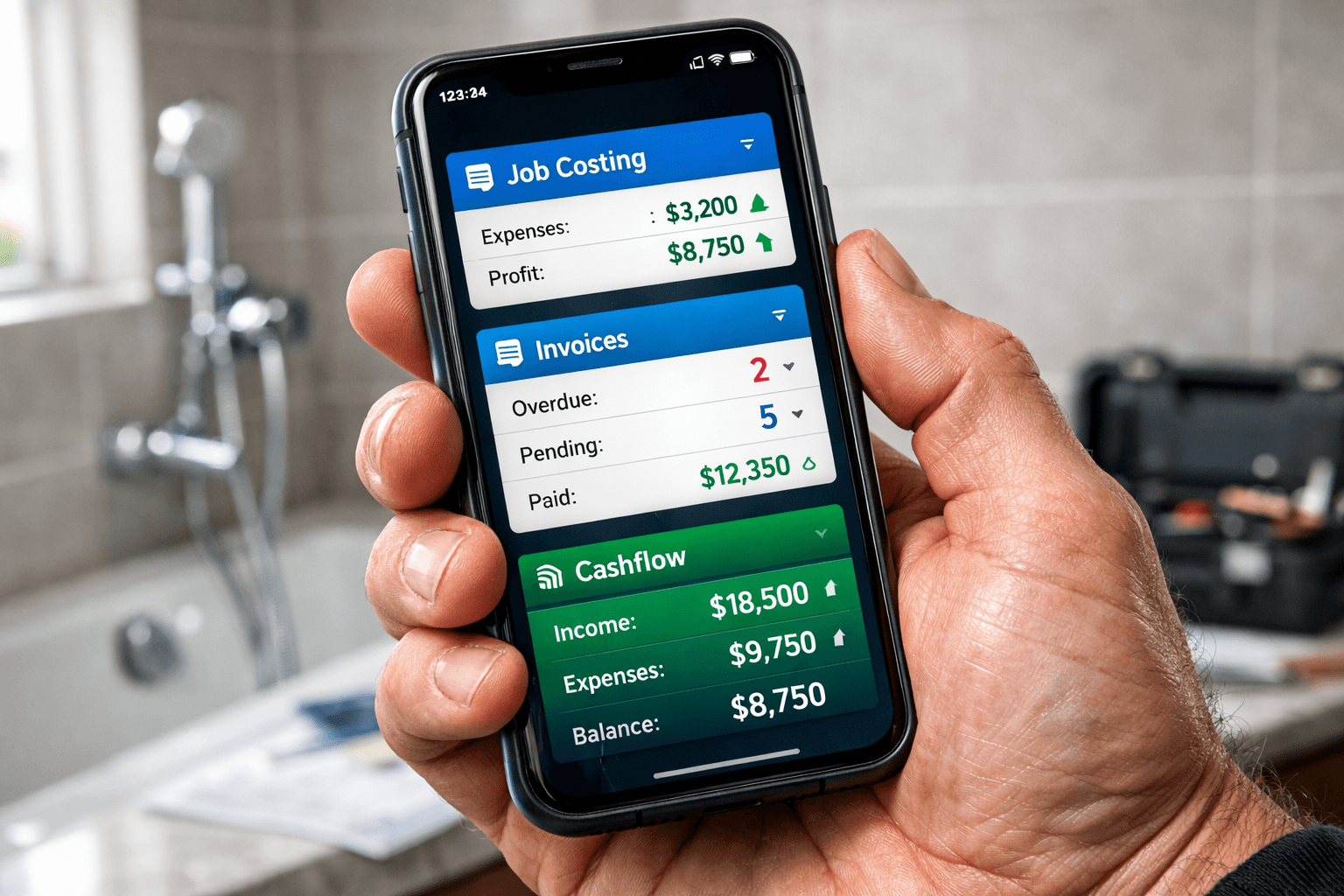
That changed when I plugged into a vertical job management platform connected to Xero. Suddenly, every quote had live material costs pulled from supplier price lists. Every hour my team logged hit the job file automatically. Every invoice synced without me touching a keyboard.
The reason fintech for trades works where generic accounting software does not is simple. Xero and QuickBooks were built for bookkeepers sitting at desks. They were not built for someone standing in a client’s laundry trying to figure out whether this callout is making money. In contrast, vertical platforms like Fergus, Tradify, and ServiceM8 were built by tradies who lived that exact problem. Fergus was created by a New Zealand plumber named Dan Pollard who went bust once and burned out once before building the tool he wished he had. That origin story matters because it means the software thinks about jobs, margins, and supplier invoices the way a contractor does.
Andreessen Horowitz published research showing that adding fintech services to vertical software can increase revenue per customer by two to five times. That tells you where the money is flowing and why these platforms keep getting better every quarter.
The Shoebox Was Costing Me Thousands
Before I had a dashboard, I was losing money in ways I could not even see. Research shows that construction net profit margins average just 3 to 6%. One underquoted job wipes out the profit from three good ones. Meanwhile, I was spending hours every week on invoicing and expense tracking instead of earning on the tools. Studies confirm small business owners spend over 20 hours a week on accounting tasks. For a tradie billing by the hour, that is real money walking out the door. Adopting fintech for trades was not about being tech-savvy. It was about survival.
The quarterly BAS nightmare made it worse. Every three months I would panic, dump receipts on my accountant’s desk, and hope nothing was missing. Meanwhile, every lost receipt meant roughly 30 to 40 cents per dollar in missed tax deductions. On $10,000 of overlooked expenses, that is up to $4,000 extra paid to the ATO for no reason.
Fintech for trades solved that by removing the data entry step entirely. When the platform captures every quote, tracks every hour, matches every supplier invoice to a specific job, and auto-generates invoices, the financial picture builds itself as a byproduct of doing the work. There is no separate “bookkeeping” task anymore. The invoice processing cost drops dramatically and errors shrink because humans are not retyping numbers between systems.
Why Vertical Always Beats Generic for Tradies
The modern fintech for trades stack has settled into a clear pattern. A vertical job management tool handles quoting, scheduling, job tracking, invoicing, and payment collection. Accounting software like Xero handles tax, BAS, payroll, and the official books. The two sync automatically in both directions.
Fergus calls itself the “system of action” while the general ledger remains the “system of record.” That distinction matters. I never need to open Xero anymore. My dashboard shows cash in, cash out, and profit per job in real time. When something looks off, I catch it the same week instead of the same quarter.
These platforms are also moving fast on embedded finance, which is the next frontier of fintech for trades. Jobber now offers business financing approved in hours rather than weeks at a bank. ServiceTitan partnered with Affirm so homeowners can split bills into monthly payments right through the platform. One contractor reported a 48% revenue increase after adding integrated financing. Fergus recently launched tap-to-pay on mobile and has BNPL support in development for 2026.
Australian platforms still trail North America on embedded lending and expense cards. Yet the infrastructure exists through Stripe to deploy fintech for trades features rapidly. The platform that first offers Aussie tradies a business line of credit based on their job pipeline data, not three years of tax returns, will earn enormous loyalty.
I am not saying a growing renovation business handling $500,000 projects with progress claims and multiple subbies can ditch financial advice entirely. Complex WIP schedules, bonding, and Payday Super compliance still demand genuine expertise. Regardless, for a sole trader or a small team running residential service work, fintech for trades has genuinely replaced the need for a dedicated bookkeeper. And it keeps getting smarter.
The question is no longer whether fintech for trades matters. Every trades business needs the dashboard. The question is whether you also need a human to interpret what the dashboard is telling you. For most of us under 20 employees, the honest answer is no.
The shoebox is dead. Good riddance.
Jesse Fowler is the founder of J&J Plumbing Services and J&J Renovations in Canberra, Australia.