Close Menu
Fintechbits
  • News
  • AI
  • Acquisitions
  • Trends
  • Insights
  • Rumors
  • Startups
  • finjobsly

Subscribe to Updates

Get the latest news from Fintechbits.

Trending Now

How Australia’s Gas Ban Created a $100 Billion Electrification Financing Gap

March 9, 2026

Failed SaaS Payments: 5 Proven Ways to Stop Losing $129 Billion in Revenue

March 9, 2026

Platform Work Directive: 5 Critical Changes Freelancer Platforms Must Prepare For

March 8, 2026

Green Lending Fintech: How Solar Installers Became Secret Lenders

March 8, 2026
Facebook X (Twitter) Instagram
Trending
  • How Australia’s Gas Ban Created a $100 Billion Electrification Financing Gap
  • Failed SaaS Payments: 5 Proven Ways to Stop Losing $129 Billion in Revenue
  • Platform Work Directive: 5 Critical Changes Freelancer Platforms Must Prepare For
  • Green Lending Fintech: How Solar Installers Became Secret Lenders
  • When Your Marketing Platform Becomes Your Payment Platform
  • Trades Businesses Don’t Need a CFO. They Need a Dashboard.
  • The Biggest Fintech Lie Is That It’s Replacing the Need for One
  • SaaS Accounting Mistakes: What Running a Subscription Business Taught Me the Hard Way
Facebook X (Twitter) Instagram Pinterest Vimeo
Fintechbits
  • News

    Affirm rises as Wall Street adopts a positive outlook on certain fintech companies following recent fluctuations.

    February 18, 2026

    The emergence of licensing for banking services as a new trend in Fintech and its implications for the financial ecosystem

    February 11, 2026

    FinTech Magazine’s Latest Issue Highlights Klarna and Stripe Discussing the Future of Cryptocurrency

    February 10, 2026

    PB Fintech shares rise over 8% following significant news regarding its fundraising strategy.

    February 5, 2026

    CBN fintech investigation report suggests significant change in regulator’s position

    February 2, 2026
  • AI

    Your Next Customer Might Not Be Human. Is Your Business Ready?

    March 3, 2026

    Why AI Quoting Will Split the Trades Industry in Two

    February 26, 2026

    How Fintech Companies Balance AI Automation With Human Expertise in Regulated Finance

    February 25, 2026

    How AI Took Over Global Finance (And Why It’s Just Getting Started)

    February 25, 2026

    Your Next Junior Hire Might Be a $50/Month Subscription

    February 24, 2026
  • Acquisitions

    What Makes a Fintech an Attractive Acquisition Target Versus One Headed for a Distressed Sale?

    February 20, 2026

    MrBeast’s Company Acquires Fintech App Targeting Gen Z

    February 10, 2026

    Capital One’s $5 billion purchase of fintech Brex may prove to be another brilliant move by billionaire Richard Fairbank.

    January 24, 2026

    Fintech Partnership Enhances UST’s Digital Banking Goals

    January 20, 2026

    CoinGecko is reportedly exploring a sale valued at $500 million.

    January 16, 2026
  • Trends

    When Your Marketing Platform Becomes Your Payment Platform

    March 8, 2026

    The Biggest Fintech Lie Is That It’s Replacing the Need for One

    March 7, 2026

    The $500B Renovation Boom Is Being Financed by Contractors, Not Banks

    March 5, 2026

    When Your Invoice Costs More to Process Than to Deliver

    March 5, 2026

    Family fintech outgrew the kids’ debit card. Here’s where it’s heading next.

    March 4, 2026
  • Insights

    Failed SaaS Payments: 5 Proven Ways to Stop Losing $129 Billion in Revenue

    March 9, 2026

    Platform Work Directive: 5 Critical Changes Freelancer Platforms Must Prepare For

    March 8, 2026

    Trades Businesses Don’t Need a CFO. They Need a Dashboard.

    March 8, 2026

    ServiceTitan IPO Embedded Finance: A Shocking $6.3B Threat to Banks

    March 7, 2026

    From the Dance Floor to the Invoice: Why the Events Industry Needs a Fintech Revolution

    March 5, 2026
  • Rumors

    Elliott and Jana Take Recent Actions Alongside Other Speculations

    February 22, 2026

    Hank Payments (TSX) Rises to CAD 0.26 on February 18, 2026: Catalyst Analysis

    February 19, 2026

    Abivax CEO refers to Eli Lilly acquisition speculation as a diversion.

    February 8, 2026

    Big Tech’s AI Investment Competition; PB Fintech Halts QIP Initiative

    February 6, 2026

    SpaceX Considers Initial Public Offering, Spirit Airlines Owner Explores Private Equity, and Other Speculations

    January 25, 2026
  • Startups

    Your Next Business Loan Will Depend on Your Carbon Footprint

    March 3, 2026

    Reasons behind creators shifting away from ad revenue towards candy bars and fintech acquisitions

    February 21, 2026

    Six entrepreneurs set to launch in the Fintech 50 in 2026

    February 21, 2026

    Inflection Point Ventures Invests INR 4 Crore in Seed Round for Fintech Startup Roopya

    February 20, 2026

    Inflection Point Ventures Heads INR 4 Crore Seed Funding for Fintech Startup Roopya

    February 20, 2026
  • finjobsly
Fintechbits
Home ยป How Fintech Is Changing the Way Family Service Businesses Get Paid
Industry Trends

How Fintech Is Changing the Way Family Service Businesses Get Paid

7 Mins Read
Facebook Twitter Pinterest Telegram LinkedIn Tumblr Email Reddit
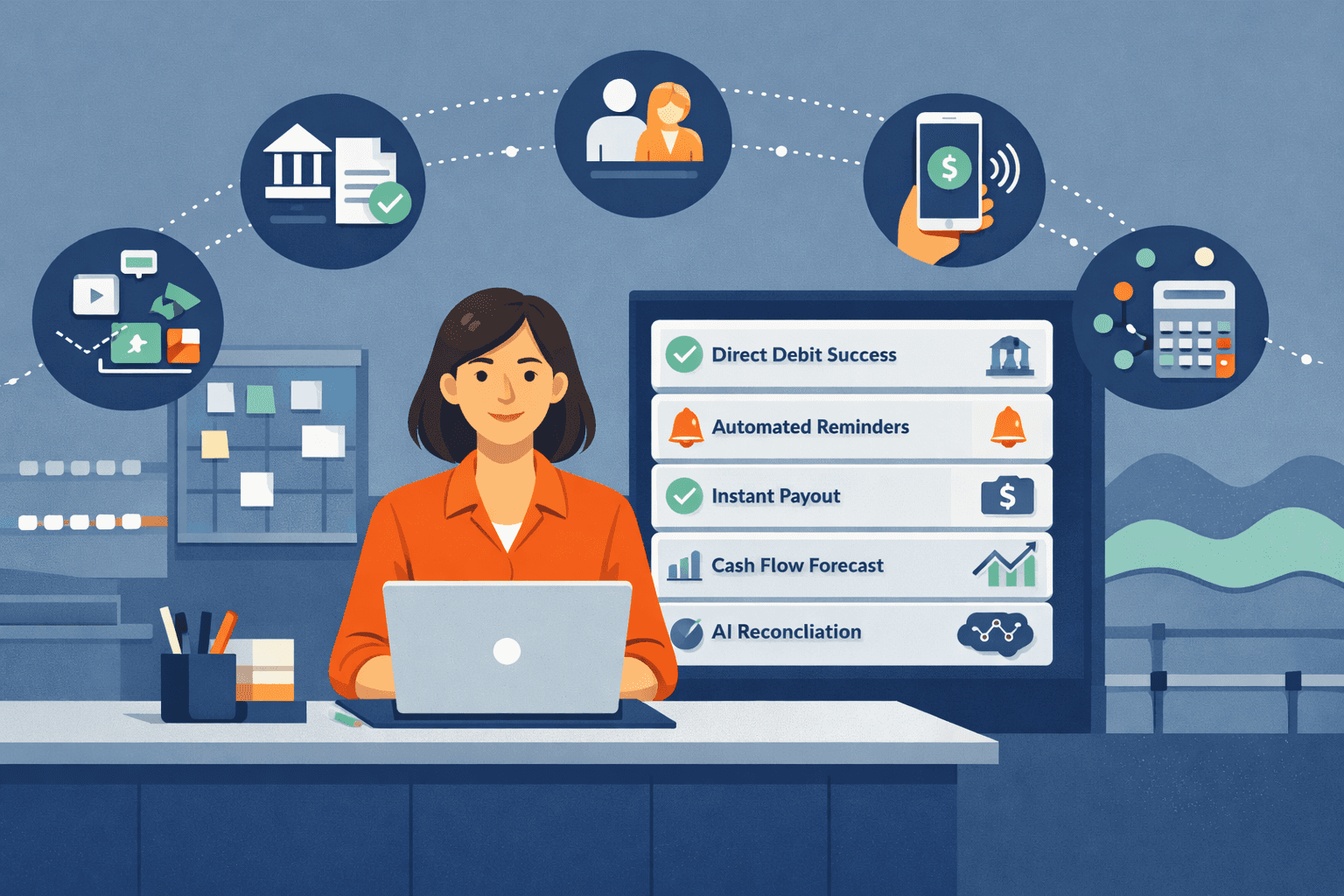
Swim school owner using fintech payment software to manage family enrolments and billing
Share
Facebook Twitter LinkedIn Pinterest Email Copy Link

Author: Alena Sarri, Managing Director, Aquatots Swim School

Family services payments have long been one of the messiest parts of running a kids’ activity business. Whether you operate a swim school, a dance studio, or a children’s tutoring centre, collecting family services payments on time and in full remains the single biggest drain on admin hours and cash flow.

Failed direct debits, expired credit cards, and seasonal enrolment dips can turn a profitable term into a cash flow headache overnight. Financial technology is catching up to this reality. The tools available to family service businesses in 2025 look nothing like what existed even three years ago. Here is what matters most for operators with 5 to 30 staff.

Family Services Payments Work Better on Direct Debit

Most swim schools and activity centres rely on term-by-term or monthly billing. Credit card payments seem convenient, but they come with a hidden cost: failure rates of 3 to 5% on average. Cards expire, get cancelled after fraud alerts, or simply hit their limit.

Direct Debit slashes that problem dramatically. GoCardless, the Official Payments Partner of Swim England, reports an average failure rate of just 0.5% for gym and wellness customers. That translates to an 80% reduction in failed family services payments compared to card-based billing. Bank account details rarely change, so once a parent sets up Direct Debit, payments flow reliably month after month.

For a swim school processing 500 monthly family services payments, the difference between a 4% and 0.5% failure rate is 17 fewer missed payments every single month. Over a year, that adds up to meaningful revenue that would otherwise require manual follow-up or write-off.

GoCardless also now offers Instant Bank Pay through open banking, letting parents make one-off family services payments directly from their bank account. This works well for trial lessons, merchandise, or make-up sessions that fall outside the regular billing cycle.

Your Booking Software Should Handle Family Services Payments Too

The most important fintech trend for family service businesses is not a standalone payment tool. It is the embedding of financial services into the management software you already use.

Swim school platforms like iClassPro offer Autopilot Billing with integrated payment processing and QuickBooks sync. iSplash, the UK’s leading swim school software, connects with both GoCardless and Stripe for flexible payment collection. Xplor Recreation provides cloud-based management with multiple payment options and open API integration.

Each of these platforms now includes parent portals where families can view schedules, manage bookings, track their child’s progress, and update payment details without calling reception. Branded mobile apps are becoming standard rather than premium add-ons.

The practical benefit is significant. When billing, scheduling, and parent communication live in one system, admin time drops and family services payments collection becomes automatic. Staff spend less time on the phone chasing overdue invoices and more time on the pool deck.

The broader family fintech sector is moving well beyond kids’ debit cards and into embedded financial tools built specifically for service operators who deal with parents every day.

Seasonal Revenue Does Not Have to Mean Seasonal Stress

Family service businesses face a challenge that construction firms and retailers do not share in quite the same way: sharp seasonal swings in enrolment. Summer programmes surge while winter terms may dip. School holidays bring intensive courses but also staff scheduling complexity.

Two fintech innovations directly address this pattern.

First, revenue-based financing ties loan repayments to a percentage of your monthly income. During a quiet winter term, repayments drop with you. When summer enrolments peak, repayments increase proportionally. The global revenue-based financing market is projected to reach $68 billion by 2029, and providers like Capchase, Lighter Capital, and Liberis are making it accessible to service businesses that would struggle with fixed monthly loan repayments.

Second, year-round billing strategies are now easy to automate. Rather than charging per term, many swim schools spread annual costs into equal monthly family services payments across all 12 months. Parents appreciate predictable spending, and the business smooths out seasonal revenue gaps. Platforms like iClassPro and GoCardless make this straightforward to set up and manage.

AI Is Shrinking the Back Office for Family Services Payments

Family service businesses typically cannot afford a full-time bookkeeper. The owner often handles reconciliation, invoicing, and tax prep on evenings and weekends.

That is changing quickly. Xero’s AI agent JAX now automates bank reconciliation, invoicing, payment reminders, and cash flow projections, with 73% of Xero customers using AI features since March 2025. QuickBooks has launched similar AI-powered accounting tools. Entry-level AI bookkeeping solutions start from $50 to $200 per month, putting them within reach of most small operators.

Cash flow forecasting tools like Float and Cash Flow Frog offer scenario planning that models enrolment peaks and off-season dips. You can test what happens to your cash position if summer enrolments drop 15%, or if you add a second pool location in March.

For a swim school owner doing the books at midnight, these tools give back hours every week. Every hour reclaimed from reconciling family services payments is an hour reinvested in the business.

Tap-to-Phone Is Opening New Family Services Payments Channels

Not every transaction fits a recurring billing model. Trial lessons, merchandise sales, event fees, and make-up sessions all generate ad hoc family services payments that fall outside the standard Direct Debit cycle.

Tap-to-phone technology fills that gap. Visa reports 200% year-over-year growth in Tap to Phone worldwide, and roughly 30% of adopters are new small businesses. For a swim instructor accepting payment poolside or at a weekend carnival, turning a smartphone into a payment terminal removes real friction from family services payments collection.

This matters especially for businesses running pop-up events, holiday programmes, or trial days at local parks and community centres. You no longer need a separate EFTPOS terminal for each location. Any staff member with a phone can accept family services payments on the spot.

The Hidden Cost of Processing Family Services Payments Manually

The cost of processing a single invoice is often higher than operators realise. Between staff time spent generating invoices, following up on missed family services payments, reconciling bank statements, and issuing receipts, each payment can cost $5 to $15 in hidden labour.

Multiply that by hundreds of families and multiple payment cycles per term, and you start to see why automation is not a luxury. It is a survival strategy.

Integrated platforms that combine booking, billing, and communication reduce the per-transaction cost of family services payments to almost zero. The software handles the entire lifecycle from enrolment through to receipt, and flags exceptions for human attention only when something goes wrong.

Event-based businesses like wedding vendors and corporate entertainment providers face similar invoicing pain points, and fintech tools built for recurring family services payments are increasingly being adapted for event-driven billing as well.

Small Changes That Add Up Fast

Three quick wins sit within reach right now. Switch recurring billing to Direct Debit if you have not already. Check whether your management software offers integrated payment processing and parent portals. Trial an AI bookkeeping feature through Xero or QuickBooks before committing to anything more complex.

The family services sector has been slower than retail or hospitality to adopt fintech tools for family services payments. That gap is closing fast. Businesses that move now will spend less time on admin, lose less revenue to failed payments, and handle seasonal swings with far more confidence.

Family services payments do not have to be the part of your business that keeps you up at night. The tools exist. The cost is reasonable. The only question is how soon you start using them.

DigitalBanking Fintech fintech growth
Share. Facebook Twitter Pinterest LinkedIn Tumblr Email

Related Posts

How Australia’s Gas Ban Created a $100 Billion Electrification Financing Gap

March 9, 2026

Failed SaaS Payments: 5 Proven Ways to Stop Losing $129 Billion in Revenue

March 9, 2026

Platform Work Directive: 5 Critical Changes Freelancer Platforms Must Prepare For

March 8, 2026
Leave A Reply Cancel Reply

Latest news

How Australia’s Gas Ban Created a $100 Billion Electrification Financing Gap

March 9, 2026

Failed SaaS Payments: 5 Proven Ways to Stop Losing $129 Billion in Revenue

March 9, 2026

Platform Work Directive: 5 Critical Changes Freelancer Platforms Must Prepare For

March 8, 2026
News
  • AI in Finance (2,157)
  • Breaking News (192)
  • Corporate Acquisitions (81)
  • Industry Trends (266)
  • Jobs Market News (338)
  • Market Insights (280)
  • Market Rumors (306)
  • Regulatory Updates (210)
  • Startup News (1,341)
  • Technology Innovations (217)
  • uncategorized (7)
  • X Feed (1)
About US
About US

FintechBits is a blog delivering the latest news and insights in fintech, finance, and technology. We cover breaking news, market trends, innovations, and expert opinions to keep you informed about the future of finance

Facebook X (Twitter) Instagram Pinterest Reddit TikTok
News
  • AI in Finance (2,157)
  • Breaking News (192)
  • Corporate Acquisitions (81)
  • Industry Trends (266)
  • Jobs Market News (338)
  • Market Insights (280)
  • Market Rumors (306)
  • Regulatory Updates (210)
  • Startup News (1,341)
  • Technology Innovations (217)
  • uncategorized (7)
  • X Feed (1)
Happening Now

November 28, 2024

“ Intentionally collaborative ”: how the Rotman school of U of T leads Innovation Fintech

February 6, 2025

‘1957 Ventures’ to Drive FinTech Innovation in Saudi Arabia

September 10, 2024
  • About FintechBits
  • Advertise With us
  • Contact us
  • Disclaimer
  • Privacy Policy
  • Terms and services
  • BUY OUR EBOOK GUIDE
© 2026 Designed by Fintechbits

Type above and press Enter to search. Press Esc to cancel.