Author: Charitarth Sindhu, Fractional Business & AI Workflow Consultant
Early payment discounts sound like a win for everyone involved. Suppliers get paid faster, buyers save money, and both sides enjoy smoother operations. Yet the reality is far more nuanced than the textbook version suggests.
We asked six business leaders across different industries one simple question: has early payment discount financing worked for your business? Their answers reveal a consistent theme. These discounts deliver results when applied with intention, but they quietly backfire when treated as a default.
Early Payment Discounts and the Hidden Math Most Businesses Ignore
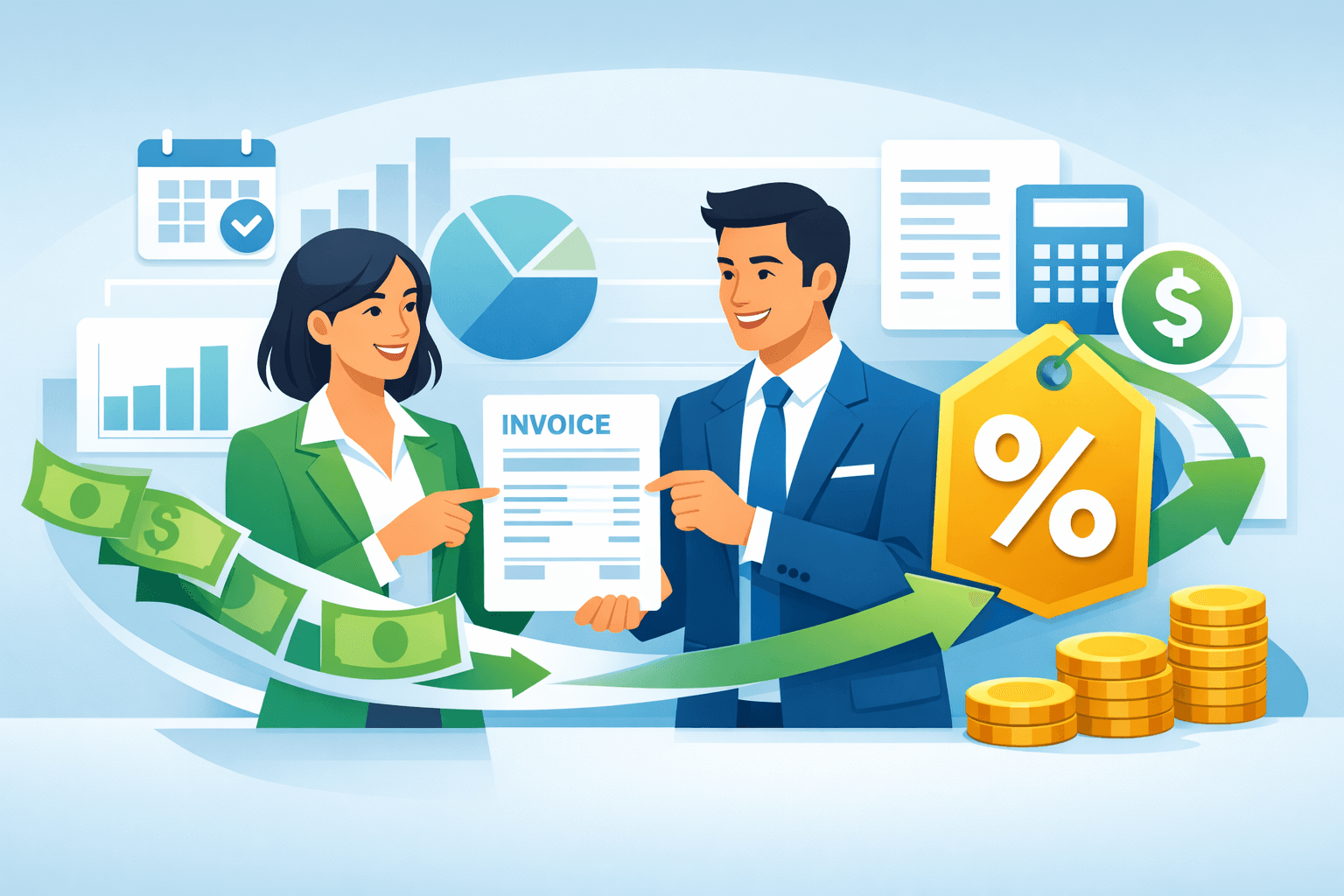
Before diving into what the experts said, it helps to understand why this topic matters so much. The classic 2/10 net 30 structure gives buyers a 2% discount for paying within 10 days instead of 30. That 2% sounds small on paper. However, the annualised return for buyers works out to roughly 36.7%. For context, that return dwarfs most short-term investment options.
On the flip side, suppliers offering that same 2% are essentially borrowing at 37% annual interest just to speed up cash by 20 days. That is more expensive than most bank lines of credit, which typically sit between 8% and 12%. So the question becomes: when does the cash flow certainty justify the margin hit?
Aditya Nagpal, who runs a global payroll and compliance platform, sees early payment discounts as a calculated trade-off rather than a blanket strategy.
Early payment discount financing can work, but only when cash flow predictability matters more than marginal margin loss. In our case, it helped smooth operations during phases where receivables timing was uncertain. As a result, we stayed focused on execution instead of collections. However, the challenge is that it can quietly become a habit rather than a deliberate choice. This is especially true if teams start relying on it without reviewing underlying payment terms. We treated it as a tactical lever, not a default approach. Ultimately, the key takeaway is to use it selectively and keep tightening core billing discipline.
- Aditya Nagpal, Founder & CEO, Wisemonk
That word “selectively” came up again and again in our conversations. In fact, research from Coupa confirms that the highest-value early payment discounts often sit with mid-size suppliers rather than the largest ones. Large suppliers typically have cheap financing options already. Consequently, they have little reason to accept meaningful discounts.
Why Every Expert We Spoke to Said the Same Thing About Early Payment Discounts
The consensus was striking. Not a single leader we interviewed recommended applying them universally. Instead, each one stressed strategic selection as the deciding factor between success and wasted margin.
Assaf Sternberg manages supplier payments across multiple manufacturing facilities. For his business, early payment discounts only make sense with partners who have a proven track record.
In our business, early payment discounts have worked when applied selectively to reliable clients. Since we manage supplier payments across multiple factories, improving cash flow predictability helps us maintain strong production timelines. Ultimately, the key is using it strategically rather than universally.
- Assaf Sternberg, Founder & CEO, Tiroflx
Brady Souden echoed a similar approach but added a seasonal dimension. His solar and electrification business faces demand swings that change how early payment discounts fit into the cash flow picture.
Running a solar and electrification business means managing payments to multiple equipment suppliers at once. As a result, early payment discounts have become a useful lever for us when cash reserves allow it. We tend to prioritise them with our key panel and battery suppliers because those relationships directly affect project timelines. However, we never treat discounts as a default setting. Instead, we assess each quarter whether the cash flow benefit justifies the margin trade-off. For seasonal businesses like ours, demand spikes during summer often mean tighter cash positions. So we pull back on early payments during peak install periods and lean in during quieter months when liquidity is stronger. The biggest lesson has been keeping it deliberate rather than automatic.
- Brady Souden, Director, Econ Energy
This seasonal lens is worth paying attention to. Research shows that 70% of suppliers report higher loyalty to buyers who offer early payment options. During supply shortages, buyers using these programs see a 35% increase in supplier prioritisation. For businesses like Econ Energy that depend on timely deliveries of panels and batteries, that loyalty translates into real competitive advantage during peak periods.
The Relationship Angle That Makes Early Payment Discounts Worth More Than the Numbers
Not every benefit shows up on a balance sheet. Jessica Liew pointed out that the relationship dynamics often matter just as much as the financial mechanics. Her team at InCorp Global has found that even partial adoption creates measurable improvements.
Early payment discounts have worked well for us at InCorp, mainly because we apply them selectively. Offering clients a small incentive to pay sooner has noticeably improved our cash flow while also reducing the time our team spends chasing overdue invoices. Beyond the financial benefit, it builds goodwill. Clients tend to see the discount as flexibility on our part, and that perception strengthens the relationship over time. Of course, not every client responds to the offer. Still, even partial adoption across our portfolio has made a measurable difference in receivables management. The key for us has been framing it as a mutual benefit rather than a blanket policy. Small incentives, applied strategically, go a long way toward both stronger cash positions and healthier client partnerships.
- Jessica Liew, Director of Business Development, InCorp Global
The data supports her experience. Companies with structured early payment discount programs report 30% fewer payment disputes and 50% lower supplier turnover. Additionally, 82% of small and medium suppliers say they prioritise orders from customers offering early payment terms. That kind of preferential treatment matters when supply chains get tight.
However, the relationship benefits only hold when the program feels genuinely voluntary. Academic research has found that buyers who extend payment terms to 90+ days while simultaneously offering early payment discounts can create a coercive dynamic. The EU recognised this risk and will cap B2B payment terms at 30 days starting in 2026, forcing a major rethink of working capital strategies across Europe.
Without Automation, Early Payment Discounts Are Just Good Intentions
Perhaps the most forceful perspective came from Girish Songirkar, whose company builds ERP solutions for exactly this kind of workflow. His argument is straightforward: manual early payment discount processes cost more to administer than they save.
Using early payment discount finance is one of the most effective ways to manage cash flow. However, when managed manually, these strategies do not yield any real benefit. The administrative load of tracking eligible invoices, checking available cash, and processing payments offsets the small savings. In contrast, early payment discounts generate real returns when the logic sits directly inside the ERP workflow. Automated triggers remove the need for human intervention, spreadsheets, or manual documentation. Consequently, the most successful organisations embed early payment discounts into their purchasing process rather than isolating them from procurement. If your team spends more time calculating whether to take a discount than it takes to make the payment, you have already lost. Furthermore, when the calculations run automatically within the accounts payable system and cash is available, the savings become a consistent method to increase working capital. Ultimately, the tools used to manage cash flow should provide relief to leadership rather than increase their workload. True efficiency comes from removing friction in these small daily transactions so leaders can focus on long-term growth.
- Girish Songirkar, Delivery Manager, Enterprise Software Engineering, Arionerp
The numbers back him up convincingly. According to Rossum’s analysis, average AP teams capture just 58% of available discounts. By contrast, teams with automation capture 85% to 95%. The Hackett Group found that best-in-class AP organisations capture seven times more early payment discounts than their peers. For a company processing $10 million in monthly invoices with 30% of suppliers offering 2% discounts, that gap translates to roughly $230,000 per year in missed savings.
Major platforms like SAP, Oracle, and Microsoft Dynamics 365 now offer built-in early payment discount automation. Oracle’s 2026 release even includes an AI-powered Payments Agent that evaluates discount opportunities and drafts supplier offers automatically. The fintech landscape has evolved rapidly in this space, with platforms like C2FO surpassing $400 billion in lifetime early payment funding.
The Bottom Line on Early Payment Discounts
Six leaders. Six different industries. One consistent message: early payment discounts work when they are deliberate, selective, and automated. They fail when they become a habit nobody questions.
The financial math overwhelmingly favours buyers who take these discounts. At the same time, suppliers should only offer them when cash flow certainty outweighs the margin cost or when cheaper financing alternatives are not available. Most importantly, automation is not optional. The difference between capturing 58% and 95% of available early payment discounts is real money that compounds over time.
Whether you run a solar installation company, a global compliance platform, or a multi-factory supply chain, the principle holds. Treat early payment discounts as a strategic lever with governance and regular review. Never let them drift into autopilot.