Author: Charitarth Sindhu, Fractional Business & AI Workflow Consultant
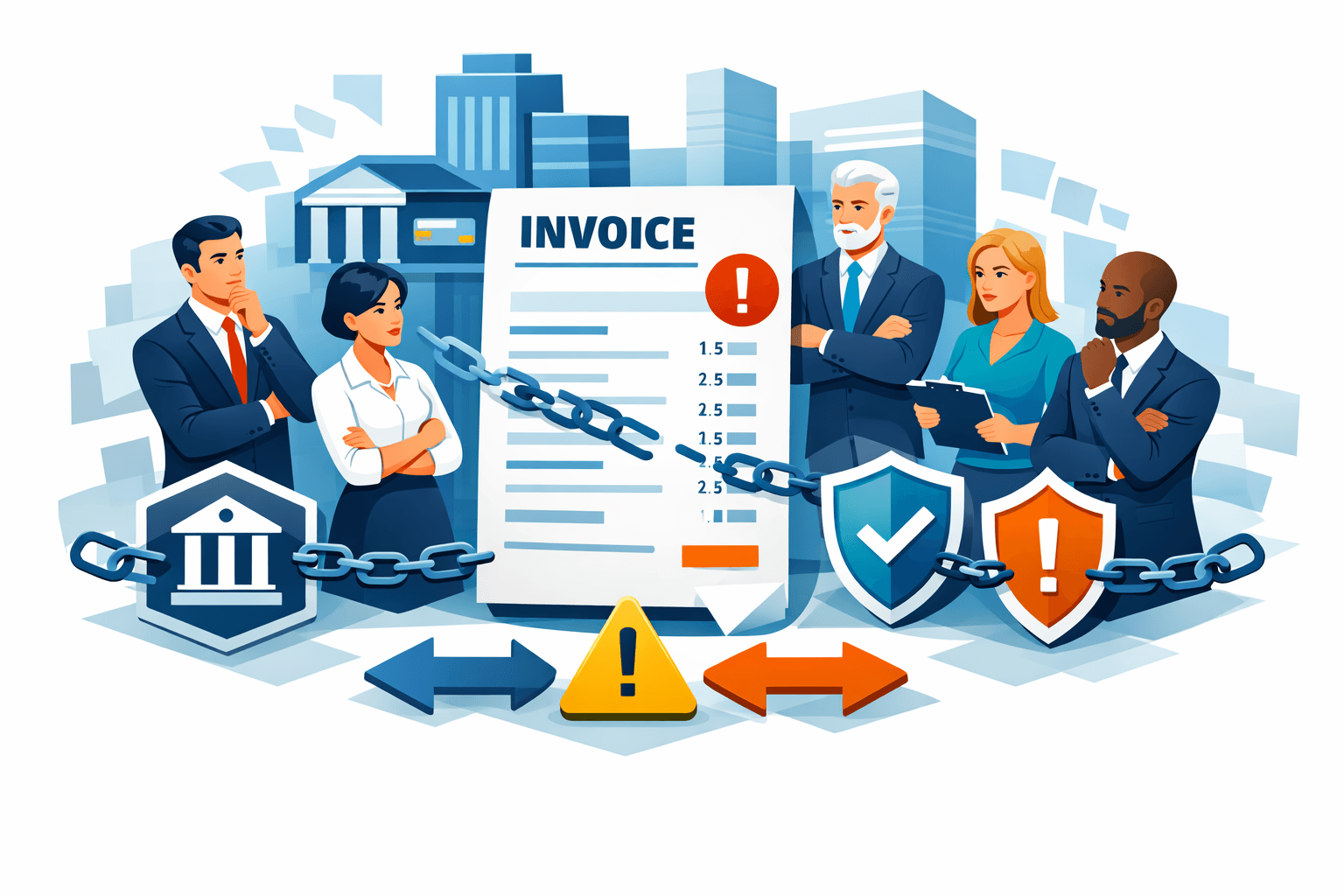
B2B invoicing should be straightforward in 2026. Send an invoice, receive payment, close the books. Yet over 50% of all U.S. B2B invoiced sales are still overdue, and 68% of companies continue processing invoices manually. So what is going wrong?
We asked six industry leaders across fintech, accounting, employee benefits, energy, steel distribution, and digital marketing to share their biggest B2B invoicing frustration this year. Their answers point to a common thread. The money moves fast, but the documentation, reconciliation, and compliance infrastructure around it has not caught up. As a result, finance teams burn hours on work that should not exist in the first place.
Here is what they told us.
B2B Invoicing and the Month-End Reconciliation Trap
The most common frustration we heard centres on reconciliation. When B2B invoicing data and payment records do not sync early in the month, revenue recognition turns into a last-minute scramble. According to the Ledge 2025 Month-End Close Benchmarks Report, 50% of finance teams take six or more business days to close their books. On top of that, reconciling bank accounts, payment processors, and credit cards ranked as the single most time-consuming close activity.
Revenue automation platform Leapfin estimates that general ledger to subledger reconciliation consumes up to 50% of an accounting team’s time. For businesses managing B2B invoicing across multiple payment processors, clearing accounts often do not tie cleanly to the ledger. Consequently, leadership cannot trust month-end numbers until well after the close window shuts. This problem is particularly acute for companies dealing with B2B payment reconciliation across fragmented systems.
“My biggest frustration with B2B invoicing in 2026 is when invoicing and payment flows are not reconciled early, turning revenue into a last-minute, error-prone step in the close. When revenue is reconciled last, deferred revenue, commissions, and cash reporting all become unreliable and force reopenings. I still see payment processor clearing accounts and AR subledgers that do not tie cleanly to the ledger or to living schedules with owners. That gap prevents leadership from using month-end numbers immediately.”
- Abhinav Gupta, Founder, Profitjets
For service businesses that juggle supplier invoices alongside government rebates, B2B invoicing reconciliation compounds even further. In the energy sector, for example, each installation can involve three or four separate supplier invoices before a single rebate clears.
“My biggest frustration with B2B invoicing in 2026 is chasing rebate reconciliation across government incentive schemes while juggling supplier invoices from multiple equipment partners. For example, when a homeowner installs solar panels through the ACT Sustainable Household Scheme, we process invoices from panel suppliers, battery manufacturers, and our in-house electricians before the rebate even clears. As a result, cash sits in limbo for weeks.
On top of that, each supplier sends invoices in a different format. Some arrive as PDFs. Others come through portal logins we need to check manually. So our admin team spends hours each week matching purchase orders to deliveries across 6,000-plus installs worth of supplier relationships. Meanwhile, the actual payment moves fast through bank transfer. The paperwork explaining what that payment covers does not.
What frustrates me most is that we run a tight ship on the job site. Every install follows strict CEC accreditation standards. Yet our invoicing workflow behind the scenes still relies on spreadsheets and manual checks that belong in 2010, not 2026.”
- Brady Souden, Director, Econ Energy
B2B Invoicing Gaps That Create Compliance Landmines
Reconciliation delays are frustrating on their own. However, compliance exposure from inconsistent B2B invoicing documentation can be outright dangerous. In the employee benefits space, misaligned billing timelines between payroll deductions, carrier invoices, and enrollment records create ERISA and COBRA risk that many small businesses overlook entirely.
The penalties for getting this wrong are steep. IRS excise taxes for COBRA violations run $100 per day per qualified beneficiary, with a minimum $2,500 penalty when discovered during audit. On top of that, DOL ERISA penalties can reach $110 per day per beneficiary for failure to provide election notices. In the 2025 case Marrow v. E.R. Carpenter Co., potential liability for a single family exceeded $700,000. These numbers make it clear that informal B2B invoicing processes carry real financial risk.
“One of my biggest frustrations with B2B invoicing in 2026 is inconsistent documentation and misaligned billing timelines that can create compliance exposure. When we uncover potential ERISA or COBRA risk during a benefits audit, my first step is always to assess the scope and exposure before reacting.
What we often find is that these invoicing gaps come from small businesses that are operating with informal processes or making quick operational decisions without realizing the compliance impact. Then we have to step in to issue corrective action plans, update documentation, and coordinate with third-party administrators, carriers, and payroll vendors to bring billing and compliance back into alignment.
It is not just an invoicing issue. It is a compliance and risk management issue, and that is how I approach it.”
- Jennifer Schaefer MBA, CLU, ChFC, RHU, REBC, SHRM-SCP, Founder & CEO, JS Benefits Group
B2B Invoicing Still Relies on Manual Payment Matching
Even when compliance is not at stake, the basic task of matching payments to invoices remains painfully manual. When businesses shifted from paper checks to ACH transfers, they lost the built-in matching mechanism. Paper checks carried remittance advice printed directly below the payment. With electronic transfers, however, that context arrives separately, in a different format, or not at all.
This is where B2B invoicing breaks down at scale. A buyer sends one ACH deposit covering five invoices with no reference number attached. The accounts team then reverse-engineers which invoices that payment covers. Versapay found that 47% of CFOs listed data reconciliation errors as their top AR challenge. For businesses exploring which fintech tools make the biggest difference to accounts receivable, the payment matching bottleneck is usually where they start.
“In 2026, my biggest frustration is that moving money is fast, but explaining why it moved is still slow. Even though we use digital payments like ACH, the paperwork behind them is often a mess. At Flexport, I saw our finance team spend thousands of hours a year just manually matching payments to invoices for multi billion dollar in revenue. We have digitized the payment process but we haven’t digitized the truth. AI is the only way forward. The future isn’t just a faster Pay button, it’s using AI to automatically link every dollar to the right invoice so humans don’t have to do the busy work anymore.”
- Karan Shah, Product Manager, Bill.com
For regional businesses competing against national chains with dedicated finance teams, every hour spent on B2B invoicing admin is an hour not spent winning the next job.
“My biggest frustration with B2B invoicing in 2026 is that the systems built for national chains do not work for regional distributors competing on speed and trust. We operate three branches across Queanbeyan, Nowra, and Moss Vale. Each branch processes orders from builders, fabricators, and contractors who need steel delivered fast and billed accurately. However, reconciling invoices across three locations with different delivery schedules creates constant friction.
In particular, partial deliveries cause the most headaches. A builder orders ten tonnes of structural steel. We deliver seven today and three next week. That single order now generates two delivery dockets, two invoices, and two payment timelines. Then the customer pays one lump sum with no reference number attached. Our accounts team has to reverse-engineer which invoices that payment covers.
As a result, we spend time on paperwork instead of building relationships with local trades. The national brands have ERP systems and dedicated finance teams to handle this. For an independent distributor like us, every hour spent on invoice matching is an hour not spent winning the next job. That is the real cost nobody talks about.”
- Darren Tredgold, General Manager, Independent Steel Company
Where B2B Invoicing Goes From Here
The technology to fix most B2B invoicing frustrations already exists. AI-powered cash application tools now achieve 95%+ straight-through match rates. Bill.com’s AI agents cut invoice processing time by 75%. Meanwhile, ISO 20022 messaging standards embed invoice-level detail directly into payment transactions, eliminating the remittance data gap that forces manual matching.
Adoption remains uneven, though. Only 7% of CFOs report a strong impact from their AI investments so far, and 45% cite cost as the top barrier to automation. For agencies and service businesses running lean operations, this creates a particularly sharp disconnect. They can deliver results for clients in days. Yet their own B2B invoicing admin still takes days of manual cross-referencing each month. Companies weighing early payment discount financing or other cash flow strategies will struggle to act on those options until their invoicing fundamentals are in order.
“My biggest frustration with B2B invoicing in 2026 is managing recurring retainer billing across a growing client base with a global remote team. We serve around 42 clients on various monthly plans. Each one has different billing cycles, scope changes, and ad hoc project add-ons that turn simple invoicing into a tracking nightmare. Consequently, our invoicing process demands far more attention than it should for a digital services business.
On top of that, paying international contractors adds another layer of complexity. Bank transfers to the Philippines or Eastern Europe come with different processing times, currency conversions, and fee structures. So a single month of outgoing payments might involve five different platforms and three currencies. None of those systems talk to each other automatically.
What bothers me most is the disconnect between how fast we deliver results for clients and how slow the financial admin moves behind the scenes. We help businesses rank on Google within weeks. Yet reconciling our own books at month end still takes days of manual cross-referencing. For an agency built on efficiency, that gap between service delivery and financial operations feels like an obvious problem that should have been solved by now.”
- Callum Gracie, Founder, Otto Media
The pattern across all six responses is unmistakable. B2B invoicing frustrations in 2026 are not about moving money. They are about the documentation, reconciliation, and compliance processes that were never rebuilt for a digital payments era. Whether you run a solar installation company in Canberra, a steel distributor in regional NSW, or a fintech platform processing $95 billion per quarter, the core problem is the same. The payments are digital. The paperwork is not. And until that gap closes, B2B invoicing will remain the bottleneck nobody budgeted for.