

By Raul Tudor, Fractional Chief Technology Officer, Tudor Software House
Expense management workflow design at most companies still follows a strangely outdated pattern. An employee pays out of pocket, uploads a receipt, waits for approval, and finance reconciles everything days, or often weeks, later. The whole process feels administrative, slow, and oddly disconnected from how money moves through modern systems.
What makes this surprising is that, behind the scenes, financial infrastructure has evolved dramatically. Payments authorise in milliseconds. Card networks provide rich transaction data in real time. Yet inside organisations, expense visibility remains delayed, fragmented, and manual. The expense management workflow simply has not kept pace.
I have spent years building fintech systems. Recently as a Lead Engineer on credit card infrastructure at NewDay, and earlier as CTO of a fintech scale-up at Raindrop. So I have seen this gap from both sides. The issue is not a lack of software. Rather, traditional expense management workflow design was never built for the realities of modern financial systems.
Where the Expense Management Workflow Falls Apart
The problems with expense management workflow design are not superficial. They are structural.
First, there is a fundamental time lag. Finance teams typically only see expenses after they have already happened. By the time a receipt is submitted and approved, the money is long gone. This stands in stark contrast to card infrastructure, where authorisation decisions happen in real time, before a transaction even completes.
Second, ownership is fragmented. An expense passes through multiple hands: employee, manager, finance, accounting. Each set of hands carries different incentives. So no single system truly owns the full lifecycle. As a result, gaps, duplication, and delays appear at every handoff.
Third, reconciliation is brittle by design. Matching receipts to transactions sounds simple, yet in practice it remains error-prone. At NewDay, transaction systems revolve around precise identifiers and structured data. By contrast, expense workflows often rely on PDFs, images, and human input. So that fidelity gets lost, and ambiguity creeps in.
Finally, there is a behavioural mismatch. Employees optimise for convenience. They want to pay quickly and move on. Finance teams optimise for control and auditability. Traditional systems try to mediate between the two, but they usually frustrate both sides instead.
The outcome is a process that feels administrative because it is. Built around managing exceptions, not designing for flow. For a deeper architectural view, see our coverage of expense management architecture shifts.
Why Better Software Has Not Closed the Gap
Over the past decade, SaaS tools have improved the experience at the edges. Submitting receipts is easier. Approval flows are more structured. Mobile apps reduce friction. Yet these tools largely digitised the existing expense management workflow rather than rethinking it.
The core architecture stayed the same. Transactions happen first, documentation follows later, and reconciliation happens at the end. From a fintech perspective, that order is backwards.
In most financial systems, the biggest gains come from moving control and data capture upstream, closer to the moment a transaction occurs. So improving downstream processes without addressing this only shifts inefficiency around. According to a recent fintech.global analysis, integrating expense platforms directly with compliance systems removes manual handoffs and accelerates approvals. Yet most legacy expense management workflow tools sit downstream of that handoff, not upstream.
At Raindrop, where we worked on real financial data pipelines and compliance requirements, it became clear that post-hoc reconciliation is always the weakest link. The more you rely on humans to reconstruct what happened, the more fragile your system becomes.
The Modern Expense Management Workflow in Practice
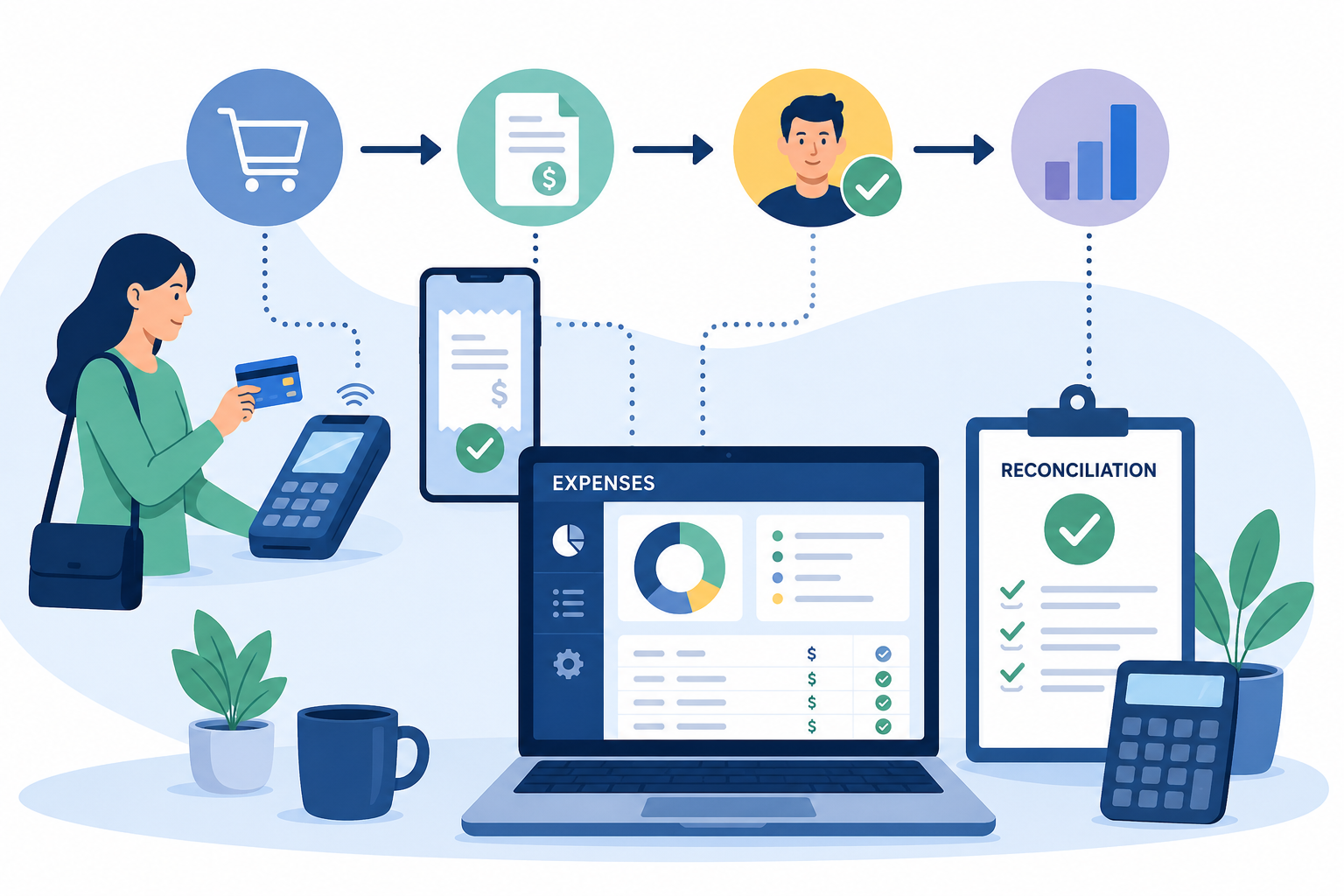
The real shift does not come from better interfaces. Instead, it comes from re-architecting the expense management workflow itself. Four design moves separate the new generation of systems from the old.
Moving from reimbursement to controlled spend. Rather than reimbursing employees after the fact, modern systems introduce controls at the point of transaction. So corporate cards, spending limits, and embedded policies replace the old approval-after-the-fact loop. This mirrors how card systems already work. At NewDay, authorisation is the critical moment. Risk gets assessed there, decisions get made there. Applying similar thinking to expenses fundamentally changes the dynamic. Control moves upstream.
Real-time data replaces batch workflows. Transactions get captured with structured metadata at the moment they occur. So later reconciliation becomes far less necessary, because the context is already attached. Rather than asking “what was this expense for” days later, the system already knows. The same logic underpins newer payment rails, as our analysis of real-time payment rails and SMB cash flow wins shows.
Policy enforcement becomes embedded. Traditional workflows rely on approval after submission. By contrast, modern approaches enforce rules during the transaction itself. Merchant restrictions, category limits, and automated checks replace manual review. As Kacey Flygare, global business head of SAP Concur, told industry analysts via Softjourn’s 2026 expense management trends report, pre-spend controls such as virtual cards and dynamic card controls will be gamechangers in how organisations control spend, lower risk, and reduce the burden of cash outlay for business expenses. So effort shifts from policing transactions to designing good policies.
Systems converge into a single source of truth. Rather than stitching together expense platforms, accounting systems, and spreadsheets, modern architectures unify transaction data, receipts, policies, and ledger integration in one place. This convergence is exactly the direction major ERPs are moving, as our coverage of NetSuite’s AI enhancements for finance teams makes clear. The insight here is simple but powerful. The more steps you collapse into a single event, the fewer opportunities there are for error.
The Hidden Complexity Beneath Every Transaction
It is tempting to assume that better expense management workflow design is just a UX problem. In reality, the complexity sits much deeper.
Payments are messy by nature. Transactions do not always settle immediately. They can be reversed, partially captured, or adjusted after the fact. Cross-border payments introduce currency considerations. Tax handling adds another layer, particularly with VAT and varying compliance rules.
At Raindrop, we saw first-hand how financial systems must balance user experience with strict auditability. Every transaction needs a clear trail. Every change must be explainable.
At NewDay, working closer to the card infrastructure, it became even more apparent that what looks like a simple “payment” is a multi-step lifecycle involving authorisation, clearing, and settlement.
Modern expense tools only work when they integrate deeply with this underlying reality. The ones that succeed are not just better interfaces. They are extensions of financial infrastructure.
Where Most Businesses Still Get It Wrong
Even today, many organisations approach expense management workflow design as a tooling problem rather than a system design challenge. So they focus on choosing the “right” platform, customising approval workflows, and adding more layers of control. Yet they consistently underestimate the importance of real-time data, the complexity of integrating with accounting systems, and the value of simplifying rather than replicating existing processes.
In some cases, businesses end up recreating the same inefficiencies inside newer tools. The underlying issue remains. If the workflow itself is flawed, better software will not fix it.
The most effective expense management workflow systems do not try to optimise a broken process. They remove the need for it. A modern expense management workflow aligns control with how transactions happen, in real time, with structure built in from the start.
For businesses, the payoff goes beyond reduced admin overhead. It changes how financial decisions get made, how quickly issues get spotted, and how confidently teams can operate. The companies that get this right do not just improve efficiency. They gain clarity. They move from reconstructing the past to understanding the present.
That is the real shift fintech enables. Not better expense reports, but a fundamentally different relationship with how money moves inside an organisation.