

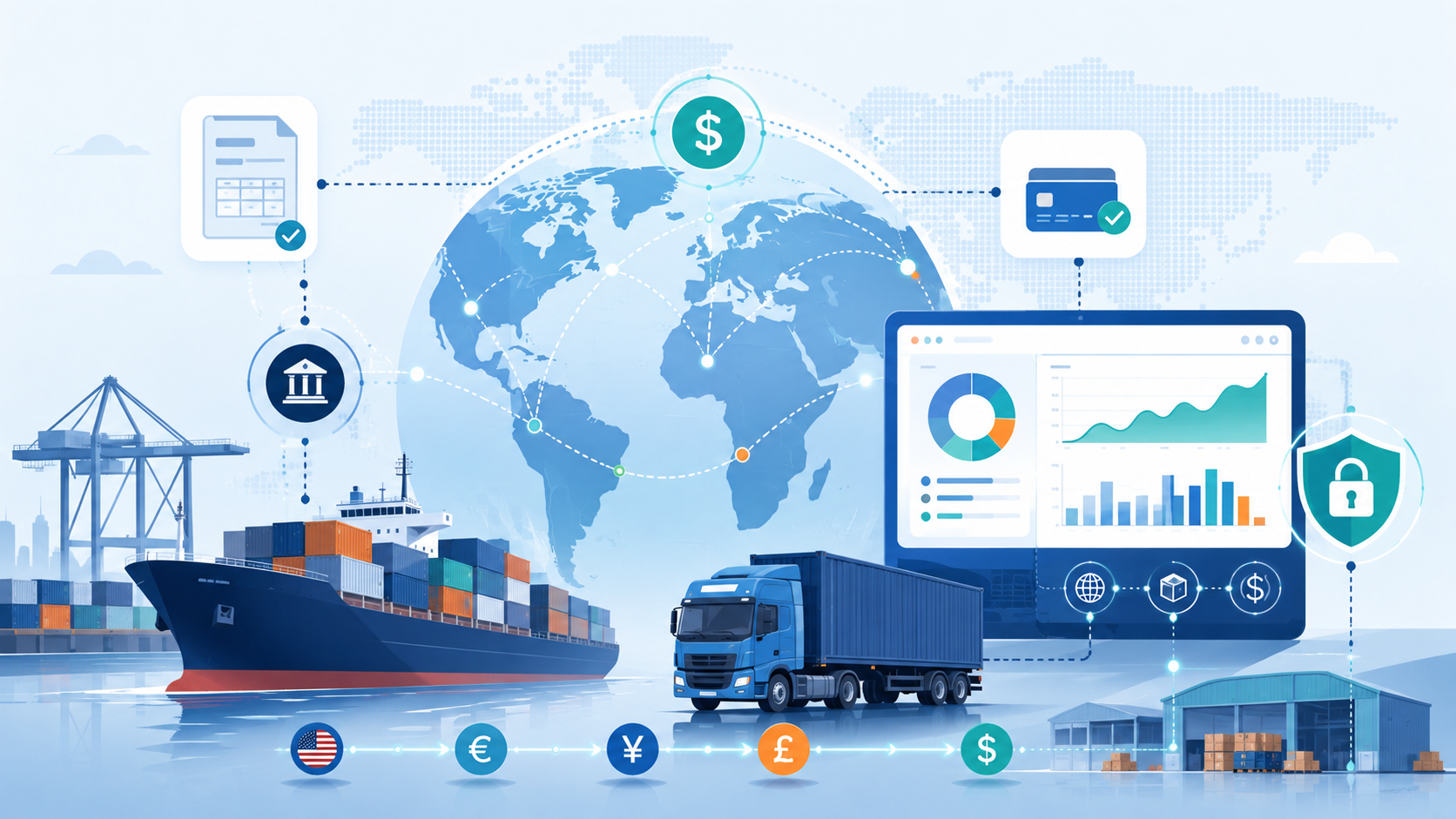
Embedded supply chain finance now drives a sharp split across global logistics. We asked four industry leaders how cross-border payments are shifting inside operational workflows. Their answers reveal who is genuinely transforming and who is polishing old plumbing. Some shippers programme money around physical container events. Most still wire dollars and pray. That gap will define winners in 2026.
Embedded Supply Chain Finance Goes Programmable
Walmart Canada built the clearest case study on the planet. Through its DL Freight system, the retailer routes GPS and IoT data from 70 carriers through Hyperledger smart contracts. Payment auto-releases on verified delivery events. Across roughly 500,000 loads per year, invoice disputes dropped from 70% to under 2%. So the pattern works at enterprise scale.
Yet beyond Walmart, true embedded supply chain finance stays narrow. Citi and Maersk run smart-contract bank guarantees triggered by vessel transit data. Meanwhile, Project44’s 2025 Intelligent TMS embeds freight audit and invoice validation directly inside the dispatch layer. Early users report 22% better billing accuracy. But for most mid-market shippers, embedded payments still trigger off invoice approval, not container telemetry.
This is where Joe Spisak, who sold his fulfillment business and now runs Fulfill.com’s 800-plus 3PL network, sees the real shift happening at ground level:
“We just helped a DTC furniture brand move their manufacturing from Vietnam to Mexico, and the payment transformation was wild. Their old setup meant waiting 45-60 days for wire transfers to clear through three different banks, each taking a cut. Now they’re using embedded finance rails where payment releases automatically when shipping containers hit certain GPS coordinates. Money moves in 48 hours instead of two months.
Here’s what I’m seeing across our 800+ 3PL network: the brands winning in 2025 are treating payments like inventory data. They’re not ‘sending money to China’ anymore, they’re programming conditional releases tied to real events. Container loaded? 30% releases. Clears customs? Another 40%. Delivery confirmed? Final 30%. The factories love it because cash flow is predictable, and brands love it because they’re not fronting six figures and praying.
The specific shift is this: payment platforms are now sitting inside the same dashboards where you manage shipments and inventory. I’m talking about tools like Flexport’s embedded financing or what companies like Veem are doing with supply chain-specific payment rails. When I sold my fulfillment company, we were still doing international wires like it was 2005. Ridiculous fees, zero visibility, constant fraud concerns.
The controversial take? Most ’embedded finance’ in logistics is still just prettier invoicing. Real transformation happens when payment timing flexes based on real supply chain events, not arbitrary NET-30 terms. One of our clients switched to a platform that pays their Chinese supplier in yuan while they pay in dollars, with the conversion happening at spot rates instead of the bank’s markup. Saved them 2.8% on every transaction. Doesn’t sound like much until you’re moving $2M annually.”
Joe Spisak, CEO, Fulfill.com
FX Math That Moves Mid-Market Books
For shippers moving real volume, foreign exchange spread is where embedded supply chain finance pays its rent. Bank wire markups run 1.5% to 4% on most B2B corridors, and over 5% on exotic pairs. Fintech-native rails post very different numbers. Wise sits around 0.45% over mid-market on major currencies. Airwallex hits 0.2% to 0.6% on majors and roughly 1% on emerging market pairs. Meanwhile, SWIFT itself reports that 75% of cross-border payments now reach the destination bank within 10 minutes.
So a $2 million annual spend through traditional correspondent banking eats $34,000 to $80,000 in pure FX markup. Switch to an embedded supply chain finance platform charging 0.5%, and the buyer keeps $20,000 to $70,000 at the bottom line. That math holds regardless of brand, vertical, or shipping lane. It also explains why B2B stablecoin volume hit $226 billion annualized in 2025, up 733% year-over-year per McKinsey and Artemis Analytics. Asian and Latin American suppliers now route around correspondent banking faster than 2023 data suggested.
Assaf Sternberg, who advises manufacturers across multiple countries, frames the operational impact this way:
“As a supply chain consultant working closely with brands and manufacturers across multiple countries, I’m seeing embedded finance fundamentally change how cross-border payments are handled. Instead of relying on fragmented bank transfers, payments are now integrated directly into sourcing and procurement workflows through platforms that provide real-time tracking, FX transparency, and faster settlement. This reduces delays between payment and production decisions, which is critical when managing supplier timelines. The biggest shift is that finance is no longer a back-office function, it’s becoming an operational lever that directly improves speed, trust, and efficiency across the supply chain.”
Assaf Sternberg, Founder & CEO, Tiroflx
The Hype Filter Most Mid-Market Misses
Here is the uncomfortable truth practitioners need to absorb. Most products marketed as embedded supply chain finance are still UX wrapping on traditional rails. McKinsey’s 2025 Global Payments Report essentially admits this, noting that broad embedded platforms lag specialists in product-specific features. So Stripe Capital, Resolve, Balance, TreviPay, and most BNPL-for-B2B players run on existing ACH and card infrastructure with conventional credit underwriting. The integration is genuinely better. The settlement architecture is not.
Yet truly transformative deployments cluster in a narrow tier. JPMorgan’s Kinexys processes $2 to $3 billion daily with Trafigura and LSEG SwapAgent live as named users. Partior runs programmable cross-border bank-deposit settlement across DBS, JPMorgan, Standard Chartered, and Deutsche Bank. HSBC TradePay handles anchor-buyer credit programs with Saint-Gobain. Beyond that tier, programmable supply-chain release stays a 2026 promise rather than a default capability for mid-market shippers.
The ADB confirms the harder truth. Its 2026 Trade Finance Gap survey puts unmet SME demand at $2.5 trillion, unchanged from 2023. So embedded supply chain finance has not yet moved the needle on the most important working capital problem. Despite marketing volume, traditional letters of credit and bank guarantees still dominate Asia and MENA flows.
Michael Kazula, who watches this space from a marketing operations angle, captures the directional shift:
“Embedded finance is revolutionizing cross-border payments in supply chains by integrating financial services directly into operational platforms. This trend alleviates challenges like high fees, lengthy processing times, and currency exchange complexities. By 2025-2026, we anticipate advancements such as instant payments, further streamlining the payment process and enhancing overall supply chain efficiency.”
Michael Kazula, Director of Marketing, Olavivo
What Ships in 2026 for Embedded Supply Chain Finance
The next twelve months bring the busiest infrastructure window in two decades. SWIFT’s ISO 20022 cross-border cutover went live November 2025. The EU Instant Payments Regulation took effect October 2025 with mandatory Verification of Payee. FedNow’s $10 million transaction limit went live November 2025. Visa launched USDC settlement on Solana with Cross River Bank and Lead Bank in December 2025. Project Nexus targets 2026 production with five Asian central banks plus the ECB and Bank Indonesia as observers.
Yet for mid-market shippers, embedded supply chain finance still trails marketing hype by about 18 months. Most production deployments handle invoice-trigger release, not container telemetry. Most cross-border payments still flow through correspondent banking with 1.7% in baked-in FX spread.
Sudhanshu Dubey, a solutions architect at Errna, frames the cultural shift this requires:
“In the past, many companies have typically processed cross-border payments as an administrative task that required batch processing but are now seeing these changes being made possible through embedded finance capabilities. By creating invoicing triggers that are put directly into the sourcing or procurement workflow, we can transition from ‘payment once verified’ to settling payments instantaneously as shipments or deliveries are tagged as verified by a secured digital milestone. The main risk decision-makers face is not with implementing new technologies but the risk of inertia and maintaining outdated or disconnected processes.”
Sudhanshu Dubey, Solutions Architect, Errna
The brands still using 2005-era trade finance in 2026 will feel like they’re sending faxes while everyone else uses Slack.