

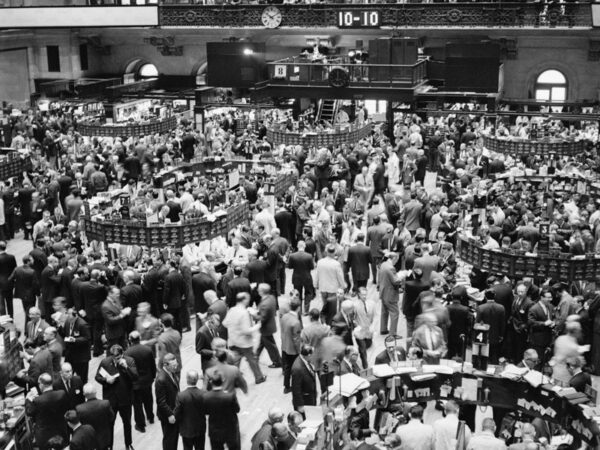
The documentary “Tune Out the Noise,” directed by Errol Morris, highlights a pivotal moment in financial history: the transformation of modern investing that originated at the University of Chicago during the 1960s and 1970s. The film, which debuted in New York in March, underscores how a group of forward-thinking economists not only challenged prevailing investment strategies but also fundamentally altered the operations of financial markets.
Before the advent of strategies grounded in data, financial markets were largely governed by intuition. Investment was predominantly seen as an art form, where seasoned professionals endeavored to outmaneuver rivals by identifying overlooked opportunities. According to Eugene Fama, a featured Nobel laureate in the film, the established view was to rely on individuals with exceptional stock-picking talents, capable of outperforming the market. However, this perspective began to dissipate with the introduction of the efficient-market hypothesis (EMH), a theory that Fama played a crucial role in developing.
The essence of the efficient-market hypothesis questions whether asset prices reflect all available information, positing that what remains is merely noise. If markets are indeed efficient, achieving consistent outperformance becomes improbable. This shift in understanding led to a focus on diversification and disciplined risk management rather than relying solely on instinct.
The timing of this economic shift coincided with a technological revolution in the 1960s, enabling investors to access detailed stock prices and company data. This newfound ability to analyze market conditions scientifically replaced reliance on instinctive approaches with data-driven investment strategies, subsequently paving the way for passive investing. As Fama notes in the documentary, “Markets work; prices are right,” suggesting that while one cannot consistently outperform the averages, embracing the market as a whole can yield better results.
Aaron Brask, a seasoned Wall Street expert and finance educator at the University of Florida, asserts that the dynamics have evolved significantly since Fama’s original dissertation. The excessive capital and analytical resources currently directing attention to investment opportunities complicate the ability to outperform the market. With less uninformed investment, market efficiency has indeed increased.
Fama’s principles ignited a financial revolution that rendered passive investing the preferred strategy for countless investors. The inception of the index fund, backed by methodologies rooted in algorithms rather than intuition, marked this shift. Wells Fargo introduced the first index fund in 1971, followed by John Bogle, who released the initial index mutual fund for individual investors in 1976. While the advantages of passive investing remain compelling, a minority of adept active managers continue to challenge this narrative, as Brask points out.
Modern portfolio theory, a cornerstone of contemporary finance, emerged from the Chicago researchers’ emphasis on diversification. Unlike traditional investors who sought out major wins, their findings advocated for a more balanced approach—mixing established stocks with promising newcomers to reduce volatility while maintaining returns.
The documentary also features prominent figures like David Booth and Rex Sinquefield, who subsequently founded Dimensional Fund Advisors, leveraging the EMH into a profitable investment entity. Despite the film’s potential advertorial nature, Morris’s stylistic approach encourages audiences to engage with the subject matter thoughtfully, encapsulating the evolution of finance from intuition-based practices to evidence-driven methodologies.
An intriguing takeaway from the film is the role of randomness in shaping the financial landscape. The documentary underscores that financial markets operate like chaotic systems, influenced more by chance than by logical decisions. The individuals instrumental in progressing passive investment were equally affected by fortunate occurrences, with significant developments occurring at the University of Chicago, particularly through the establishment of the Centre for Research in Security Prices in 1960, which provided invaluable long-term data for investors.
Although the film touches on the unintended repercussions of this intellectual shift, critiques suggest that the EMH may have inadvertently led to excesses by fostering an over-reliance on market infallibility. Critics assert that the efficacy of the EMH has encouraged complacency among investors and regulators, potentially staving off necessary vigilance against asset bubbles.
Proponents of the EMH maintain that the theory remains sound, arguing that the behavioral biases of traders persist as they did in the past. While market efficiency is not absolute, its overall status implies that active managers operate at a considerable disadvantage compared to passive strategies.
The equations underpinning various investment methodologies, such as the renowned Black-Scholes model, have also faced scrutiny, particularly for inadvertently fueling speculative trading in derivatives. Initially devised for risk management, derivatives have evolved into high-stakes gambles that contributed to the financial turbulence witnessed during the 2008 banking crisis.
Ultimately, “Tune Out the Noise” extends beyond finance, portraying a shifting American ethos increasingly at odds with the notion of passive investing. The film suggests that this acceptance of average returns is incongruent with traditional American ideals, as noted by Sinquefield. David Booth’s personal narrative also highlights this cultural contrast, illustrating the legacy of diligence and modest success juxtaposed against a landscape now dominated by speculative pursuits.
As the documentary concludes, it raises questions about the flow of information, the quest for efficiency, and humanity’s enduring challenge to distill genuine insight from overwhelming data. The EMH relies on the premise that data is a reliable indicator; however, as algorithmic trading ascends, the stability of this principle comes into question. “Tune Out the Noise” ultimately leaves viewers contemplating the premise that even the most logical frameworks derive from human assumptions, hinting that future investment revolutions might revolve around rekindling human judgment.