

Author: Callum Gracie, Founder, Gia AI
In January 2026, Google stood on a stage at NRF and launched the Universal Commerce Protocol with Walmart, Target, and Shopify. A few weeks later, Block, Anthropic, and OpenAI announced the Agentic AI Foundation to build open standards for autonomous AI systems. Mastercard followed with its Agent Suite for Q2 2026. Visa piloted Intelligent Commerce with DBS Bank in Singapore.
These are not incremental updates to existing payment infrastructure. They represent a fundamental shift in who the customer is. And most small businesses have no idea it is happening.
I run an SEO agency with 42 clients and co-founded GiaAI, an AI platform for service businesses. So I spend every day thinking about how people find, evaluate, and pay for services. What I am watching unfold right now will reshape all three of those steps within the next 18 months.
The customer is becoming a machine
OpenAI’s “Buy it in ChatGPT” went live in September 2025, charging a 4% transaction fee processed through Stripe. That means a consumer can describe what they want, and an AI agent will find, compare, select, and purchase it without the consumer ever visiting a website. McKinsey projects that agentic commerce could orchestrate $3 to $5 trillion in global retail spend by 2030.
This is not theoretical. Walmart reports that customers using its AI assistant Sparky have 35% higher order values. IBM found that 45% of consumers already use AI for part of their buying journey. The trajectory is clear. Consumers are delegating purchasing decisions to AI, and the businesses those agents choose will win.
For fintech, this creates an entirely new infrastructure challenge. When the buyer is an AI agent, the transaction requires new authentication protocols, new discovery mechanisms, and new payment rails. Visa and Mastercard are not launching agent-focused products because they think this is a trend. They are launching them because they know agents will become the dominant transaction initiator for certain categories within a few years.
Why small businesses should pay attention now
Here is the part most fintech coverage misses. The first wave of agentic commerce will not hit banks or enterprise clients. It will hit local service businesses first.
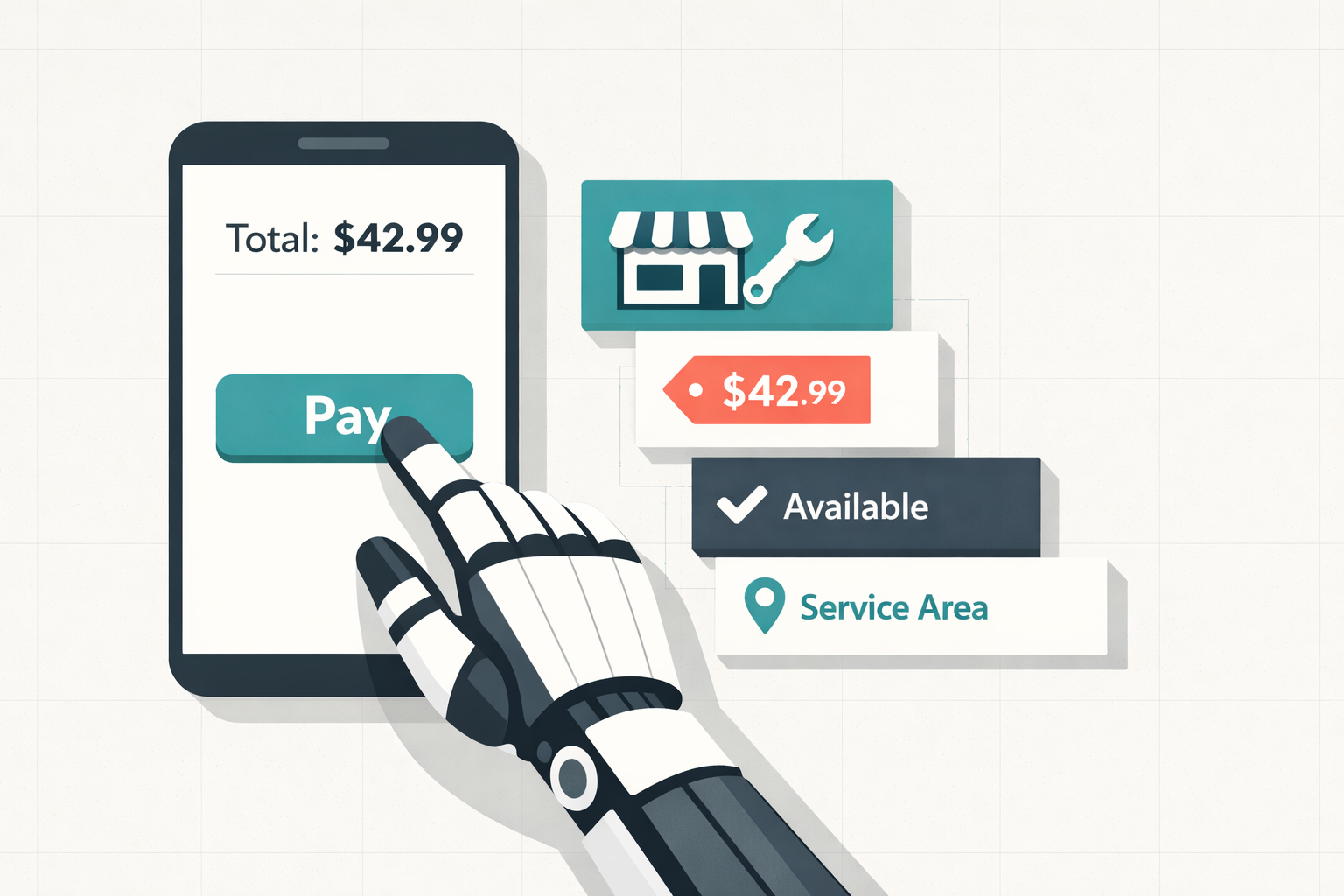
When a parent asks their AI assistant to book a plumber for Thursday afternoon, that agent needs structured data to evaluate options. It needs pricing, availability, service area, credentials, and payment endpoints. The business that provides this information in machine-readable formats gets chosen. The business that relies on a brochure website with a phone number does not.
This is where SEO transforms into something the industry is starting to call AEO, or Answer Engine Optimisation. Traditional search optimisation focused on ranking for human queries. AEO focuses on making businesses discoverable and transactable by AI agents. The difference matters enormously. A human might browse five plumber websites and choose based on reviews and gut feel. An AI agent processes structured data, compares on objective criteria, and transacts in seconds.
For my 42 SME clients, this means the stakes are changing. Being invisible to Google was bad. Being invisible to AI purchasing agents is worse, because there is no second page of results. The agent either finds you and transacts, or it picks your competitor.
The fintech infrastructure gap
The payment side of this equation is moving fast. Mastercard’s Agent Suite gives merchants tools to deploy agentic AI that can handle transactions autonomously. FIS launched what it calls an industry-first AI transaction platform to help banks lead in agentic commerce. Stripe already processes payments for ChatGPT’s commerce features. These platforms are building the rails for agent-to-business transactions.
But there is a gap between what the infrastructure can do and what small businesses have prepared for. Most SMEs still operate on manual invoicing, phone bookings, and PDF quotes. None of that is legible to an AI agent. The businesses that integrate structured product data, API-accessible pricing, and real-time payment endpoints into their operations will capture the agent-driven transaction flow. Everyone else will wonder where their leads went.
At GiaAI, we are building tools that automate lead generation for service businesses. The next step is obvious. Those tools need to make businesses not just findable by humans, but transactable by agents. That means embedding payment capabilities, availability data, and service specifications into formats that AI systems can consume and act on without human intervention.
What fintech builders should take from this
The opportunity for fintech platforms is enormous, but it requires a different product mindset. Most fintech tools serve human operators. The coming generation needs to serve two users simultaneously: the business owner and the AI agent transacting on behalf of a consumer.
Vertical SaaS platforms that combine scheduling, payments, and service data already sit in the right position. ServiceTitan, Housecall Pro, and similar platforms hold the operational data that agents need. The fintech companies that embed agent-ready commerce layers into these existing tools will capture a distribution advantage that is difficult to replicate.
For service businesses, the message is simpler. The way customers find and pay for your work is about to change in ways that make the shift from Yellow Pages to Google look gentle. The businesses that prepare now will not just survive the transition. They will be the ones the AI picks first.
Callum Gracie is the founder of Otto Media Group and co-founder of GiaAI. He works with SMEs across multiple industries and builds AI-powered tools for service businesses.