Surprisingly, Micron technology (NASDAQ:MU) The stock has had a disappointing stock market performance in 2024. It has posted gains of just 20%, despite strong results in recent quarters that point to exceptional revenue and profit growth for the company.

Shares of the memory specialist are down 27% since hitting a 52-week high in mid-June. However, it won’t be surprising to see the stock’s fortunes change after Micron reports its first quarter fiscal 2025 results on December 18.

Let’s see why this may be the case.

Micron Technology is known for manufacturing memory chips for computing and storage. This market is historically cyclical in naturebased on the demand for personal computers (PCs) and smartphones. That explains why the global memory market plunged nearly 39% last year, according to Gartner estimates, due to a 4.4% drop in shipments of PCs, smartphones and tablets.

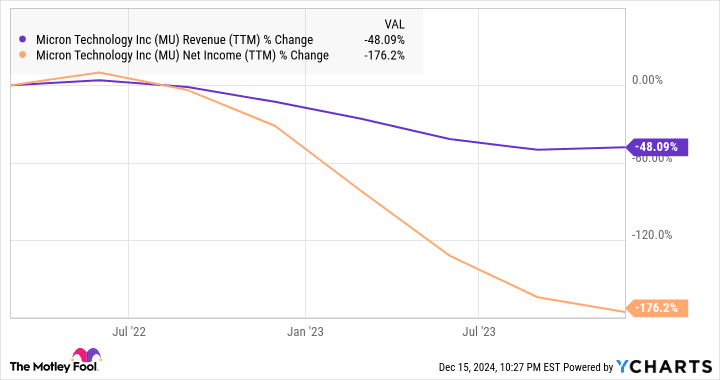
The decline in device shipments was more pronounced in 2022, with a decline of 11.9%. Unsurprisingly, Micron’s financial performance in 2022 and 2023 suffered as a result.

MU Earnings Chart (TTM)
MU revenue (TTM) data by Y charts.

However, the memory industry has seen a turnaround this year. It is driven by catalysts such as artificial intelligence (AI) which lead to increased memory consumption in several areas, such as data centers, smartphones, and PCs. For example, the use of high-bandwidth memory (HBM) in AI chips has increased at an incredible rate, as Nvidia have integrated this type of memory to make their AI accelerators more powerful.

Nvidia’s latest Blackwell B200 GPU is equipped with 192 gigabytes (GB) from HBM, which is a big improvement over the previous generation H100’s 96 GB and the H200’s 144 GB. This factor could help Micron achieve better results than expected. Indeed, when Nvidia reported its latest quarterly results last month, management emphasized that Blackwell’s production ramp-up was occurring at a faster pace than expected.

Nvidia emphasizes that it is on track to “surpass our previous Blackwell revenue estimate by several billion dollars as our supply visibility continues to increase.” This is good news for Micron, since the chipmaker has already supplied its HBM chips to Nvidia. Blackwell’s stronger demand could help it exceed market expectations. Catalysts like HBM also explain why the global memory market is expected to generate $163 billion in revenue this year, a significant increase from last year’s $92 billion.