Writer: Darren Tredgold, Common Supervisor, Independent Steel Company
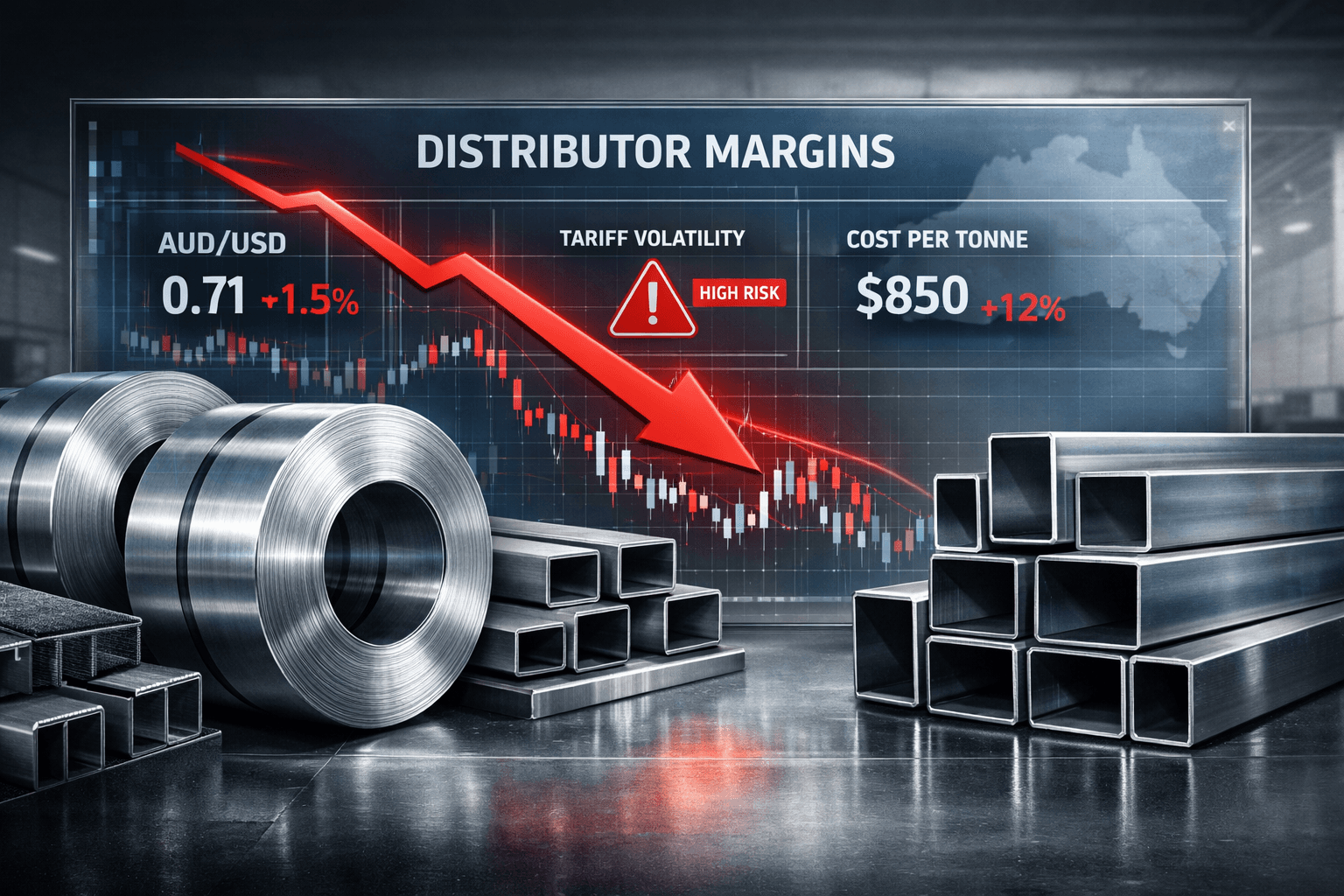
Metal foreign money danger is costing Australian SME distributors hundreds of thousands, and most of them don’t even realise it. This metal foreign money danger grew sharply between April 2025 and March 2026, when the AUD/USD charge swung from 0.5955 to 0.7147. That 12-cent transfer shifted the landed price of imported metal by roughly AUD $140 per tonne. For a mid-size distributor importing 50,000 tonnes yearly, the result’s a $6-7 million margin swing in below twelve months.
But fewer than 20% of Australian SMEs use any type of foreign money hedging. Companies constructed to chop, inventory and ship metal are as an alternative compelled to gamble on foreign money markets each time they place a purchase order order.
How Tariff Volatility Compounds Metal Foreign money Danger
Metal is priced globally in US {dollars}. So when an Australian distributor commits to a USD value with an Asian mill, they flip round and promote to clients in AUD. The hole between dedication and fee sometimes runs 6 to 16 weeks for imported metal, and that window is pure publicity.
Trump’s 2025 tariff escalation made this far worse. In February, Part 232 tariffs hit a flat 25% on all metal imports. By June, the speed doubled to 50% for many nations. These bulletins triggered wild commodity value swings alongside AUD/USD volatility, which compounded metal foreign money danger from two instructions directly.
The downstream results landed squarely on Australian distributors. China’s metal exports surged previous 110 million tonnes in 2024 and grew one other 10% by 2025 as tariff partitions redirected international provide. Low-cost metal flooding into the area pushed down the costs distributors might cost, whereas enter price volatility made margins practically unattainable to foretell. On the identical time, US hot-rolled coil surged to $975 per metric tonne in contrast with simply $410 in China. That 114% premium reshaped international commerce flows in a single day and created pricing chaos for every importer in the supply chain.
Regional Distributors Carry the Heaviest Burden
Right here is the uncomfortable reality about metal foreign money danger on the SME stage. BlueScope runs a devoted treasury crew with layered ahead contracts, commodity swaps and operations throughout 4 nations. Their North Star mill in Ohio instantly advantages from tariff-inflated US costs, giving them a pure hedge. They reported a 118% revenue improve in H1 FY2026 largely due to these tariff-protected spreads.
Regional distributors have none of this infrastructure. Research from Alt21 reveals 80% of SMEs conducting cross-currency enterprise have by no means used a hedging instrument. A Duke College research discovered corporations of this dimension hedge solely 33% of transactions on common, in contrast with 49% for big corporates.
The limitations are each structural and cultural. Australia’s Large 4 banks sometimes require minimal transaction sizes of $25,000 to $100,000. They cost SMEs margins of 2-4% versus below 1% for corporates and demand vital collateral. In different phrases, the companies most uncovered to metal foreign money danger are those least geared up to handle it.
At ISC, we see this play out consistently. Each cent of AUD/USD motion shifts landed price by AUD $10-14 per tonne on a $500 product. A 5-cent swing on a $500,000 cargo can due to this fact wipe out $50,000-80,000 in anticipated margin. On typical distributor margins beneath 10%, that’s the distinction between a worthwhile quarter and a loss.
Fintech Is Closing the Hole, however Not Quick Sufficient
A brand new wave of fintech platforms is starting to handle metal foreign money danger for SMEs, although vital gaps stay.
OFX now gives ahead contracts from as little as A$1,000 with only a 5% deposit, at FX margins of 0.4-2%. Their Digital Ahead product integrates with Xero and QuickBooks, which brings hedging nearer to the place buying selections occur. In the meantime, Airwallex gives a set 0.5% FX margin throughout all currencies and ahead contracts for patrons of any dimension. Alt21 raised $44 million together with a $12.5 million Collection A in March 2025. It positions itself because the Stripe for hedging, providing FX forwards and choices by each direct entry and a white-label banking platform.
Nevertheless, no fintech platform at present gives simplified metal commodity hedging accessible to Australian SMEs. LME futures require brokerage accounts, margin deposits of 5-15% and minimal contract sizes of 65 tonnes. The device that might let a regional distributor handle B2B payment exposure and commodity risk in a single place merely doesn’t exist but.
What distributors want is embedded FX hedging on the level of buy and real-time margin visibility connecting AUD/USD charges with HRC benchmarks. Additionally they want contract-back pricing that locks in prices the second a buyer quote goes out. These instruments would rework metal foreign money danger administration from guesswork into technique.
The Guess You Are Already Making
The forces driving volatility present no indicators of easing. US tariff coverage shifts with a single presidential announcement. Chinese language overcapacity will push international extra metal capability towards 721 million tonnes by 2027. Each buy order is a foreign money place. Every tonne on the rack is a commodity place. A buyer quote with 30-day validity is an choices contract written with out premium.
Regional distributors can’t keep away from metal foreign money danger. They will, nevertheless, cease managing it with spreadsheets and intuition. The fintech industry is waking up to this underserved market. The actual query is whether or not they may construct the built-in instruments quick sufficient, earlier than the subsequent 12-cent swing arrives.
Darren Tredgold is Common Supervisor of Unbiased Metal Firm, serving South-East NSW and the ACT from branches in Queanbeyan, Nowra and Moss Vale.