8 mins read
Stablecoins are no longer a crypto experiment. They are becoming the plumbing behind how businesses pay each other across borders.
B2B stablecoin payment volumes grew 733% year-over-year in 2025, reaching $226 billion. That is still a fraction of global B2B payment flows, but the trajectory is hard to ignore. Visa launched stablecoin settlement in the US. Stripe spent $1.1 billion acquiring stablecoin infrastructure company Bridge. Mastercard enabled stablecoin spending at over 150 million merchant locations. JPMorgan’s blockchain payments platform now processes over $5 billion in daily volume.
The message from major financial institutions is clear: this is not a side project anymore.
We asked industry leaders how stablecoins will reshape B2B cross-border payments over the next 12 months. Their answers point to a common theme: the technology is ready, the regulations are catching up, and the real challenge now is making stablecoins invisible enough that businesses can use them without thinking about blockchain at all.
The correspondent banking problem is real
Anyone who has sent money internationally through traditional banking channels knows the drill. Payments get passed between multiple correspondent banks, each one adding time and fees. The Financial Stability Board pegs average B2B cross-border costs at around 1.5%, but for smaller or more exotic corridors, fees climb much higher.
SWIFT has made progress. Around 90% of cross-border payments now reach the destination bank within an hour. But only 43% land in the final customer account within that timeframe. For many emerging market corridors, multi-day settlement is still the norm. Meanwhile, the number of active correspondent banking relationships has dropped 30% since 2011 according to the Bank for International Settlements, and Circle estimates $5 to $10 trillion sits locked in nostro and vostro accounts just to keep the system running.
Stablecoins bypass this architecture entirely. Fiat converts to stablecoins, tokens transfer peer-to-peer on a blockchain in seconds, and the recipient converts back to local currency. No nostro accounts. No batch processing. No banking hours dependency.
“The biggest change over the next year will be that we will start using stablecoins to settle all transactions instead of just using them as a speculative investment. B2B cross-border transactions have suffered for years from being stuck in a ‘black hole’ of correspondent banks, where the money has been held up for an average of three to five days before being available to the recipient. With stablecoins, those time delays can now be eliminated. Mid-market businesses will be able to access almost instant liquidity using stablecoins as their method of settlement, allowing them to access working capital that has historically been locked up in lengthy clearing/settlement cycles.”
- Sudhanshu Dubey, Delivery Manager & Enterprise Solutions Architect, Errna
The cost savings are real but not universal
Traditional international wire transfers carry sender bank fees of $25 to $75, intermediary charges of $10 to $30 per hop, FX markups of 1 to 4%, and receiving bank fees up to $25. For a $10,000 B2B payment, all-in costs typically run $160 to $530.
Stablecoin transaction costs on the blockchain are negligible. A transfer on Solana costs a fraction of a cent. The real costs sit in converting between fiat and stablecoins, typically 0.1% to 1.5% on each side. KPMG research claims stablecoins can cut costs by up to 99% in the most expensive corridors. For developed markets where costs already sit around 1.5%, savings are more modest. The credible range from non-crypto sources is 40% to 80% depending on corridor and transaction size.
“Transitioning to a programmable settlement model means that payments will no longer be interpreted purely as a message or piece of information but will become an automatic transfer of value once a smart contract has been executed. This will have a significant impact on supply chains, where a payment would be executed upon receipt of digital proof of delivery. Our own observations support industry research which shows that by moving to blockchain technology for settlement, transaction fees can be reduced by close to 80% when compared with the costs associated with traditional international wire transfers. This is much more than just a way to reduce your bank fees; it is also an opportunity for the CFOs of multinational companies to change how they manage their global cash flow and counterparty risk.”
- Sudhanshu Dubey, Delivery Manager & Enterprise Solutions Architect, Errna
Programmable payments are the real game changer
Speed and cost savings get the headlines, but programmable settlement is where stablecoins fundamentally change how B2B payments work.
Traditional cross-border payments use a messaging-based system where the payment instruction and value transfer are separate processes. With blockchain settlement, those two things happen simultaneously in a single atomic transaction. This opens the door to smart contract-triggered payments. In a supply chain context, a payment can execute automatically when a shipment clears customs or when a sensor confirms goods arrived in the right condition. Citi and Maersk have piloted this approach, cutting processing from days to minutes. Zeebu has processed over $6.8 billion in telecom B2B settlement using programmable stablecoin payments across 140+ carriers.
The integration problem is the real bottleneck
Regulation is no longer the primary barrier. The US GENIUS Act, signed in July 2025, established the first comprehensive federal framework for payment stablecoins. The EU’s MiCA regulation is fully in effect. Seven major economies now have dedicated stablecoin frameworks. Fireblocks reports fewer than 1 in 5 firms now cite regulation as a hurdle, down from 80% two years ago.
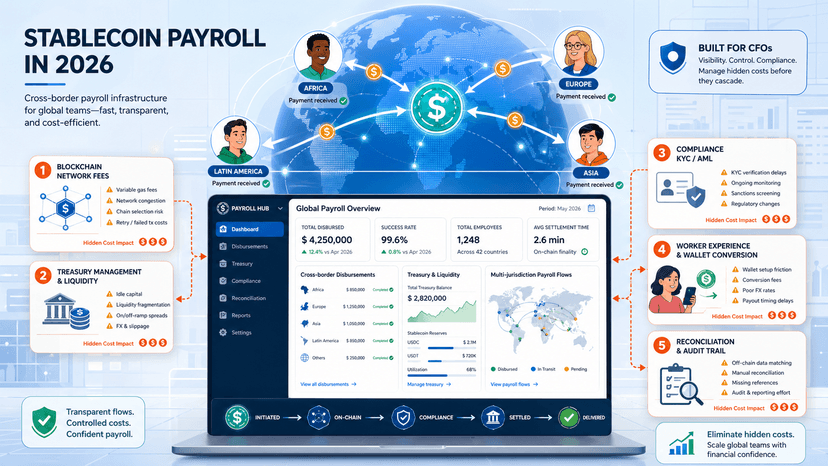
The real bottleneck is making stablecoins work with existing business systems. EY-Parthenon found that 70% of corporates would be more willing to adopt if ERP integrations were available. SAP has taken an early lead with its Digital Currency Hub, but broader adoption still requires solving accounting treatment (US GAAP has no definitive standard for stablecoins), building enterprise-grade wallet infrastructure, and ensuring seamless fiat conversion in every corridor.
“While the technology to enable these new processes is ready, the major hurdle will be integrating with legacy ERPs and finance systems. Companies that position themselves to capitalize on the opportunity associated with stablecoin settlement will be those that see stablecoins as an essential and boring infrastructure layer, rather than a financial science project or experiment. A stablecoin framework must include established governance measures and auditing processes that take precedence over the hype surrounding the underlying technology.”
- Sudhanshu Dubey, Delivery Manager & Enterprise Solutions Architect, Errna
The freelancer economy is already feeling the impact
The shift is not limited to large enterprise payments. Platforms that manage cross-border payments for freelancers and contractors are seeing stablecoins solve the same fundamental problems at smaller transaction sizes, where traditional banking friction is often worse.
“The biggest shift stablecoins will bring to B2B cross-border payments in the next 12 months is making freelancer and contractor payouts feel as simple as paying someone in your own country. Right now, when a company in Germany needs to pay a freelancer in Nigeria or the Philippines, there are layers of friction: VAT compliance, currency conversion markups, banking delays, and fees that eat into what the freelancer receives. We process payments for over 10,000 freelancers across dozens of countries, and no two corridors work the same way. That inconsistency is the real problem.
Stablecoins give us a common settlement layer that works the same whether you’re paying someone in Istanbul or São Paulo. The freelancer doesn’t need to care about which correspondent bank their payment is routed through or why it takes four days to land in their account. They just get paid. For platforms like ours that sit between businesses and global talent, stablecoins simplify the backend plumbing without changing the user experience on the front end. The company still clicks ‘pay invoice’ in their dashboard. The freelancer still sees money hit their account. What changes is everything in between gets faster, cheaper, and more predictable.
The catch is that most freelancers don’t want to hold crypto. They want local currency in their bank account. So the real opportunity over the next year isn’t convincing people to adopt stablecoins as a currency. It’s using stablecoins as invisible infrastructure, a settlement rail that platforms and payment providers use behind the scenes while the end user never has to think about blockchain at all.”
- Hasan Can Soygök, Founder, Remotify
What happens next
Citi projects a $1.9 trillion stablecoin market by 2030. Standard Chartered forecasts $2 trillion by 2028. Bloomberg Intelligence projects $5.3 trillion in stablecoin payment flows by 2026 alone.
But projections do not pay invoices. The companies that win over the next 12 months will treat stablecoins as just another payment rail. Not a blockchain revolution. Just a faster, cheaper way to move money from point A to point B. The race is no longer about the technology. It is about making it boring enough that a CFO does not need to understand blockchain to benefit from it.