Space data centers are no longer a sci-fi pitch deck fantasy. Starcloud just proved it by closing a $170 million Series A that values the company at $1.1 billion, making it one of the fastest Y Combinator graduates to reach unicorn status.
So what is driving this rush to move computing off-planet? And more importantly, can space data centers deliver on the hype before terrestrial alternatives catch up?
Here is everything you need to know.
Starcloud’s Funding Puts Space Data Centers on the Map
Benchmark and EQT Ventures co-led the round, which closed just 17 months after Starcloud’s Y Combinator demo day. That timeline alone signals serious investor conviction. EQT, for context, operates more than 70 terrestrial data centers globally, so their bet on orbital computing carries weight beyond the dollar amount.
In addition to the headline names, the round pulled in Macquarie Capital, NFX, 776 Ventures, and several notable angel investors. Among them: retired U.S. Air Force General Stephen Wilson, former Boeing CEO Dennis Muilenburg, and former Starbucks CEO Kevin Johnson.
Starcloud has now raised $200 million in total. Earlier backers include Andreessen Horowitz and In-Q-Tel, the CIA’s venture capital arm. That mix of aerospace, defense, and enterprise capital tells you exactly who sees value in space data centers right now.
Founded in January 2024 by Philip Johnston, CTO Ezra Feilden, and Chief Engineer Adi Oltean, the Redmond, Washington-based company draws heavily on its founders’ backgrounds at SpaceX’s Starlink division, Airbus, and McKinsey. Johnston holds an MPA from Harvard, an MBA from Wharton, and a CFA charter. The pedigree is not accidental. Building something this capital-intensive requires credibility with both deep-tech investors and aerospace procurement teams.
Space Data Centers Start With a Single GPU in Orbit
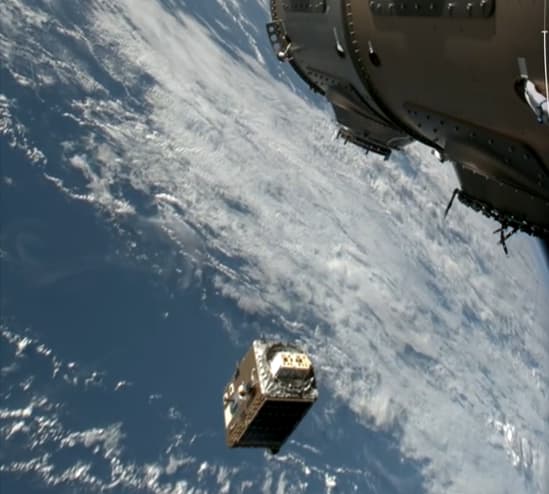
Before you build a constellation, you prove the concept. Starcloud did that in November 2025 by launching its first satellite carrying an Nvidia H100 GPU into low Earth orbit.
That 60-kilogram satellite, roughly the size of a small fridge, became the first to train a large language model in space. It also ran a version of Google’s Gemini. While the H100 may not be the ideal chip for orbital computing (CEO Philip Johnston has said as much), the mission generated critical performance data about running high-end terrestrial hardware in space.
Not everything went smoothly, however. An Nvidia A6000 GPU failed during launch, which only reinforced why collecting real-world orbital data matters more than theoretical projections.
The Roadmap: From Starcloud 2 to Cost-Competitive Orbital Computing
Starcloud’s next satellite, Starcloud 2, launches later this year with a serious upgrade. It will feature multiple GPUs, including Nvidia’s Blackwell B200 chip, an AWS server blade, and even a bitcoin mining computer. On top of that, Starcloud 2 will carry the largest deployable radiator ever flown on a private satellite to help solve one of the trickiest problems in orbital computing: cooling.
Beyond Starcloud 2, the company is developing Starcloud 3. This spacecraft is designed to launch aboard SpaceX’s Starship and will weigh three tons with 200 kilowatts of power capacity. Johnston believes Starcloud 3 will be the first orbital facility that competes on cost with terrestrial space data centers, targeting roughly $0.05 per kilowatt-hour.
There is a catch, though. That cost target depends on commercial launch costs landing around $500 per kilogram, and Starship still has not reached operational status. Johnston expects commercial access to open between 2028 and 2029, which means the full economics of space data centers remain a few years away from validation.
Why Terrestrial Constraints Are Pushing Compute Into Orbit
The business case for space data centers does not exist in a vacuum (no pun intended). Terrestrial data centers face a growing crisis of surging power demand and increasing community opposition.
Consider the numbers. Nvidia reportedly sold close to four million GPUs to terrestrial hyperscalers in 2025 alone, and the power required to run them is straining electrical grids worldwide. Meanwhile, NIMBY pushback makes permitting new facilities slower and more expensive every year. Some proposed data center projects in the U.S. and Europe have faced multi-year delays due to local opposition over noise, water usage, and grid capacity concerns.
Orbital computing sidesteps both problems. Space data centers leverage solar panels in orbit that provide near-constant renewable energy without battery storage. The vacuum of space serves as an infinite heat sink, eliminating the need for water-intensive cooling towers. According to Starcloud’s white paper, the temperature in space sits around -270 degrees Celsius, meaning waste heat can be passively radiated using deployable black panels. For companies facing multi-year permitting timelines on Earth, the appeal of launching a satellite within months is obvious.
Nvidia’s Vera Rubin Space Module Signals Industry Momentum
Starcloud is not operating alone in this emerging ecosystem. At GTC 2026, Nvidia CEO Jensen Huang unveiled the Vera Rubin Space-1 Module, purpose-built for orbital computing environments. The chip delivers up to 25 times more AI compute than the H100 for space-based inferencing.
Six companies are already partnering with Nvidia on space deployments: Starcloud, Axiom Space, Aetherflux, Kepler Communications, Planet Labs, and Sophia Space. That kind of chipmaker commitment shows space data centers have moved past the concept stage and into active hardware development.
Meanwhile, Crusoe has committed to deploying on a Starcloud satellite in late 2026, with plans to offer limited GPU capacity from its space data centers by early 2027. Johnston also points to two core business models: processing data for other spacecraft already in orbit, and eventually handling workloads uplinked from the ground as costs decrease.
SpaceX Looms as Both Partner and Competitor
The elephant in the room is SpaceX. In January 2026, the company filed with the FCC to develop a network of up to one million satellites dedicated to distributed space data centers. The filing described the constellation as a stepping stone toward becoming a “Kardashev II-level civilization.”
For Starcloud, that creates a complicated dynamic. SpaceX launches their satellites, but it could also become a direct competitor in orbital computing. Johnston, however, argues there is room for both. He points out that SpaceX’s primary focus is on running specific workloads for Grok and Tesla rather than building a broad third-party cloud platform.
Still, the SpaceX factor adds urgency to Starcloud’s timeline. In the emerging space data centers market, competing with a company that builds its own rockets, manufactures its own satellites, and has a rapidly evolving Starship program is not something any startup can take lightly.
Space Data Centers Face Real Technical Hurdles
For all the momentum, space data centers still have a list of engineering challenges to solve. Efficient power generation, thermal management, and chip reliability in high-radiation environments sit at the top. Cosmic rays can flip bits and cause resets in standard computing hardware, which means radiation-hardened components or error-correction workarounds add cost and complexity to every orbital deployment.
Synchronizing workloads across vast networks of GPUs in orbit presents another layer of complexity. Latency between ground stations and satellites, combined with the coordination required for distributed training runs, makes some AI workloads impractical in orbit today. Many industry leaders believe simpler computational tasks will need to run successfully in space before more demanding training workloads become viable. That sequencing is important because it means the full vision of orbital AI training clusters is likely a second-half-of-the-decade reality at the earliest.
Storage also poses unique constraints. Radiation-hardened SSDs with sufficient over-provisioning for multi-year wear-out rates are necessary, and traditional disk drives consume too much power while being less able to survive rocket launch conditions.
Beyond the technical side, regulatory and environmental concerns are mounting. Scientists have flagged light pollution and orbital debris risks, particularly around SpaceX’s million-satellite proposal. The American Astronomical Society has publicly called for careful evaluation of these environmental impacts.
Despite those hurdles, the investment trajectory for space data centers speaks for itself. Google’s Project Suncatcher, Aetherflux, Axiom Space, and Aethero are all pursuing variations of the same orbital computing thesis. Starcloud’s $1.1 billion valuation suggests investors believe the engineering challenges are solvable and that space data centers will eventually become a meaningful part of the global computing infrastructure.
What Comes Next for Space Data Centers
The next 12 to 18 months will be defining for the industry. Starcloud 2’s launch later this year will demonstrate whether high-power orbital computing can deliver commercially viable results at scale. If the Blackwell B200 chip performs as expected in orbit and the radiator system handles thermal loads, it will validate much of the core technology that investors are banking on.
SpaceX’s Starship development will determine how quickly launch costs fall to the levels needed for cost-competitive space data centers. The rocket’s Block 3 version is expected to fly in 2026, and commercial payload operations could begin within a couple of years after that. Every dollar per kilogram that drops off the launch cost curve makes the orbital computing thesis more compelling.
Meanwhile, Nvidia’s dedicated chip modules signal that the semiconductor supply chain is taking this market seriously. Johnston and his team are betting that by the time Starship enters commercial service, Starcloud will have the operational experience and hardware iterations to capitalize on dramatically lower launch costs.
Long-term, Starcloud envisions an 88,000-satellite constellation and even a 5-gigawatt orbital facility with solar and cooling panels spanning four kilometres. Whether that vision materializes depends on execution, timing, and a healthy dose of rocket science going right. But one thing is clear: the race is on, and Starcloud just put itself squarely in the lead.