Author: Brady Souden, Director, Econ Energy
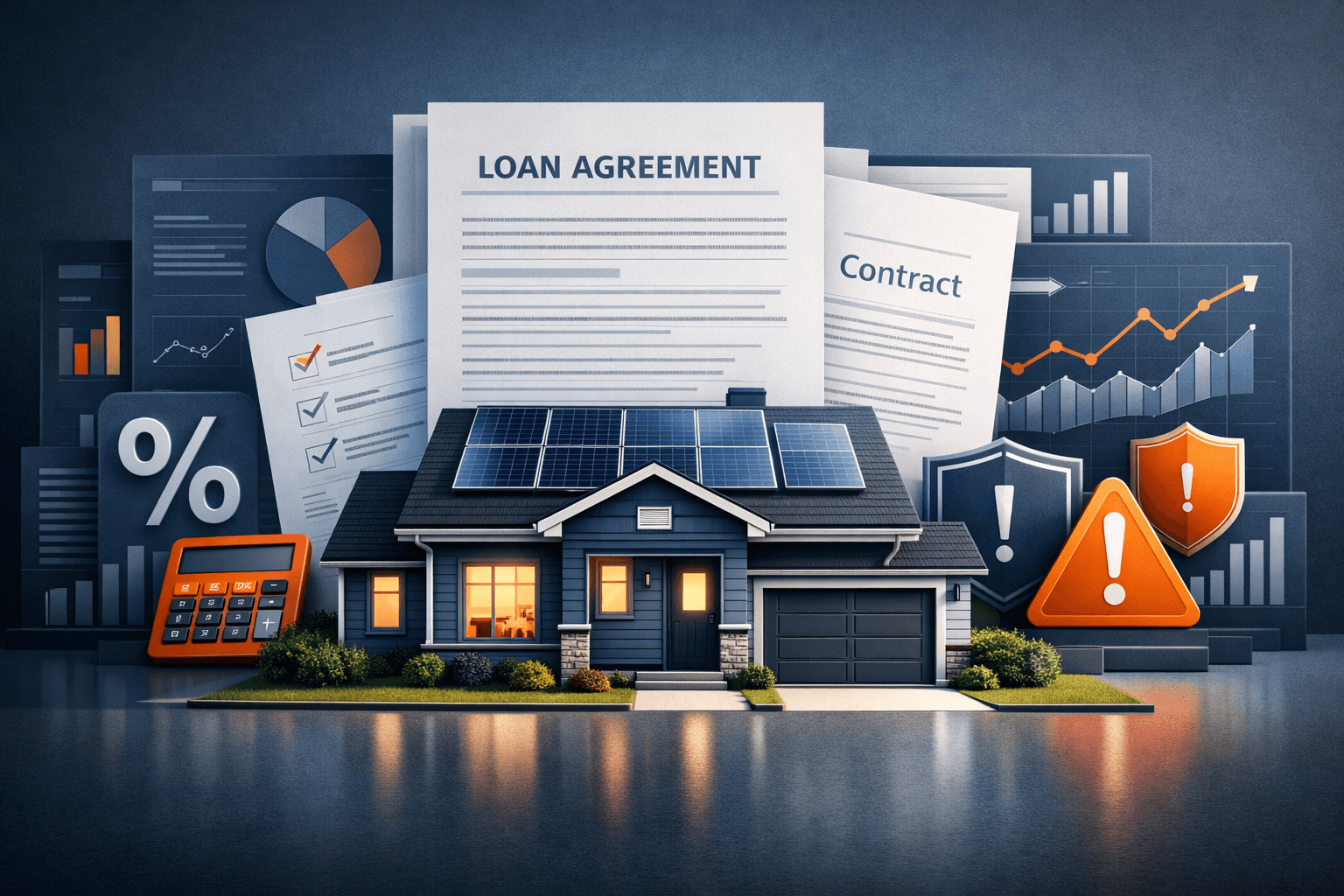
Solar financing risks are quietly reshaping how families take on household debt. When a whole-home electrification quote lands between $30,000 and $75,000, the installer standing in your living room is no longer just selling panels. They are walking you through 25-year cash flow projections, comparing loan products, and promising savings that will shape your finances for decades.
Yet here is the problem. These salespeople hold zero financial services licences. They have no training in compound interest, tax liability, or lending regulation. And the regulators tasked with protecting consumers are only now catching up.
Solar Financing Risks Start With Inflated Savings Claims
The most common solar financing risks begin with the numbers on the quote itself. Installers routinely promise annual savings of $3,000 to $6,000, lifetime returns exceeding $60,000, and home value increases of $4 per watt. However, these projections rest on assumptions about future electricity prices, net metering policies, and equipment performance that no one can predict over 25 years.
Enforcement actions tell a sobering story. The FTC settled a $13.8 million case against Vision Solar for promising 20 to 50 percent energy bill savings that were entirely unsubstantiated. Meanwhile, Pink Energy customers were told their electric bills would vanish completely. In reality, savings covered roughly 25 percent of the promised amount. The company later filed for bankruptcy with up to 50,000 creditors and $143 million in claims against just $4 million in assets.
Even more alarming, New York’s attorney general sued Attyx in March 2026 over a $275 million fraud scheme targeting 4,500 households. The company promised “free” solar through nonexistent government programmes. One senior in Queens was signed up for a $160,000 loan without her knowledge.
Hidden Fees Make Solar Financing Risks Even Worse
Beyond inflated savings, the financing products themselves carry buried costs that amplify solar financing risks for ordinary families. The CFPB found that solar-specific lenders routinely add “dealer fees” of 10 to 30 percent to loan principal without clear disclosure. As a result, a $30,000 system quietly becomes a $39,000 obligation.
These fees are excluded from the stated APR, so a loan marketed at 1.99 percent costs far more than a straightforward 7 percent product with no hidden markup. Minnesota’s attorney general sued four major solar lenders over $35 million in concealed dealer fees across 5,000 loans. Those four companies controlled roughly 80 percent of the US residential solar loan market. Two of them have since filed for bankruptcy.
PACE financing presents its own dangers. These loans attach to the property through tax assessments and carry “super-priority” lien status above first mortgages. Because major mortgage buyers refuse to purchase PACE-encumbered loans, homeowners effectively cannot sell or refinance without paying off the full balance first. The FTC sued PACE administrator Ygrene Energy Fund for deception and coercion, resulting in a $22 million judgment.
The Regulatory Gap Is Global
Understanding solar financing risks requires looking at the regulatory picture. No country has clearly defined where product sales end and financial advice begins in the home electrification space. In the US, installers making 25-year savings projections face no financial licensing requirement. The FTC demands that savings claims be substantiated, but there is no specific accuracy standard for long-term solar projections and no mandatory methodology.
Consequently, the landscape varies widely across markets. In the UK, the FCA classifies solar installers who arrange financing as “credit brokers” requiring authorisation. Still, enforcement remains inconsistent. Australia requires an Australian Credit Licence for anyone engaged in credit activities, and ASIC has taken action against solar companies offering unregulated payment plans. The Consumer Action Law Centre filed Australia’s first “super complaint” with the ACCC in 2025 targeting unsolicited solar sales nationwide.
The EU’s new Consumer Credit Directive, effective November 2026, will prohibit advertising that suggests credit improves one’s financial situation. That provision directly targets the solar financing risks embedded in marketing claims like “this system pays for itself.”
Why These Solar Financing Risks Keep Growing
The structural incentives driving solar financing risks are not going away. Commission-based compensation rewards overstatement. Same-day closing pressure discourages comparison shopping. And the dual role of product salesperson and loan broker creates conflicts of interest that voluntary industry codes struggle to address.
Professional software like Aurora Solar achieves reasonable accuracy on energy production estimates. Nevertheless, the financial projections built on top of those estimates compound assumptions upon assumptions over decades. Utility rate trajectories are unknowable. Net metering policies shift without warning. Tax credits expire unexpectedly, as the early termination of the US 30 percent solar ITC proved in late 2025.
Trust is eroding fast. Aurora Solar’s own research showed that the share of homeowners who could not find a trustworthy solar company doubled from 22 to 44 percent between 2023 and 2024. The industry’s credibility problem is now outpacing its growth.
What Needs to Change
Industry bodies have started responding. SEIA’s ANSI-approved consumer protection standard establishes sales training requirements and aims to standardise savings estimates. NABCEP’s PV Technical Sales certification covers ethical presentation and financial projection accuracy. In the UK, the Renewable Energy Consumer Code requires realistic performance estimates and conducts accuracy analyses of members’ projections.
These steps matter, but they remain voluntary. Addressing solar financing risks at scale requires structural change, not just guidelines. The jurisdictions showing the most promise are those implementing exactly that. Victoria, Australia banned door-to-door solar sales and saw doorknocking complaints drop 75 percent. The CFPB’s PACE rule, effective March 2026, applies full mortgage-style ability-to-repay protections for the first time.
For homeowners, the takeaway is straightforward. Treat every electrification quote as a financial plan, because that is what it is. Get independent financial advice before signing. Compare the installer’s savings projections against your own utility bills and usage patterns. And never sign a financing agreement on the same day the salesperson knocks on your door.
Solar financing risks will persist as long as the clean energy transition depends on commission-driven salespeople presenting complex financial instruments to families at their kitchen tables. The question is whether regulation catches up before consumer trust runs out entirely.