Author: Brady Souden, Director, Econ Energy
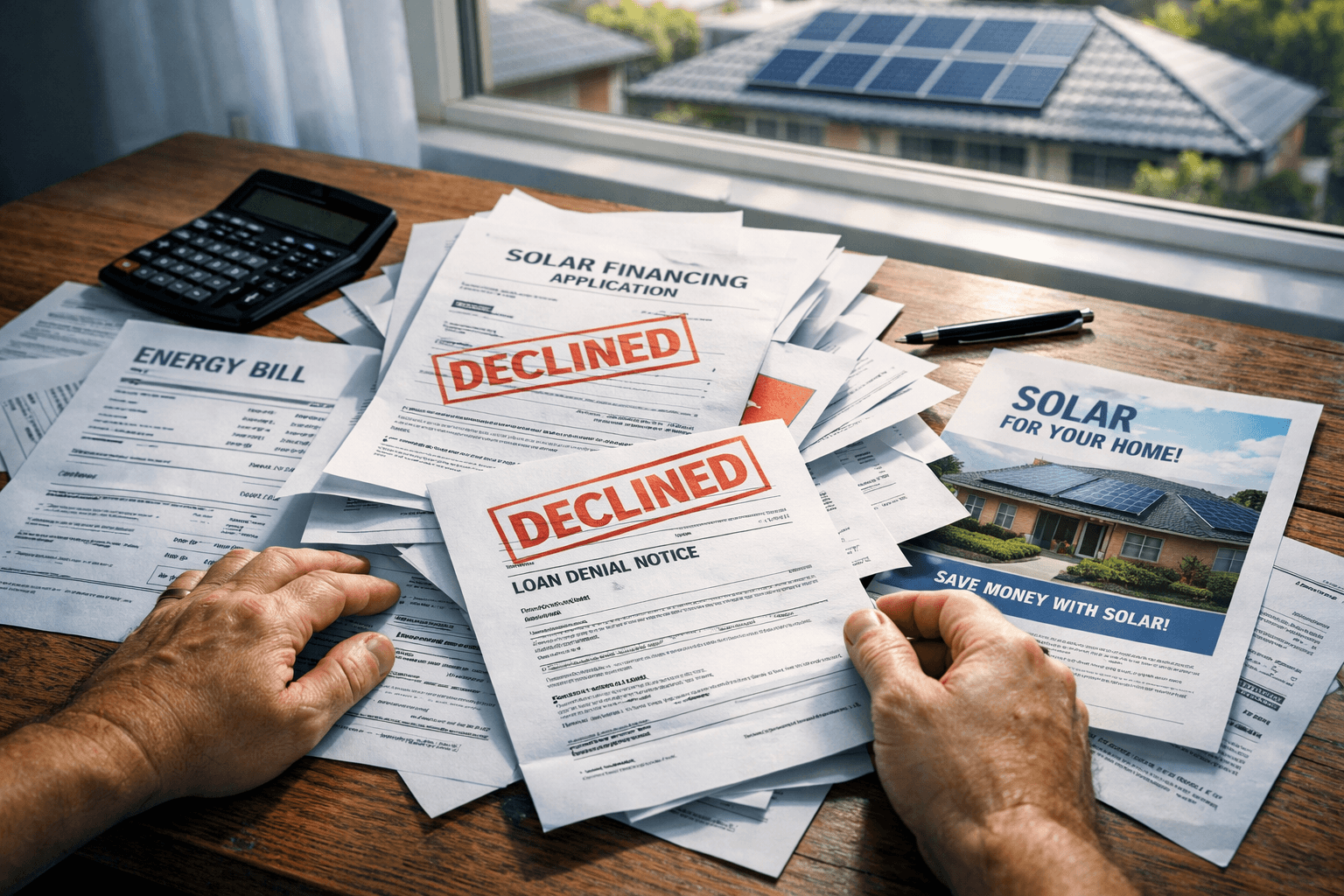
The solar financing collapse sweeping the United States should worry every Australian thinking about rooftop solar. At its core, this solar financing collapse exposed what happens when the people selling you panels, the crew installing them, and the company financing the deal are three completely separate businesses with zero accountability to each other.
I have spent 15 years in the electrical trade. With over 6,000 installs behind us at Econ Energy, my team has watched this crisis unfold with a mix of frustration and grim recognition. Because the same warning signs are showing up here in Australia.
Solar Financing Collapse: How a $15 Billion Lender Vanished in 91 Days
Mosaic Solar filed for Chapter 11 bankruptcy on June 6, 2025, with more than $15 billion in originated loans and 500,000 households on its books. Just ten days earlier, the Oakland-based lender had frozen all new lending and cut off milestone payments to its 2,000 installer partners. By September 2025, a newly created subsidiary of Forbright Bank called Solar Servicing LLC had acquired the loan portfolio. In other words, Mosaic went from billion-dollar fintech darling to liquidated shell in roughly three months.
However, Mosaic was not an isolated case. Sunnova Energy filed its own Chapter 11 three days later, carrying $10.67 billion in debt against just $13.5 million in cash. Before that, SunPower entered bankruptcy in August 2024 with $2.01 billion in liabilities. Titan Solar Power, Vision Solar, Lumio Holdings, and PosiGen all followed. According to Solar Insure, more than 100 solar company bankruptcies hit in 2024 alone.
So what drove this wave? Rising interest rates crushed consumer demand. Residential solar installations dropped 31% in 2024. Then the One Big Beautiful Bill Act killed the US residential solar tax credit seven years early. Yet the real poison was hiding in plain sight all along.
The Hidden Fee That Broke Solar Lending
At the centre of this solar financing collapse sat a mechanism most homeowners never knew about: the dealer fee. Lenders charged installers between 10% and 30% of every project’s cost simply for access to their financing platform. Installers then inflated the quoted system price to cover it. As a result, homeowners financed bloated amounts and paid interest on every dollar of the markup without ever being told it existed.
The Consumer Financial Protection Bureau laid it bare in August 2024. A solar system with a $30,000 cash price and a 30% dealer fee became a $39,000 loan. The lender pocketed $9,000 at disbursement while the homeowner paid interest on the full amount for 20 to 25 years. On top of that, lenders contractually banned installers from disclosing or explaining the fee during the sales process.
Meanwhile, the Minnesota Attorney General alleged that Mosaic and three other lenders concealed $35 million in hidden fees across more than 5,000 installations. Mosaic’s average dealer fee in that state was 17.6%, meaning the typical borrower unknowingly paid an extra $5,843. For many homeowners, the dealer fee wiped out the entire benefit of the 30% federal solar tax credit they were trying to capture.
The consequences of this solar financing collapse have been brutal. Consumer complaints reveal payment amounts changing without explanation, phantom loans for projects where panels were never installed, and communication dead zones where nobody accepts responsibility.
Why Australian Homeowners Should Pay Attention
You might assume this is purely an American problem. Still, Australia has its own version of this solar financing collapse playing out right now. More than 750 solar companies have gone bust during the boom. That has left an estimated 600,000 to 700,000 orphaned systems on Australian rooftops with nobody to honour their warranties.
Furthermore, fintech risk has arrived here too. Brighte, Australia’s largest green buy now pay later lender with $1.6 billion financed across 130,000 households, faced scrutiny after ABC’s Four Corners documented retirees being sold systems at inflated prices. In one case, a system worth roughly $5,000 was sold for $10,500. The markup covered Brighte’s merchant fee, passed through by the installer.
Consequently, regulators have started tightening the screws. From January 2025, all BNPL providers financing solar must hold an Australian Credit Licence. In February 2025, the Consumer Action Law Centre filed a super complaint to the ACCC targeting unsolicited solar sales specifically. These steps are overdue, but like every response to a solar financing collapse, they come after years of damage.
What the Solar Financing Collapse Means for Your Next Solar Decision
Every solar financing collapse follows an identical pattern. The company that sells is different from the one that installs. The one that installs is different from the one that finances. When any link breaks, the homeowner discovers nobody is accountable.
Industry data backs this up clearly. Companies with in-house teams report 30% fewer service calls related to installation errors compared to those using subcontractors. Beyond that, one in five residential solar systems installed by sales-only organisations experience delayed warranty responses because the sales company and the installer cannot agree on responsibility.
For this reason, I built Econ Energy around a straightforward principle. Our electricians work for us. We do not subcontract installation work. We hold CEC accreditation, Tesla and Sigenergy approved installer status, and we participate in the ACT Sustainable Household Scheme. That scheme offers government-backed interest-free loans up to $15,000 over 10 years, removing the fintech middleman entirely. Zero dealer fees, zero lender collapse risk, and zero hidden markups.
Before you sign anything, ask three questions. Who holds my loan if the lender folds? Who honours my warranty if the installer disappears? Does the company quoting you employ the electricians who will be on your roof?
If you cannot get clear answers, that tells you everything about where their priorities sit. The solar financing collapse proved this the hard way for half a million American families. Australian homeowners do not need to learn that same expensive lesson twice.
Brady Souden is Director of Econ Energy, a family-owned Canberra solar and electrification company with over 6,000 installs and 15+ years in the electrical trade. CEC accredited. In-house electricians only.