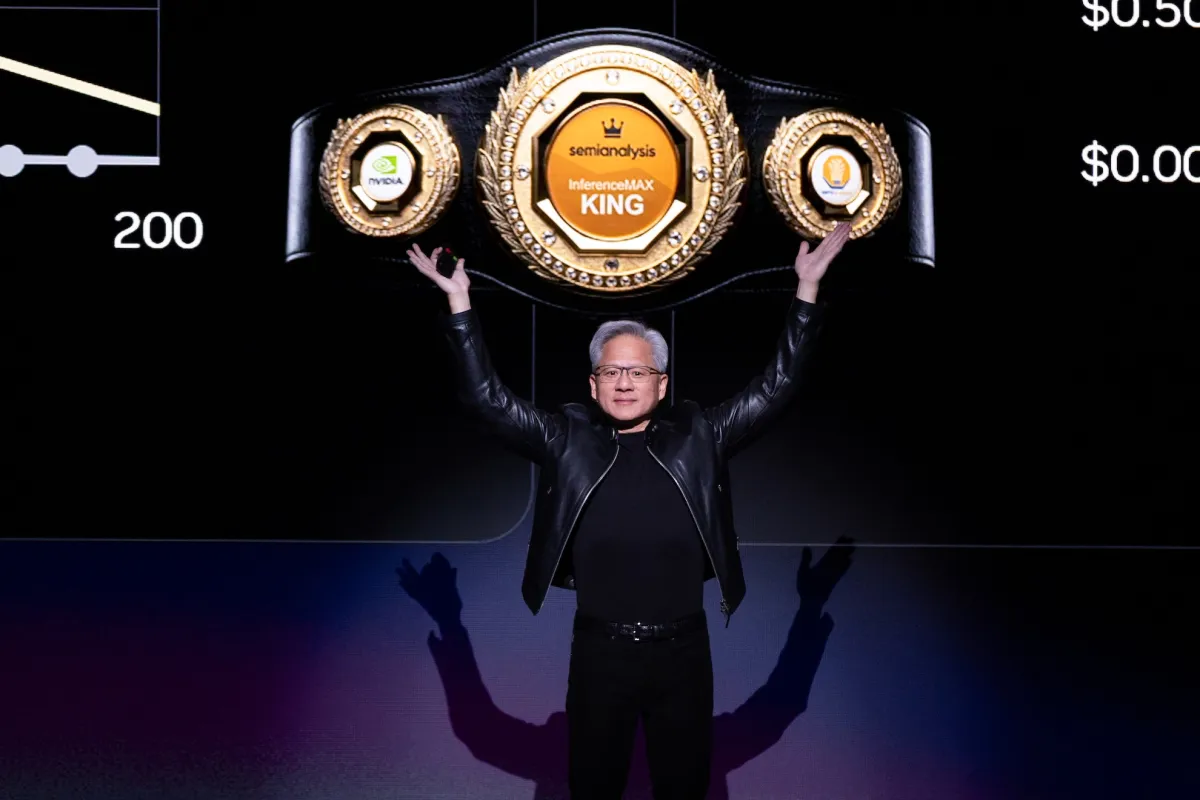
During his annual GTC keynote on Monday, Nvidia CEO Jensen Huang delivered an extensive presentation, yet the company’s stock saw a decline.
Despite Huang’s enthusiastic two-and-a-half-hour address, Wall Street investors appeared skeptical. Their concerns centered on the unpredictable trajectory of artificial intelligence (AI) and potential market bubbles. This cautious sentiment starkly contrasts with the prevailing optimism in Silicon Valley, where confidence in AI technology is burgeoning.
Huang’s keynote covered a range of topics, from cutting-edge video game graphics and revamped networking infrastructure to partnerships in autonomous vehicles and a new chip developed with Groq aimed at enhancing AI inference in the Vera Rubin system. He presented ambitious projections, estimating the AI agent ecosystem as a $35 trillion market, while the physical AI and robotics sector is projected to be worth $50 trillion.
Further reinforcing his vision, Huang anticipated reaching $1 trillion in orders for Nvidia’s Blackwell and Vera Rubin chips by the end of 2027—two key products among Nvidia’s extensive portfolio. While such projections might typically excite investors, Futurum CEO Daniel Neuman suggested that market reactions are muted for reasons beyond surface-level concerns.
Navigating New Uncertainties
Neuman expressed that the rapid advancements in AI are creating a landscape of uncertainty and hesitation. “The markets dislike uncertainty,” he noted, attributing this discomfort to the transformative and fast-paced nature of AI technology. He emphasized that the swift pace of innovation is yielding unexpected challenges that investors are struggling to comprehend.
Moreover, Neuman pointed out that misconceptions about AI adoption might be distorting perceptions. He argued that the narrative surrounding low enterprise adoption rates doesn’t accurately reflect the conversations happening in the industry. “Enterprise AI adoption will accelerate significantly,” he asserted, suggesting that the current state of ROI data may lag behind the pace of technological change.
This perspective gains traction when examining Nvidia’s performance over recent quarters. Although companies may hesitate to publicize their returns from AI investments, their procurement of Nvidia’s technology continues to rise significantly. The company recently reported a staggering 73% year-over-year revenue increase in the last quarter.
Looking ahead, Nvidia’s momentum remains strong. Just this week, the company announced a substantial agreement with Amazon, which plans to acquire 1 million GPUs as part of its AI infrastructure for Amazon Web Services (AWS) by the end of 2027, according to Reuters.
Kevin Cook, a senior equity strategist at Zacks Investment Research, echoed Neuman’s insights, humorously noting that while investors may express dissatisfaction, Nvidia’s innovations are central to the broader stock market’s performance. “The economy is orbiting around Nvidia,” Cook commented, highlighting the company’s critical role in creating foundational infrastructure for various sectors, including hardware, software, and physical AI applications.
While the GTC event may not have provided a lift for Nvidia’s stock, the ongoing uncertainties in the AI landscape are not solely attributable to the company’s status. With Huang at the helm, Nvidia appears to be propelling forward, positioning itself as a driving force within the global economy.
“Nvidia is fundamentally a platform company,” Huang stated during his keynote. “We possess the technology, platforms, and a rich ecosystem that encompasses a sizable portion of the $100 trillion global industry.”