Close Menu
Fintechbits
  • News
  • AI
  • Acquisitions
  • Trends
  • Insights
  • Rumors
  • Startups
  • finjobsly

Subscribe to Updates

Get the latest news from Fintechbits.

Trending Now

Lean Technologies Achieves Milestone with Saudi Arabia’s First Open Banking License from SAMA

March 27, 2026

Mastodon Enhances Usability of Its Decentralized Social Network with Recent Revamp

March 27, 2026

UK Establishes Itself as the Leading European FinTech Hub with Six of the Top Ten Deals in 2025

March 27, 2026

CurrentClient Secures $1.25 Million Seed Round for Advisor Communications Expansion

March 27, 2026
Facebook X (Twitter) Instagram
Trending
  • Lean Technologies Achieves Milestone with Saudi Arabia’s First Open Banking License from SAMA
  • Mastodon Enhances Usability of Its Decentralized Social Network with Recent Revamp
  • UK Establishes Itself as the Leading European FinTech Hub with Six of the Top Ten Deals in 2025
  • CurrentClient Secures $1.25 Million Seed Round for Advisor Communications Expansion
  • Mastercard Advances Financial Inclusion by Targeting Mainstream Remittances with Stablecoins
  • Transfer Your Chats and Personal Information from Other Chatbots Directly to Gemini
  • An Analysis of Bahrain’s Fintech Ecosystem in 2026
  • Anthropic Secures Injunction Against Trump Administration in Defense Department Dispute
Facebook X (Twitter) Instagram Pinterest Vimeo
Fintechbits
  • News

    CurrentClient Secures $1.25 Million Seed Round for Advisor Communications Expansion

    March 27, 2026

    An Analysis of Bahrain’s Fintech Ecosystem in 2026

    March 27, 2026

    Plum Secures Series B Funding to Enhance Claims Experience in India

    March 27, 2026

    Grand Secures $5 Million in Pre-Seed Funding to Develop AI-Driven Trade Trust Network

    March 27, 2026

    Chexy Secures $14 Million in Series A Funding Led by Khosla Ventures

    March 26, 2026
  • AI

    Central African Republic’s Fintech Developments and Broader Digital Initiatives in 2026

    March 24, 2026

    The Fintech Ecosystem of Cabo Verde in 2026: Insights from an African Nation

    March 22, 2026

    Your Next Customer Might Not Be Human. Is Your Business Ready?

    March 3, 2026

    Why AI Quoting Will Split the Trades Industry in Two

    February 26, 2026

    How Fintech Companies Balance AI Automation With Human Expertise in Regulated Finance

    February 25, 2026
  • Acquisitions

    Regnology Expands Portfolio with Addition of Invoke to Strengthen RegTech Presence

    March 25, 2026

    FinTech Acquisition Activity Declines More Than Other Sectors in the First Half of 2023

    March 24, 2026

    LATAM FinTech Investments Decrease 31% Year-over-Year Amid Growing Investor Caution

    March 23, 2026

    UK FinTech Deal Activity Declines by 61% Amid Five-Year Low in Investment

    March 22, 2026

    European FinTech Transactions Exceeding $100 Million Rise by 2.6 Times Quarter-over-Quarter as Funding Rebounds in Q1 2025

    March 22, 2026
  • Trends

    Brazil Maintains Leadership in LatAm FinTech Market in Q2 Despite 77% Year-over-Year Decline in Deal Activity

    March 22, 2026

    We Asked 9 Industry Leaders: What Fintech Tool Made the Biggest Difference to Your Accounts Receivable?

    March 21, 2026

    Client Churn Data Is a Better Default Predictor Than a Balance Sheet

    March 20, 2026

    European FinTech 2025 Is Back and Means Business

    March 16, 2026

    Subscription Payment Fatigue Is Coming for Children’s Services

    March 16, 2026
  • Insights

    UK Establishes Itself as the Leading European FinTech Hub with Six of the Top Ten Deals in 2025

    March 27, 2026

    Corporate Event Payment Terms: 5 Brutal Realities Every Vendor Faces

    March 26, 2026

    Children’s Activity Providers Are Sitting on Retention Data That Insurers Would Pay For

    March 26, 2026

    California Firms Led the US FinTech Market, Executing One-Third of All Deals in 2025

    March 25, 2026

    Fintech Marketing Agencies: 5 Critical Reasons Startups Hire Them Before CFOs

    March 25, 2026
  • Rumors

    Gilead Snaps Up Arcellx in $7.8B Most cancers Drug Deal

    March 14, 2026

    Tilly’s Inventory Pops After This autumn Earnings Shock

    March 14, 2026

    Elliott and Jana Take Recent Actions Alongside Other Speculations

    February 22, 2026

    Hank Payments (TSX) Rises to CAD 0.26 on February 18, 2026: Catalyst Analysis

    February 19, 2026

    Abivax CEO refers to Eli Lilly acquisition speculation as a diversion.

    February 8, 2026
  • Startups

    Mastodon Enhances Usability of Its Decentralized Social Network with Recent Revamp

    March 27, 2026

    Transfer Your Chats and Personal Information from Other Chatbots Directly to Gemini

    March 27, 2026

    Anthropic Secures Injunction Against Trump Administration in Defense Department Dispute

    March 27, 2026

    David Sacks Steps Down as AI Czar: His New Endeavors Revealed

    March 27, 2026

    Wikipedia Implements Restrictions on AI Usage in Article Writing

    March 26, 2026
  • finjobsly
Fintechbits
Home » What Should Businesses Look for When Choosing a Platform to Pay Freelance Contractors Across Borders?
Industry Trends

What Should Businesses Look for When Choosing a Platform to Pay Freelance Contractors Across Borders?

11 Mins Read
Facebook Twitter Pinterest Telegram LinkedIn Tumblr Email Reddit
Pay freelance contractors across borders, business leaders discussing platform selection
Industry leaders share what businesses should prioritise when choosing a cross-border freelancer payment platform, from hidden fee structures to compliance automation and contractor retention.
Share
Facebook Twitter LinkedIn Pinterest Email Copy Link

Author: Charitarth Sindhu, Fractional Business & AI Workflow Consultant

Industry leaders share what businesses should prioritise when choosing a platform to pay freelance contractors across borders, from hidden fee structures to compliance automation and contractor retention.


When businesses pay freelance contractors overseas, one payment feels simple enough. But when you need to pay freelance contractors across five countries while staying compliant, keeping fees transparent, and retaining your best talent, that is where most companies get it wrong.

The cross-border payments market now processes over $194 trillion annually, and the B2C segment covering gig economy payouts is growing at 11.1% CAGR. Meanwhile, international contractor engagements jumped 46% between 2023 and 2024 according to Oyster’s hiring data. More businesses than ever need to pay freelance contractors in other countries. Yet most have no idea what those payments cost or what risks they carry.

So we asked founders, CEOs, and business leaders who manage distributed teams across borders: what should businesses prioritise when choosing a platform to pay freelance contractors internationally?

Their answers clustered around four themes. Costs are not what they appear. Compliance is not optional. The freelancer’s experience matters more than you think. And the best infrastructure to pay freelance contractors should feel invisible.

Pay Freelance Contractors Without Getting Stung by Hidden Fees

The World Bank’s latest data puts the global average cost of sending $200 internationally at 6.49%. Banks specifically average a staggering 14.55%. But the biggest chunk of that cost hides inside the exchange rate, not listed as a fee. A Capital Economics study found that US consumers and small businesses paid $17.9 billion in international FX transaction fees in a single year. Of that total, $5.8 billion came from hidden exchange rate markups that appeared nowhere on any fee schedule.

Some platforms advertise low flat fees while quietly marking up the exchange rate by 3% or more. For a company that needs to pay freelance contractors $50,000 per month internationally, a 3% FX markup alone costs $18,000 a year. That number scales fast.

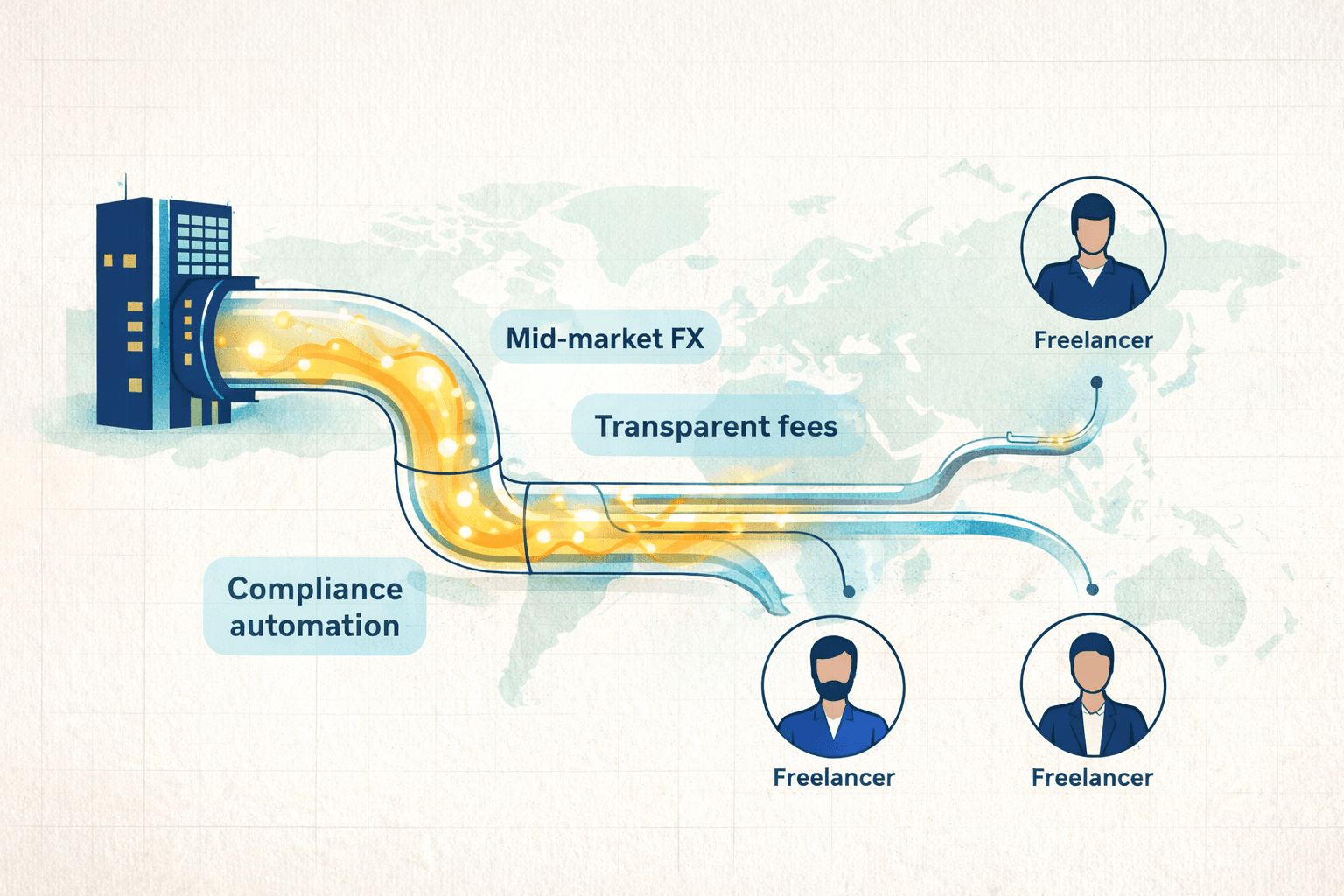
The majority of businesses fail to recognize the substantial savings opportunity available by keeping an eye on the full range of costs associated with each transaction, whether through high transaction fees or hidden transaction costs in the form of currency conversion markups that ultimately lead to significant cost increases. From our own experience managing the world’s largest developer marketplace, we’ve seen that some platforms claim to be low transaction fee platforms with flat rates but may be 3% costlier because of hidden markups in currency conversion. Instead, businesses that have global payroll operations should seek out mid-market rates or transparently disclosed spread when comparing global payment platforms, as these cost increases scale rigidly with your payroll obligations.

Compliance automation represents the second most critical factor for a successful global payment platform. Collecting localized tax forms as well as ensuring that the agreements with independent contractors comply with the applicable labour laws in the contractors’ countries can create an extreme amount of exposure to litigation and penalties if it’s done incorrectly. Therefore, companies that are considering using a global payments platform should adequately evaluate the extent to which they will automate compliance.

Finally, if you want to get the best from your contractors, be sure to investigate multi-currency wallet capabilities. This feature allows businesses to hold cash in multiple currencies and settle payments locally, without being subject to the excess transaction costs typically associated with multiple banking “hops” performed by intermediary banks between the originator and receiver of funds. Eliminating excess hops will significantly increase the likelihood that global contractors will continue working for your firm, which will help maintain a steady flow of high-quality, independent contractors.

Managing cross-border payments is ultimately about making the working relationship between companies and contractors as seamless as possible. For example, by transferring at least the amount of funds that were expected to be received, on time and without any unanticipated deductions from the amount that was received, will provide contractors with the reassurance that they are receiving professionally stable payments, thereby allowing them to focus on their work.

  • Abhishek Pareek, Founder & Director, Coders.dev

Multi-currency wallets address this problem directly. By holding funds in the currency received and converting only when rates are favourable, businesses that pay freelance contractors internationally can eliminate repeated conversion fees. Platforms like Wise, Payoneer, and Airwallex offer local receiving accounts in major currencies. This lets companies pay freelance contractors via domestic rails like ACH or SEPA instead of routing everything through SWIFT and correspondent banks. The cost difference between a transparent fintech solution (0.5 to 2% all-in) and a traditional bank wire (up to 14.55%) is not marginal. It is transformational.

Why Compliance Is Now a Survival Issue When You Pay Freelance Contractors

The regulatory environment for cross-border contractor payments tightened dramatically through 2024 and 2025. Three major shifts happened almost simultaneously.

The EU Platform Work Directive created a rebuttable presumption of employment for platform workers, affecting an estimated 28.3 million people across the bloc. DAC7 enforcement entered its second full reporting cycle, requiring digital platforms to collect and report contractor income data to EU tax authorities. And the UK updated its IR35 off-payroll rules with expanded scope and higher employer NICs.

The penalties for getting classification wrong are severe. Uber paid $100 million in New Jersey for misclassifying roughly 300,000 drivers. FedEx settled for $228 million in California. In the US, intentional misclassification can trigger fines up to $500,000 and criminal prosecution. Germany imposes fines starting at €60,000 per misclassified worker. Any business that needs to pay freelance contractors in multiple jurisdictions cannot afford to ignore these risks.

When choosing a platform to pay freelance contractors across borders, businesses should look for a solution that is easy for both finance teams and contractors to use across time zones. In a global, remote-first environment like ours at Carepatron, clear visibility into payment status and straightforward processes matter because work is happening around the clock. It is also important to confirm the platform supports the countries and payment methods your contractors use so payments do not turn into a back-and-forth or a burden. Finally, prioritize a provider with responsive support and clear documentation, since cross-border questions tend to come up at the least convenient times.

  • Jamie Frew, CEO, Carepatron

As the founder of Remotify, I advise businesses to choose a platform that handles VAT-compliant invoicing and cross-border payments natively. Pick a provider that demonstrably reduces missed payments and administrative overhead for freelancers. Verify the platform supports payments into the countries where your contractors live; at Remotify we support freelancers in 150+ countries. Prioritize solutions that remove the need for freelancers to register a company just to invoice, so your teams and contractors can focus on the work rather than payment admin.

  • Hasan Can Soygök, Founder, Remotify

How VAT and Tax Requirements Shape the Way You Pay Freelance Contractors

VAT compliance adds a specific friction point that many businesses overlook when they pay freelance contractors in the EU. EU-based freelancers must acquire a VAT number to invoice foreign clients, a process that can take one to ten weeks depending on the country. The Merchant of Record model, where platforms act as the legal entity responsible for processing payments and managing tax obligations across multiple countries, removes this barrier entirely. Freelancers can invoice without registering a company. Businesses receive consolidated invoicing with built-in compliance. That trade-off, a modest transaction fee in exchange for eliminating administrative overhead that consumes roughly 25% of a freelancer’s working time, is one of the clearest value propositions in the market.

Your Best Contractors Will Leave Before They Complain

Here is the part most businesses miss entirely. Payment experience is a retention lever for every company that needs to pay freelance contractors reliably. The data on payment delays is worse than most companies realise.

Remote’s 2025 Contractor Management Report found that 85% of freelancers have invoices paid late at least some of the time. Over 21% are paid late more than half the time. A Leapers survey of 715 freelancers found 71% experienced late payments in 2024, with 55% reporting negative mental health impacts. Freelancers spend an estimated 8 to 12 hours monthly chasing late payments, a direct productivity loss estimated at $85 to $95 billion annually across the global freelance economy. If your business needs to pay freelance contractors on time and you are failing, you are bleeding talent without realising it.

When you are paying freelancers across borders, you are not just choosing a payment tool. You are choosing a trust system.

The first thing I look for is predictability. How long will the money take? What are the fees? Where does the conversion happen? If I need a spreadsheet and three support emails to understand it, that is friction waiting to happen.

Second, compliance. This is the unsexy part founders ignore until something breaks. Contracts. Tax forms. Documentation. If the platform helps you handle that cleanly, it saves stress you will only appreciate later.

And here is something most businesses overlook: the freelancer experience. If payments arrive late or feel confusing, your best contractors will notice. They may not complain. They will just prioritize someone else next time.

The right platform should feel boring. Money goes out. It arrives. No drama. No mystery.

When you remove uncertainty from payments, you protect relationships. And relationships, especially across borders, are built on reliability.

– Sahil Gandhi, Brand Strategist, Brand Professor

The thing nobody tells you when you start hiring globally is that the payment platform you pick will either save you hours every week or quietly eat your time and your margins.

We run a remote team across multiple countries from Canberra. The first thing I learned is that the platform has to work for your contractors, not just your finance process. If your developer in the Philippines needs to chase a payment or figure out a confusing fee structure, that is your problem. They will not complain. They will just start replying slower and eventually disappear.

The second thing is transparency on fees. Some platforms look cheap until you realise the exchange rate they are giving you is 3% worse than the mid-market rate. That is not a fee. That is a tax on trust. We switched platforms purely because I could not get a straight answer on what our contractors were receiving versus what we were sending.

Third, compliance. If you are paying people in multiple countries, you need a platform that handles local tax requirements without you having to become an expert in every jurisdiction. We are a marketing agency, not an international tax firm. The right platform should make that invisible.

Pick the platform your contractors would choose if they had the vote. If they are happy, they stay. If they stay, you stop burning money on recruitment.

  • Callum Gracie, Founder, Gia AI

The pattern across every response is consistent. Experienced freelancers prioritize payment reliability over payment speed. A fast payment that arrives unpredictably causes more damage than a slower payment that arrives on schedule every time. Companies that pay freelance contractors on a predictable schedule retain better talent.

The Best Way to Pay Freelance Contractors Is the Boring Way

The highest-performing cross-border payment setups share one characteristic. They make the process to pay freelance contractors invisible. Money goes out, money arrives, nobody has to think about it.

Based on the research and the insights from these industry leaders, the evaluation framework for any business that needs to pay freelance contractors is clear. Start with fee transparency, because if you cannot see exactly what you are paying and what your contractor is receiving, you are losing money. Layer in compliance automation appropriate to your contractor jurisdictions, because the regulatory landscape is only getting stricter. Then optimise for the freelancer experience, because the best talent will quietly walk away from confusing or unreliable payment processes long before they send you a complaint.

The single most counterintuitive finding across the data is this: the cheapest platform to pay freelance contractors is rarely the most cost-effective. A $49 per month subscription that automates compliance and uses mid-market exchange rates costs far less than a free bank wire that hides 3 to 5% in currency conversion and exposes the business to six-figure misclassification penalties.

The right platform to pay freelance contractors should feel boring. And boring, it turns out, is worth paying for.

Financial FinancialTechnology
Share. Facebook Twitter Pinterest LinkedIn Tumblr Email

Related Posts

Corporate Event Payment Terms: 5 Brutal Realities Every Vendor Faces

March 26, 2026

Children’s Activity Providers Are Sitting on Retention Data That Insurers Would Pay For

March 26, 2026

Fintech Marketing Agencies: 5 Critical Reasons Startups Hire Them Before CFOs

March 25, 2026

1 Comment

  1. Pingback: DAC7 Freelancer Payments: 6 Proven Shifts to Know

Leave A Reply Cancel Reply

Latest news

Lean Technologies Achieves Milestone with Saudi Arabia’s First Open Banking License from SAMA

March 27, 2026

Mastodon Enhances Usability of Its Decentralized Social Network with Recent Revamp

March 27, 2026

UK Establishes Itself as the Leading European FinTech Hub with Six of the Top Ten Deals in 2025

March 27, 2026
News
  • AI in Finance (2,159)
  • Breaking News (281)
  • Corporate Acquisitions (89)
  • Industry Trends (55)
  • Jobs Market News (338)
  • Market Insights (331)
  • Market Rumors (308)
  • Regulatory Updates (217)
  • Startup News (1,438)
  • Technology Innovations (226)
  • uncategorized (11)
  • X Feed (1)
About US
About US

FintechBits is a blog delivering the latest news and insights in fintech, finance, and technology. We cover breaking news, market trends, innovations, and expert opinions to keep you informed about the future of finance

Facebook X (Twitter) Instagram Pinterest Reddit TikTok
News
  • AI in Finance (2,159)
  • Breaking News (281)
  • Corporate Acquisitions (89)
  • Industry Trends (55)
  • Jobs Market News (338)
  • Market Insights (331)
  • Market Rumors (308)
  • Regulatory Updates (217)
  • Startup News (1,438)
  • Technology Innovations (226)
  • uncategorized (11)
  • X Feed (1)
Happening Now

November 28, 2024

“ Intentionally collaborative ”: how the Rotman school of U of T leads Innovation Fintech

February 6, 2025

‘1957 Ventures’ to Drive FinTech Innovation in Saudi Arabia

September 10, 2024
  • About FintechBits
  • Advertise With us
  • Contact us
  • Disclaimer
  • Privacy Policy
  • Terms and services
  • BUY OUR EBOOK GUIDE
© 2026 Designed by Fintechbits

Type above and press Enter to search. Press Esc to cancel.