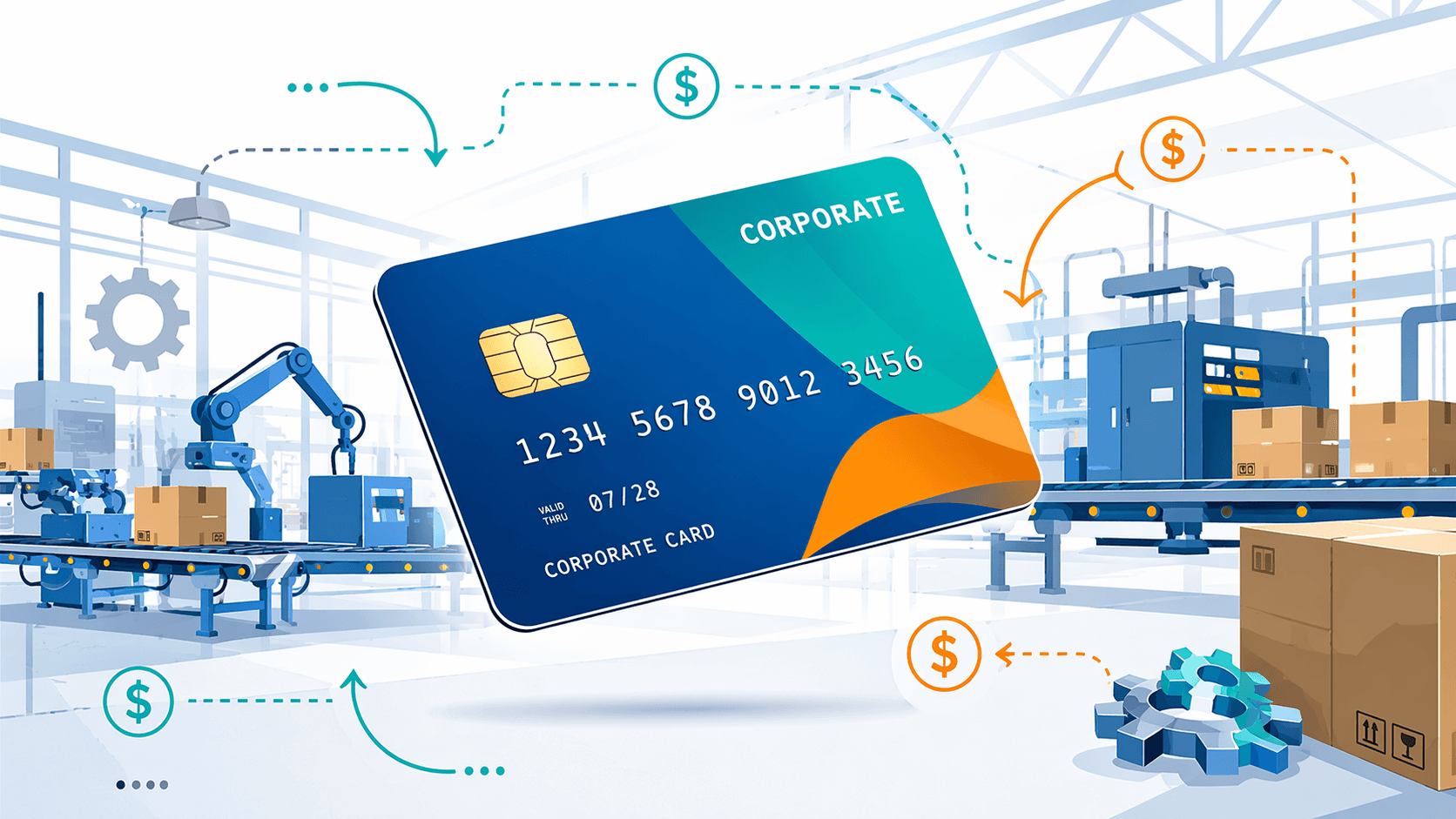
Embedded finance is quietly reshaping how mid-market manufacturers and distributors manage working capital. We asked three industry leaders how virtual cards and fintech tools improve cash flow for companies in the $10M to $500M revenue range. Their answers revealed a mix of real opportunity, structural friction, and genuine skepticism about the pace of change.
The numbers support the growing buzz around embedded finance adoption. A PYMNTS/Visa survey of 1,297 CFOs found that top-performing mid-market firms achieved $11 million in average bottom-line benefits from working capital optimization in 2024. That figure tripled from $3.3 million the prior year. At the same time, 56% of CFOs now consider virtual cards essential for financial flexibility.
However, adoption tells a starkly different story. Virtual cards still account for only 2% of accounts payable transactions despite strong buyer preference. The gap between enthusiasm and implementation defines embedded finance in this segment right now.
Transaction costs also favor the shift. Processing a virtual card payment costs roughly $13 per transaction compared to $38 for a paper check, according to RPMG Research. For a mid-market manufacturer processing 1,500 invoices monthly, that difference adds up fast. Forrester Consulting calculated a 132% three-year ROI with a payback period under six months for organizations adopting commercial virtual payments. So where does the real value sit, and what holds manufacturers back from capturing it?
Embedded Finance Turns Accounts Payable Into a Revenue Line
The core value proposition is straightforward. When manufacturers pay suppliers with virtual cards instead of checks or ACH transfers, they capture 1-2% cash-back rebates on every transaction. For a company moving $500K monthly through suppliers, that translates to $5,000 to $10,000 in monthly rebates from payments they would make regardless. Furthermore, RPMG benchmarks show that $20 million in virtual card spend with 48 days of float generates $122,740 in annual savings before counting rebates.
Lyle Solomon, a principal attorney who advises on corporate restructuring, sees mid-market manufacturers treating virtual cards as a multi-purpose financial tool.
“In the legal practice of corporate restructuring, I have seen mid-market manufacturers and distributors use Virtual Cards as a financial Swiss Army Knife. The primary application is Working Capital Optimization. Instead of mailing paper checks to vendors (which is slow and insecure), or sending wires (which is expensive), they issue a single-use virtual card for each supplier payment. This allows them to maximize Cash-Back Rebates, often 1-2%, which, when you are spending millions on raw materials, becomes a significant revenue stream that offsets operational overhead.
Furthermore, they are embedding finance directly into their supply chain. Platforms like HighRadius or Billtrust allow manufacturers to offer ‘Buy Now, Pay Later’ terms to their B2B customers. Instead of chasing invoices for 60 days, they get paid upfront by the fintech partner, who assumes the credit risk. This drastically reduces Days Sales Outstanding and frees up cash flow to reinvest in inventory or growth, rather than acting as a bank for their customers.
Finally, virtual cards provide Forensic Control. Every card is tied to a specific budget, project, or employee. If a project goes over budget, the card declines instantly. This prevents unauthorized spending and simplifies expense reconciliation. It turns the finance department from a historical record-keeper into a real-time risk manager.”
- Lyle Solomon, Principal Attorney, Oak View Law Group
Beyond rebates, virtual cards extend payment terms by 30 to 45 days while suppliers receive funds immediately. As a result, manufacturers create free float that can unlock significant working capital without taking on new debt. Joe Spisak, who built and exited a fulfillment company before founding Fulfill.com, saw the embedded finance advantage firsthand during his years managing supplier relationships.
“Last year I watched a $8M industrial parts distributor nearly miss payroll because their biggest customer paid Net-60 while their suppliers demanded Net-30. They weren’t bleeding money, they were bleeding time. That’s when their CFO switched to virtual cards for supplier payments and everything changed.
Here’s what most people miss about embedded finance in mid-market distribution: it’s not really about technology, it’s about turning your AP department into a profit center. When you pay suppliers with virtual cards instead of ACH or checks, you capture 1-2% rebates on every transaction. Sounds small until you’re moving $500K monthly through suppliers. That distributor I mentioned? They’re now generating $8K-$12K in monthly rebates just by changing how they pay people who were getting paid anyway.
The cash flow piece is even better. Virtual cards let you extend your payment terms by 30-45 days while suppliers still get paid immediately. You’re essentially creating free float. I saw this firsthand when we were scaling my fulfillment company and dealing with packaging suppliers, freight carriers, and equipment vendors. The gap between when you pay out and when customers pay in can kill you faster than bad margins.
What surprised me most is how many mid-market operators think this is only for enterprise companies. Wrong. The embedded finance platforms now integrate directly with QuickBooks and NetSuite. Setup takes maybe two weeks. One manufacturing client told me they freed up $180K in working capital in the first quarter just by restructuring payment timing, no new financing required.
The manufacturers winning right now aren’t the ones with the cheapest products. They’re the ones who figured out that financial operations are as important as production operations. When you can pay suppliers instantly, negotiate better terms because you’re a reliable fast payer, AND capture rebates that drop straight to your bottom line, you’re playing a completely different game than competitors still cutting checks. Cash flow isn’t just king anymore, it’s the whole kingdom.”
- Joe Spisak, CEO, Fulfill.com
Spisak’s $180K example aligns with broader market data. Platforms like Ramp (50,000+ business customers, $100 billion in annualized purchase volume) and BILL/Divvy now offer deep two-way sync with QuickBooks and NetSuite. That ERP integration matters because it determines whether embedded finance adoption takes two weeks or six months. However, the supplier side of the equation introduces friction that no platform has fully resolved.
The Legacy Rails Problem Behind Virtual Card Enthusiasm
Still, not everyone views embedded finance as a genuine breakthrough. Supplier resistance remains the primary barrier, with 41% of mid-market firms citing it as their top adoption challenge. The reason is straightforward: suppliers absorb interchange fees of 2.5% to 4% on every virtual card payment. On a $100,000 invoice, that cost reaches $2,500 to $4,000. For businesses operating on thin margins, that math does not work.
There is also a deeper structural critique that goes beyond fee disputes. The banking infrastructure underneath these embedded finance tools dates back to the 1970s. Settlement still takes days regardless of how sleek the interface looks. Networks like RTP and FedNow offer instant settlement at roughly $0.045 per transfer, yet most banks still operate in receive-only mode.
Riccardo Spagni, an entrepreneur and former lead maintainer of cryptocurrency project Monero, takes a sharply skeptical view of the current embedded finance wave.
“Honestly, they’re mostly just participating in finance theatre.
Everyone gets very excited about ’embedded finance’ right now. It’s just a fancy way of saying they figured out how to issue corporate IOUs with an API. Manufacturers use virtual cards because the legacy banking system is so agonisingly slow and opaque that layering another FinTech product on top of it feels like innovation.
It speeds up reconciliation, sure. But it doesn’t change the underlying reality that settlement still takes days. It’s like putting a spoiler on a 1.1L Chevy Spark and pretending it’s an F1 car. It looks fast, but the engine is still the same antiquated banking rails from the 1970s. Eventually, they’ll realise that actual cryptographic settlement is faster and cheaper. But we have to get through this phase of playing dress-up with virtual cards first.”
3 Practical Takeaways for Manufacturers Considering Embedded Finance
Spagni’s critique carries weight. Multiple blockchain trade finance platforms, including We.trade, Marco Polo Network, and Contour, collapsed between 2022 and 2023 despite backing from major banks. Nevertheless, the point about legacy infrastructure limitations remains valid even if the crypto alternative has yet to deliver at scale.
In the meantime, the most measurable wins from embedded finance come from the receivables side rather than payables. Companies deploying AI-powered AR automation have cut Days Sales Outstanding by up to 40%. Research from Billtrust across 500 finance leaders showed 75% achieved at least a six-day DSO reduction. Meanwhile, distributors like McPherson Oil unlocked $2 million in cash flow through automated invoicing workflows alone.
B2B Buy Now, Pay Later platforms represent another practical embedded finance lever. When manufacturers offer net terms through providers like Resolve or Billie, the BNPL provider pays them within 24 hours. The buyer still receives Net 30, 60, or 90 terms, but the manufacturer eliminates DSO on those transactions entirely. This market reached $14 billion in global transaction value in 2023, and Arthur D. Little projects it will capture 15-20% of B2B commerce payments by 2030.
The honest takeaway is that embedded finance works best as one component within a broader cash flow optimization strategy. Virtual card rebates deliver clear income for manufacturers who hold supplier leverage. AR automation and B2B BNPL address the receivables gap that typically matters more to mid-market cash flow health. Regulation also adds a layer of complexity, as the U.S. Treasury has recommended enhanced supervision for bank-fintech partnerships powering these tools. And the legacy banking rails underneath every embedded finance product remain stubbornly slow, no matter how polished the fintech dashboard appears on top.