Author: Charitarth Sindhu, Fractional Business & AI Workflow Consultan
Early payment discount financing remains one of the most debated tools in B2B cash flow management. Some companies swear by it, while others see it as a silent margin killer. So we asked four industry leaders a simple question: has early payment discount financing worked for your business?
Their answers reveal a clear pattern. The strategy works, but only when companies treat it as a deliberate financial decision rather than a standing default.
How Early Payment Discount Financing Shapes Cash Flow
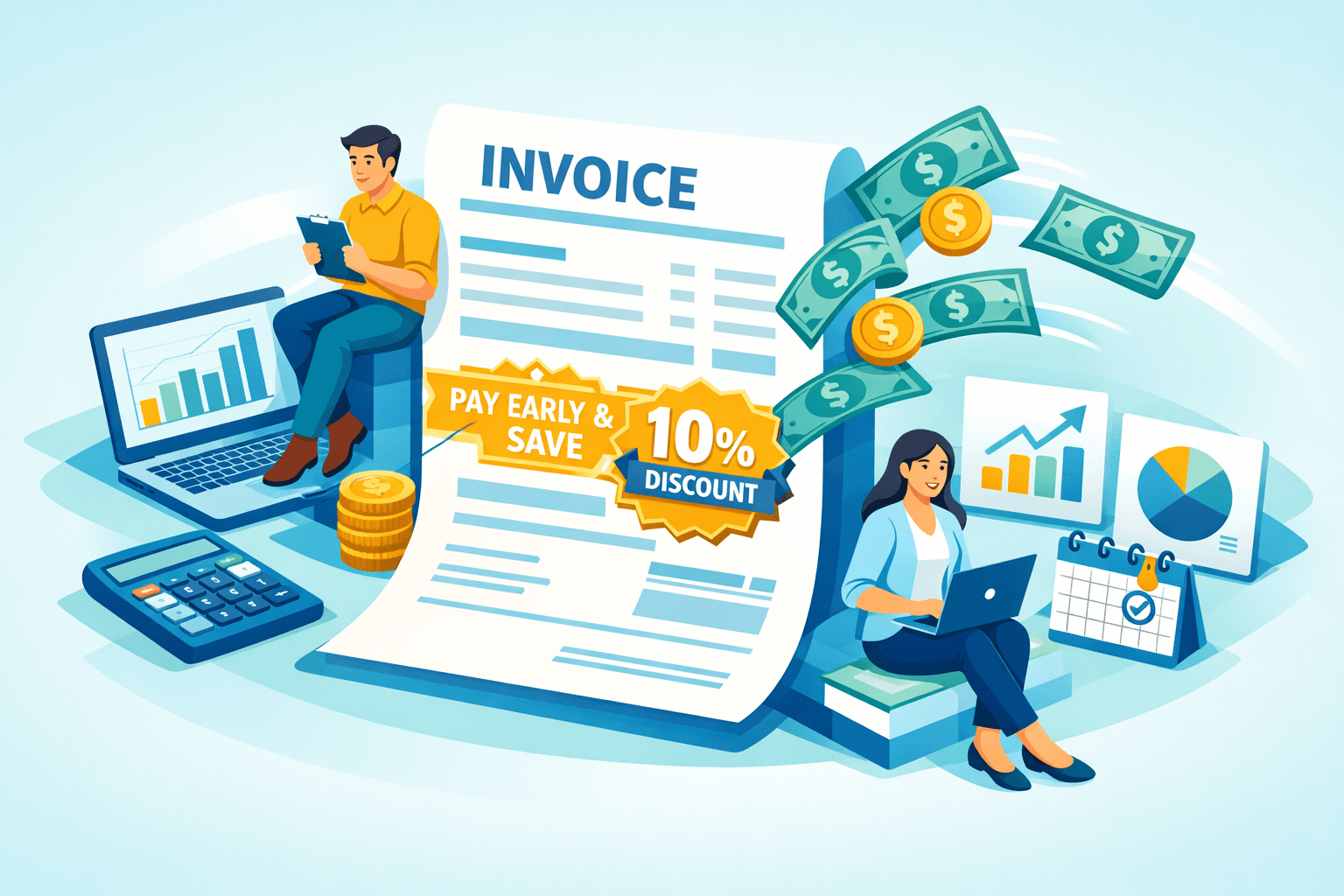
The concept is straightforward. Buyers receive a small percentage off an invoice when they pay before the due date. The most common structure, known as 2/10 net 30, gives buyers a 2% discount for paying within 10 days instead of the standard 30. That 2% saving translates to a 36.7% annualized return on early cash deployment.
Despite these numbers, most companies still miss available discounts. Research from the Hackett Group estimates that $1.7 trillion remains trapped in excess working capital among the top 1,000 U.S. public companies. Meanwhile, average accounts payable teams capture just 58% of eligible early payment discount financing opportunities.
Aditya Nagpal, however, sees value in the approach when it is applied with discipline.
“Early payment discount financing can work, but only when cash flow predictability matters more than marginal margin loss. In our case, it helped smooth operations during phases where receivables timing was uncertain, allowing us to stay focused on execution instead of collections. The challenge is that it can quietly become a habit rather than a deliberate choice, especially if teams start relying on it without reviewing underlying payment terms. We treated it as a tactical lever, not a default approach. The key takeaway is to use it selectively and keep tightening core billing discipline.”
- Aditya Nagpal, Founder & CEO, Wisemonk
His point about selectivity is well supported. According to Coupa’s research, enterprises that target their top suppliers strategically see adoption rates above 50%. In contrast, broad and untargeted discount programs often achieve below 10%.
Why Selective Application of Early Payment Discount Financing Matters
Not every client relationship benefits from early payment discount financing. The approach works best when businesses understand which partners will respond to the incentive and which ones would have paid on time regardless.
Assaf Sternberg takes this targeted approach across his manufacturing operations.
“In our business, early payment discounts have worked when applied selectively to reliable clients. Since we manage supplier payments across multiple factories, improving cash flow predictability helps us maintain strong production timelines. The key is using it strategically rather than universally.”
- Assaf Sternberg, Founder & CEO, Tiroflx
This selective mindset also extends to the supplier side. C2FO surpassed $400 billion in lifetime early payments facilitated by the end of 2024, processing 42 million invoices that year. Their data shows suppliers who participate in early payment discount financing programs receive payment an average of 32 days ahead of schedule.
Jessica Liew has seen these relationship benefits firsthand.
“We’ve had a good experience with early payment discounts at InCorp. It offers clients a small incentive to pay earlier and works surprisingly well. When clients take up the offer, it improves cash flow and reduces the time we spend chasing payments. It also helps build a positive relationship with clients. They see it as flexibility on our part and it encourages smoother, more predictable payment behavior. Of course, it doesn’t work for every client, but even partial adoption can make a noticeable difference in managing receivables. Small incentives can go a long way in improving cash flow while also strengthening client relationships.”
- Jessica Liew, Director of Business Development, InCorp Global
Her observation about partial adoption aligns with broader findings. Research from Resolve indicates that supplier retention rates improve by 35% over two years among companies offering early payment options. Even when not every client participates, the ones who do create a more predictable revenue stream.
Early Payment Discount Financing Fails Without Automation
The strongest consensus among our respondents centers on one issue: manual processes undermine the entire strategy. When invoice approval takes 11 to 21 days on average, a 10-day discount window becomes impossible to capture. Ardent Partners’ 2025 AP report found that only 10% of organizations have fully automated their early payment discount financing capture.
Girish Songirkar argues that this technology gap is the core problem.
“Using early payment discount finance is one of the most effective means to manage cash flow. However, when managed manually, early payment discount strategies do not yield any benefit. The administrative load associated with tracking the required invoicing of eligible early payment discounts, determining how much cash is available for payment, and the process of making the payment offsets the very small amount of money saved by taking the early payment discount. The use of early payment discount strategies generates real returns when the logic is baked directly into the ERP workflow, allowing for automated triggers for decisions based on early payment discounts, which do not require human intervention to complete a spreadsheet or provide documentation to support an early payment discount.”
- Girish Songirkar, Delivery Manager, Enterprise Software Engineering, Arionerp
His perspective reflects a growing industry trend. The dynamic discounting platform market reached approximately $2.2 billion in 2024 and continues growing at over 10% annually. Companies like SAP Taulia and C2FO now offer platforms where suppliers can choose which invoices to accelerate and set their own discount rates. This shift from static terms to dynamic and automated early payment discount financing programs is helping more businesses capture savings that previously slipped through the cracks.
The role of AI in financial process automation continues to expand in this direction. Platforms now use machine learning to predict which suppliers will accept discounts, optimize payment timing, and flag invoices approaching their discount windows. As the broader fintech landscape evolves, early payment discount financing is becoming less of a financial gamble and more of a strategic advantage for businesses willing to invest in the right systems. Meanwhile, AI-driven fraud detection is making automated payment workflows safer, removing another barrier to adoption.
The Verdict
Early payment discount financing works. Yet it only delivers consistent results when companies apply it selectively, automate the process, and resist the temptation to turn it into a blanket policy. As these four leaders demonstrate, the businesses that benefit most are the ones that treat it as a calculated tool rather than an accounting shortcut.