Author: Darren Tredgold, General Manager, Independent Steel Company
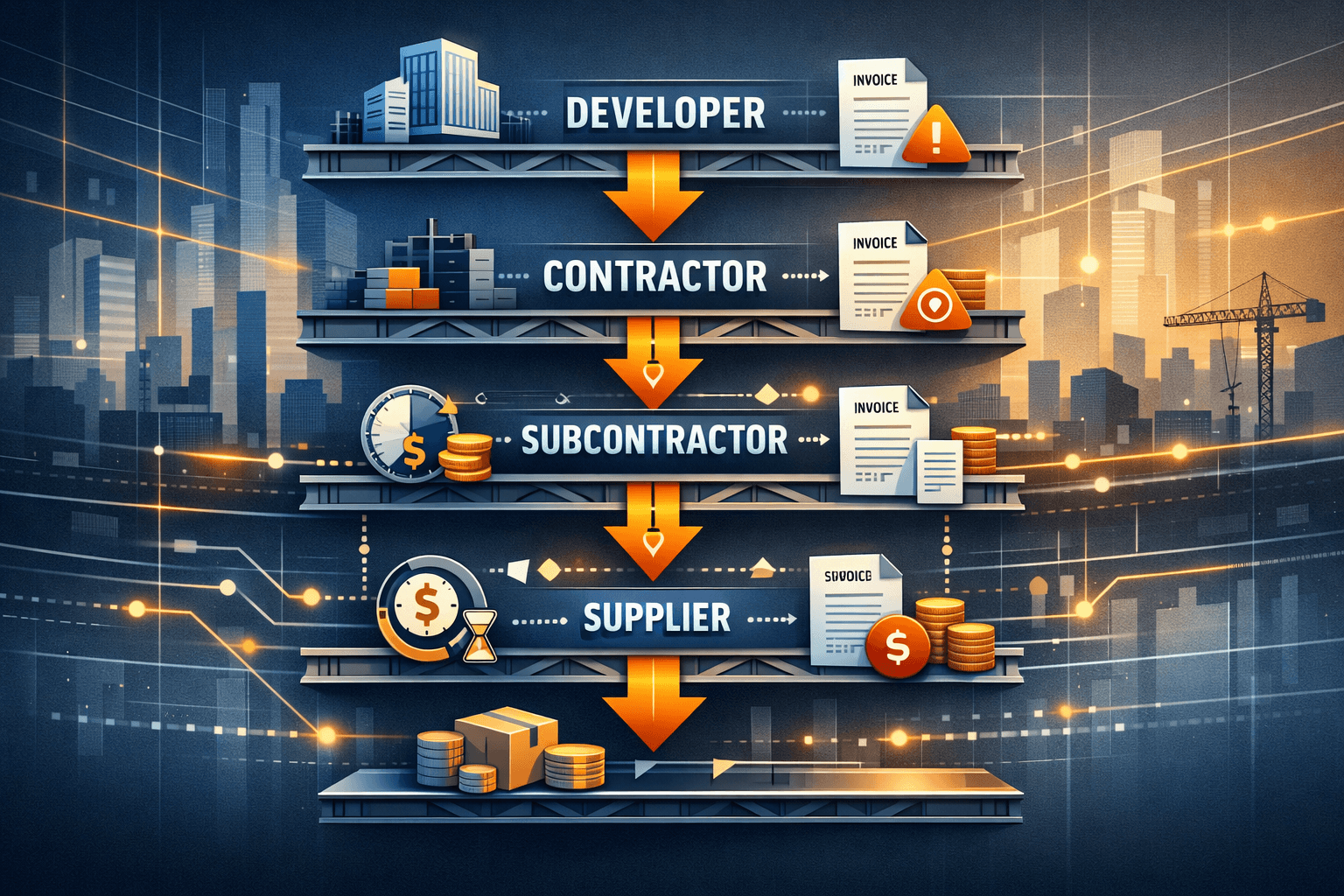
The construction payment chain is broken, and suppliers are paying the price. Every construction payment chain runs four layers deep: developer to head contractor, head contractor to subcontractor, subcontractor to material supplier. Money trickles down. Risk concentrates at the bottom. For a steel distributor like us at Independent Steel Company, that means delivering product, covering freight, carrying inventory, and then waiting 60 to 120 days before a cent hits our account. Meanwhile, every layer above us treats our working capital as an interest-free loan.
Thirty years of Australian legislation have tried to fix this problem. Still, none of it has worked. So let me walk you through what suppliers face, why policy keeps failing, and why fintech innovation holds the real answer.
How the Construction Payment Chain Traps Suppliers
Here is how the process works in practice. A developer engages a head contractor. That head contractor hires subcontractors. Those subcontractors order materials from suppliers like us. In turn, each layer contracts independently with the one below, extending trade credit upward.
When we deliver steel to a site in South-East NSW, the clock does not start on our invoice until the subcontractor submits a progress claim to the head contractor. The head contractor then submits their own claim to the developer. Each approval cycle takes 15 to 30 business days. By the time payment reaches the bottom of the construction payment chain, two to four months have passed since delivery.
On top of that, head contractors typically withhold 5% of each progress payment as retention. They release it only after practical completion. That locks up supplier cash for 12 to 24 months beyond the initial payment delay. According to Reserve Bank of Australia analysis, the median builder carries short-term unsecured trade credit equal to roughly 40% of total liabilities. That is double the figure for businesses in other sectors.
The result is an inverted financing structure. The party with the thinnest margins funds the parties with the thickest ones. At ISC, 120 days is not a minor inconvenience. We have already paid our own suppliers, covered freight, and carried stock for months before that invoice lands.
Why Policy Has Failed to Fix Construction Payment Chain Delays
Australia has thrown legislation at this problem since the 1990s. New South Wales introduced the first Security of Payment (SOP) Act in 1999. Every state and territory followed between 2002 and 2009. The core principle was “pay now, argue later,” and on paper it sounded right.
Yet construction insolvencies have accelerated, not declined. Between June 2022 and March 2025, more than 7,600 construction firms became insolvent. In FY 2024-25, ASIC recorded approximately 3,217 construction insolvencies, representing roughly 27% of all corporate insolvencies nationally.
Why has this happened? Because subcontractors fear retribution. In fact, pre-qualification questionnaires routinely ask whether a contractor has ever invoked SOP legislation. That creates a chilling effect that keeps most claims unfiled.
The most comprehensive reform effort, the Murray Review (2018), produced 86 recommendations across 382 pages. Its most transformative proposal for deemed statutory trusts remains unimplemented seven years later. The Albanese Government finally responded in March 2025, expressing “general support” but deferring implementation to states and territories.
Meanwhile, the ASBFEO estimates that $115 billion sits in overdue invoices owed to Australian small businesses at any given time. Notably, construction contributes the largest share of payment disputes at 42% of all ASBFEO assistance cases. Thirty years and 30-plus government reviews later, the construction payment chain keeps grinding smaller businesses into the ground.
Fintech Solves What Legislation Cannot
Technology offers what three decades of policy reviews could not: speed, visibility, and liquidity. Several fintech platforms now tackle the construction payment chain from multiple angles simultaneously.
Earlytrade’s progress claims platform serves over 100,000 companies globally. It ensures claims submit within SOP timelines while enabling head-contractor-funded early payments. As a result, their clients receive payment 28 days earlier on average. Similarly, Billd pays suppliers upfront and offers contractors 120-day terms aligned with industry cycles, having funded nearly $750 million in financings. In November 2024, Constrafor raised a $264 million Series A to scale its Early Pay Program, which gets subcontractors paid within 48 hours on approved invoices.
In Australia, IPEX creates dedicated project bank accounts with automated verification, currently protecting over $400 million in projects. Fifo Capital has underwritten over $2 billion to 3,000 businesses, offering supply chain finance with repayment terms up to 120 days. As fintech continues to reshape cross-border payment systems, similar innovation is reaching construction supply chains.
These platforms deliver three capabilities that legislation structurally cannot. First, instant liquidity through supply chain finance that pays suppliers within 24 to 48 hours. Second, enforced transparency through real-time dashboards showing where money sits at every tier of the construction payment chain. Third, automated compliance through payment cascading that removes human discretion from fund distribution. Just as AI-driven systems protect digital financial transactions, fintech tools can safeguard the flow of money through construction.
Suppliers Cannot Afford to Wait
For a steel distributor operating on 5% net margins, the financing cost of extended payment terms is existential. Consider a supplier with $5 million in annual revenue and average receivables outstanding of 90 days. At any given time, roughly $1.25 million sits in unpaid invoices. Consequently, financing that gap through an unsecured business overdraft at current Australian rates of 14.5% to 25% costs up to $180,000 annually. Against a net profit of $250,000, financing costs alone consume over half the entire margin.
Nearly half of all construction and trade businesses have turned to credit facilities and loans simply to maintain cash flow while waiting for payments. Another 27% of SME owners have dipped into personal savings or gone without paying themselves. The construction payment chain does not just delay money. Instead, it systematically destroys the businesses at its base.
The construction payment chain will not fix itself. Thirty years of evidence confirms that legislation alone cannot fix it either. As a supplier who sits at the bottom of this chain every single day, I see the problem clearly: it is architectural and it demands a technology solution.
Supply chain finance platforms, automated payment cascading, and real-time visibility tools exist today. The question for Australian suppliers is not whether to adopt them. It is whether they can afford not to.
Darren Tredgold is General Manager of Independent Steel Company, an Australian-owned steel distributor serving South-East NSW from branches in Queanbeyan, Nowra, and Moss Vale.