

Author: Darren Tredgold, General Manager, Independent Steel Company
Banks are changing the rules on who gets a loan. And most regional businesses have no idea.
I run a steel distribution company with three branches across South-East NSW. We serve infrastructure projects, renewable energy installations, defence contractors, and residential builders. For 25 years, our lending conversations have centred on revenue, margins, debtor days, and collateral. That is about to change in ways that will catch thousands of Australian SMEs off guard.
Climate risk scoring is quietly becoming part of the lending equation. The question is no longer whether your business is profitable. The question is whether your business is sustainable. And your bank is starting to care about the answer before you do.
The regulatory shift is already underway
In Europe, the European Banking Authority’s guidelines on ESG risk management took effect on 11 January 2026. Banks must now incorporate climate risk into their lending frameworks. That means every loan in the portfolio carries a carbon risk assessment alongside the traditional financial one. If a bank’s aggregate climate exposure exceeds internal limits, corrective action is mandatory.
Australia is following the same trajectory. Mandatory climate-related financial disclosures under AASB S2 are live for Group 1 entities with 500 or more employees. Group 2 entities with 250 or more employees start reporting from 1 July 2026. Group 3, covering businesses with 100 or more employees, kicks in from July 2027.
Here is the part that hits regional suppliers hardest. Scope 3 emissions reporting becomes mandatory from the second reporting period. Scope 3 covers the entire supply chain. Every material, every delivery, every input a large company purchases carries an emissions footprint that they must now measure and disclose.
For a steel distributor like us, that means our infrastructure and construction clients will soon need to quantify the carbon impact of every tonne of steel they buy. They will ask for that data. And if we cannot provide it, they will find a supplier who can.
The lending connection most businesses are missing
This is where the fintech angle gets interesting. Banks face growing pressure around what regulators call “financed emissions.” That is the total carbon footprint of every business in a bank’s lending portfolio. European regulators now require banks to measure and manage this exposure. Australian regulators are heading in the same direction.
Think about what that means for a regional business seeking a line of credit. Your carbon profile is becoming a lending input alongside your balance sheet. Businesses that can demonstrate green credentials are already accessing sub-4% working-capital lines through sustainability-linked lending. Businesses that cannot demonstrate any carbon awareness face higher rates, lower limits, or both.
In China, several cities are piloting “carbon account” models that directly link corporate carbon performance to credit ratings. It sounds extreme until you realise that European banks are doing a softer version of the same thing right now.
The biggest gap in the system is reliable emissions data for small and medium businesses. Large corporations have sustainability teams and carbon consultants. Regional distributors, builders, and manufacturers have spreadsheets and good intentions. That gap is where fintech platforms have an opportunity to build tools that help SMEs measure, report, and reduce emissions in ways that feed directly into lending applications.
What this means for regional supply chains
The Carbon Measures Coalition, launched in October 2025 by 19 major companies, is proposing a shift to ledger-based emissions tracking. The idea is to treat carbon accounting with the same rigour as financial accounting. Double-entry bookkeeping for emissions. Auditable records. Transaction-level granularity.
For regional distributors, this means the days of vague sustainability statements on your website are numbered. Your large clients will need verified emissions data at the product level. Your bank will factor that data into your borrowing capacity. And the penalties for getting it wrong are severe. False or misleading climate statements carry fines of up to $15 million or 10% of annual turnover under Australian law.
I see this playing out in real time across our client base. Infrastructure companies that never mentioned carbon 18 months ago now ask about our sourcing and freight emissions before they ask for a price. Defence procurement contracts increasingly include sustainability criteria. Renewable energy projects want to know the embedded carbon in the steel they are using to build solar farms.
The irony is not lost on me. The steel going into a solar farm has a carbon footprint. And someone now has to measure it.
The fintech opportunity is at the small end
The tools to solve this problem for large enterprises exist. SAP, Watershed, and Persefoni have built platforms for companies with dedicated sustainability teams and seven-figure budgets. What does not exist yet is a practical, affordable solution for a 30-person steel distributor in regional NSW.
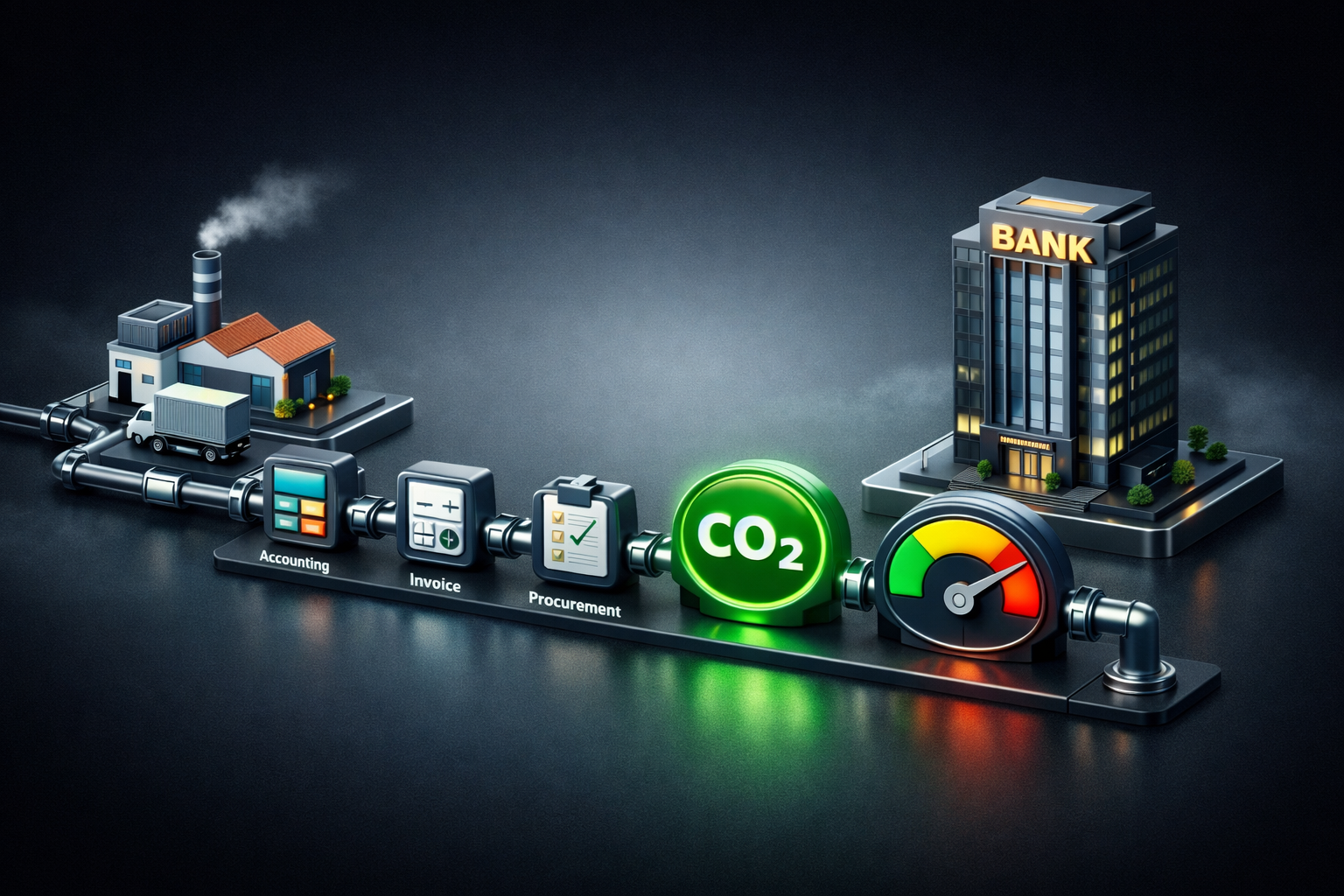
That is the gap fintech should be chasing. Automated Scope 3 calculators that pull data from invoicing and procurement systems. Emissions dashboards that integrate with accounting platforms like Xero and MYOB. Pre-populated sustainability reports that satisfy both client requirements and lending criteria without requiring a consultant.
The businesses that figure out carbon compliance first will not just avoid penalties. They will access cheaper capital, win contracts from large reporters, and build competitive advantages that price alone cannot replicate. The rest will wonder why their loan terms changed.
Regional Australia is about to learn that sustainability is not a marketing exercise. It is a financial instrument. And the banks are already keeping score.
Darren Tredgold is the General Manager of Independent Steel Company, an Australian-owned steel distributor serving South-East NSW since 2000.