Close Menu
Fintechbits
  • News
  • AI
  • Acquisitions
  • Trends
  • Insights
  • Rumors
  • Startups
  • finjobsly

Subscribe to Updates

Get the latest news from Fintechbits.

Trending Now

Novidea Enhances Platform to Optimize Insurance Workflows

March 17, 2026

Apple Introduces First Background Security Update for iPhones, iPads, and Macs to Address Safari Vulnerability

March 17, 2026

Battery Storage Financing: 5 Proven Models Reshaping Home Energy

March 17, 2026

The Invoice Gap Is Killing Trades Businesses Before They Go Broke

March 17, 2026
Facebook X (Twitter) Instagram
Trending
  • Novidea Enhances Platform to Optimize Insurance Workflows
  • Apple Introduces First Background Security Update for iPhones, iPads, and Macs to Address Safari Vulnerability
  • Battery Storage Financing: 5 Proven Models Reshaping Home Energy
  • The Invoice Gap Is Killing Trades Businesses Before They Go Broke
  • Akur8 Acquires Slope Software to Enhance Actuarial Platform
  • BuzzFeed Launches AI-Driven Applications to Explore New Revenue Streams
  • Profile of Daniel Ruhman, CEO of Cumbuca
  • Apple’s September Announcements: MacBook Neo, AirPods Max 2, iPhone 17e, and More
Facebook X (Twitter) Instagram Pinterest Vimeo
Fintechbits
  • News

    Novidea Enhances Platform to Optimize Insurance Workflows

    March 17, 2026

    Akur8 Acquires Slope Software to Enhance Actuarial Platform

    March 17, 2026

    Upvest Secures $125 Million to Modernize Banking Infrastructure in Europe

    March 17, 2026

    Exposing the Anti-Money Laundering Blind Spot in South Africa’s Illegal Gambling Sector

    March 17, 2026

    The Potential of Angola’s Fintech Ecosystem in 2026

    March 17, 2026
  • AI

    Africa’s Fintech Future Highlights the Opening of IFF 2026 in Kigali

    March 17, 2026

    Algeria’s Fintech Ecosystem in 2026: Strategies for Building Momentum

    March 16, 2026

    Exploring the Concept of Bloxx in The Fintech Times

    March 15, 2026

    Mastercard Launches Unified Global Commerce Suite to Enhance Cross-Border SME Payments in APAC

    March 15, 2026

    Bybit Connects Traditional Banking and Digital Assets Through Direct AED Trading Pairs

    March 15, 2026
  • Acquisitions

    Californian Companies Lead US FinTech Transactions in Q2 with a 19% Year-Over-Year Growth in Deal Activity

    March 17, 2026

    Brazilian Companies Lead LatAm FinTech Transactions in Q3 with 54% Quarter-over-Quarter Growth

    March 16, 2026

    Latin American FinTech Investments Decline by 50% Year-over-Year in Q4 2025 Amid Increased Investor Caution

    March 15, 2026

    What Makes a Fintech an Attractive Acquisition Target Versus One Headed for a Distressed Sale?

    February 20, 2026

    MrBeast’s Company Acquires Fintech App Targeting Gen Z

    February 10, 2026
  • Trends

    European FinTech 2025 Is Back and Means Business

    March 16, 2026

    Subscription Payment Fatigue Is Coming for Children’s Services

    March 16, 2026

    Green Fintech: 5 Proven Reasons It Goes Beyond a Compliance Checkbox

    March 16, 2026

    Claude overtakes ChatGPT as AI trust debate intensifies

    March 16, 2026

    Eleven companies, eighty-three days: the race for a federal crypto-banking license

    March 15, 2026
  • Insights

    The Invoice Gap Is Killing Trades Businesses Before They Go Broke

    March 17, 2026

    Battery Storage Financing: 5 Proven Models Reshaping Home Energy

    March 17, 2026

    US Maintains Status as Premier Global WealthTech Hub Despite 47% Decline in Deal Activity in 2025

    March 16, 2026

    Green Fintech: 5 Proven Reasons It Goes Beyond a Compliance Checkbox

    March 16, 2026

    European FinTech Investments Decline 11% Year-Over-Year Due to Market Uncertainties in 2025

    March 16, 2026
  • Rumors

    Gilead Snaps Up Arcellx in $7.8B Most cancers Drug Deal

    March 14, 2026

    Tilly’s Inventory Pops After This autumn Earnings Shock

    March 14, 2026

    Elliott and Jana Take Recent Actions Alongside Other Speculations

    February 22, 2026

    Hank Payments (TSX) Rises to CAD 0.26 on February 18, 2026: Catalyst Analysis

    February 19, 2026

    Abivax CEO refers to Eli Lilly acquisition speculation as a diversion.

    February 8, 2026
  • Startups

    Apple Introduces First Background Security Update for iPhones, iPads, and Macs to Address Safari Vulnerability

    March 17, 2026

    BuzzFeed Launches AI-Driven Applications to Explore New Revenue Streams

    March 17, 2026

    Apple’s September Announcements: MacBook Neo, AirPods Max 2, iPhone 17e, and More

    March 17, 2026

    Amazon Introduces 1-Hour and 3-Hour Delivery Services in the U.S.

    March 17, 2026

    Jensen Huang Elevates Nvidia’s Blackwell and Vera Rubin Sales Projections to $1 Trillion Level

    March 17, 2026
  • finjobsly
Fintechbits
Home » Battery Storage Financing: 5 Proven Models Reshaping Home Energy
Market Insights

Battery Storage Financing: 5 Proven Models Reshaping Home Energy

5 Mins Read
Facebook Twitter Pinterest Telegram LinkedIn Tumblr Email Reddit
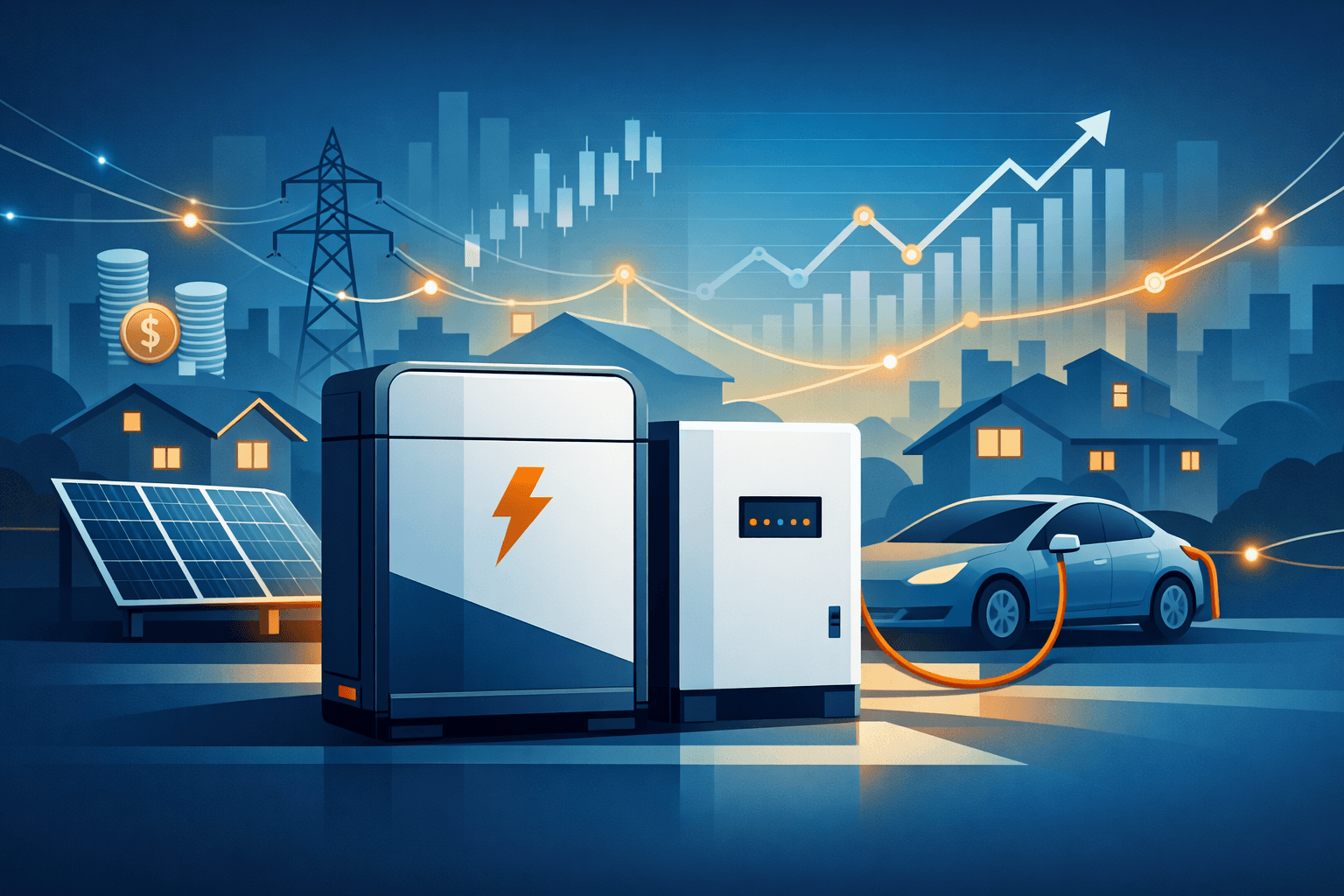
Battery storage financing models for home energy VPP systems
Five emerging models are closing the gap between home battery revenue and consumer lending.
Share
Facebook Twitter LinkedIn Pinterest Email Copy Link

Author: Brady Souden, Director, Econ Energy

Battery storage financing has not kept up with the technology it supports. Even as virtual power plants (VPPs) now span over 37.5 GW of flexible capacity in the US alone, the battery storage financing options available to homeowners still treat these systems like generic appliances rather than revenue-producing assets.

That disconnect has real consequences. For instance, a 13.5 kWh Tesla Powerwall can earn $300 to $1,000 per year through VPP participation. Yet no mainstream battery storage financing product factors this revenue into a borrower’s capacity to repay. Instead, lenders rely on FICO scores and standard personal loan terms. According to the US Department of Energy, home batteries could deliver $10 billion per year in grid savings by 2030. Without better lending products, adoption will lag far behind that potential.

Battery Storage Financing Hits a Wall With Traditional Lending

So why can’t existing loan products handle this asset class? Put simply, batteries break every traditional lending category.

Car loans cover depreciating assets that produce no income. Mortgages cover appreciating assets with clear shelter value. In contrast, home batteries depreciate at 1 to 2% per year while simultaneously generating revenue from energy arbitrage, demand response, and capacity payments. No standard underwriting model accounts for all three dimensions at once.

On top of that, battery revenue is wildly volatile. In Texas, batteries earned 50% of their annual income in just 13 days during 2023. Then ERCOT revenues collapsed roughly 90% between 2023 and 2025 as installed capacity tripled to 11 GW. Similarly, California battery net revenues per kilowatt dropped from $103 in 2022 to $53 in 2024 as solar penetration softened peak prices.

Because of this volatility, most homeowners still access battery storage financing through four limited channels: cash purchase at around $15,000, solar-bundled loans through platforms like GoodLeap, PACE financing at 6.5 to 9.0% rates, or green loans like Australia’s Brighte at 6.99% introductory rates. None of these incorporate VPP revenue into their lending decisions.

5 Models Closing the Battery Storage Financing Gap

Despite these challenges, five approaches are reshaping how home batteries get funded. Each one tackles the problem from a different angle, and together they point toward what a mature lending market could look like.

1. Fleet Ownership (Base Power) Austin-based Base Power raised $1 billion in October 2025 by eliminating consumer financing altogether. Essentially, the company owns the batteries, installs them for $695, and charges homeowners $19 per month plus electricity at 8.5 cents per kWh. As a result, Base Power transforms the question from consumer lending into something closer to utility-scale project finance. Its fleet already exceeds 100 MWh of residential capacity across Texas, proving that creative battery storage financing can scale without touching a credit score.

2. Utility-Contract-Backed Lending (Swell Energy) Swell Energy created a $450 million financing vehicle backed by 10 to 15 year utility capacity payment contracts. Consequently, the utility contract itself serves as collateral rather than relying on a borrower’s credit score alone. Meanwhile, Swell’s GridAmp software platform manages multi-vendor battery fleets, generating the performance data lenders need.

3. Solar-Plus-Battery Securitisation (Sunrun) Sunrun priced a $629 million securitisation in January 2025 covering residential solar and battery systems. With battery attachment rates hitting 70% of new installations by Q3 2025, batteries are gradually becoming standard components within securitised pools. Over time, this builds the performance track record that standalone battery-backed instruments will eventually require.

4. Utility-Led Leasing (Green Mountain Power) Vermont’s Green Mountain Power leases Tesla Powerwalls for $55 per month. Here, the utility carries the financing risk while monetising VPP value across its entire customer base. Therefore, this model replaces consumer underwriting with investment-grade utility credit, removing one of the biggest barriers to residential battery adoption.

5. Government-Backed Subsidy Architecture (Australia) Australia’s Cheaper Home Batteries Program expanded to $7.2 billion in December 2025, providing roughly a 30% discount on costs through Small-scale Technology Certificates. Importantly, eligible batteries must be VPP-capable to qualify for the subsidy. More than 125,000 households installed batteries in the first four months alone. As a result, this program creates a growing pipeline of verified VPP performance data that future lenders can use for underwriting.

What Stands Between Today and Scalable Battery Storage Financing

All five models represent meaningful progress. Still, no purpose-built product exists that underwrites projected VPP revenue as part of a borrower’s repayment capacity at scale. Each approach solves one piece of the puzzle, but none yet delivers a complete battery storage financing solution that a mainstream lender could offer across geographies and market conditions without bespoke structuring.

Three things need to happen before that changes. First, standardised data infrastructure must emerge for real-time battery performance and revenue tracking. Companies like Texture and Swell’s GridAmp are working on this problem from different directions, but widespread adoption remains fragmented across markets. Second, VPP participation agreements need longer terms and standardised structures so lenders can treat them as assignable collateral. Most current agreements are far too short for that purpose. Third, the market needs enough performance history to satisfy rating agencies evaluating securitised battery portfolios.

Australia’s approach offers the clearest global template. By combining subsidies with VPP-readiness mandates and mature wholesale market access, it gives lenders something they can measure and model. For fintech builders and energy finance innovators, battery storage financing remains one of the largest untapped opportunities in distributed energy. Ultimately, the companies that solve it will help build both a new lending category and the distributed grid itself.

Brady Souden is Director of Econ Energy, a family-owned Canberra solar and electrification business with over 6,000 solar installations. He writes about the intersection of clean energy and financial innovation for FintechBits.

BankingInnovation Financial
Share. Facebook Twitter Pinterest LinkedIn Tumblr Email

Related Posts

The Invoice Gap Is Killing Trades Businesses Before They Go Broke

March 17, 2026

US Maintains Status as Premier Global WealthTech Hub Despite 47% Decline in Deal Activity in 2025

March 16, 2026

Green Fintech: 5 Proven Reasons It Goes Beyond a Compliance Checkbox

March 16, 2026
Leave A Reply Cancel Reply

Latest news

Novidea Enhances Platform to Optimize Insurance Workflows

March 17, 2026

Apple Introduces First Background Security Update for iPhones, iPads, and Macs to Address Safari Vulnerability

March 17, 2026

Battery Storage Financing: 5 Proven Models Reshaping Home Energy

March 17, 2026
News
  • AI in Finance (2,163)
  • Breaking News (214)
  • Corporate Acquisitions (84)
  • Industry Trends (280)
  • Jobs Market News (338)
  • Market Insights (303)
  • Market Rumors (308)
  • Regulatory Updates (214)
  • Startup News (1,362)
  • Technology Innovations (230)
  • uncategorized (9)
  • X Feed (1)
About US
About US

FintechBits is a blog delivering the latest news and insights in fintech, finance, and technology. We cover breaking news, market trends, innovations, and expert opinions to keep you informed about the future of finance

Facebook X (Twitter) Instagram Pinterest Reddit TikTok
News
  • AI in Finance (2,163)
  • Breaking News (214)
  • Corporate Acquisitions (84)
  • Industry Trends (280)
  • Jobs Market News (338)
  • Market Insights (303)
  • Market Rumors (308)
  • Regulatory Updates (214)
  • Startup News (1,362)
  • Technology Innovations (230)
  • uncategorized (9)
  • X Feed (1)
Happening Now

November 28, 2024

“ Intentionally collaborative ”: how the Rotman school of U of T leads Innovation Fintech

February 6, 2025

‘1957 Ventures’ to Drive FinTech Innovation in Saudi Arabia

September 10, 2024
  • About FintechBits
  • Advertise With us
  • Contact us
  • Disclaimer
  • Privacy Policy
  • Terms and services
  • BUY OUR EBOOK GUIDE
© 2026 Designed by Fintechbits

Type above and press Enter to search. Press Esc to cancel.