Close Menu
fintechbits
  • News
  • AI
  • Acquisitions
  • Trends
  • Insights
  • Rumors
  • Startups
  • finjobsly

Subscribe to Updates

Get the latest news from Fintechbits.

Trending Now

B2B buy now pay later is having a moment. Not the hype kind. The “this fixes a real operational headache” kind.

February 15, 2026

NextGen Finance AI Summit Kicks Off at Technopark in Thiruvananthapuram

February 14, 2026

Romance scams, chargebacks, and the trust problem fintech cannot ignore

February 14, 2026

BNPL, wallets, and the new last-minute Valentine checkout

February 14, 2026
Facebook X (Twitter) Instagram
Trending
  • B2B buy now pay later is having a moment. Not the hype kind. The “this fixes a real operational headache” kind.
  • NextGen Finance AI Summit Kicks Off at Technopark in Thiruvananthapuram
  • Romance scams, chargebacks, and the trust problem fintech cannot ignore
  • BNPL, wallets, and the new last-minute Valentine checkout
  • Evaluating Whether ChatGPT, Gemini, or Grok is the Best Option for Personal Finance Management
  • Fundamentum and SMBC Asia invest in fintech startup Olyv.
  • Singapore spearheads the implementation of AI in the financial services sector.
  • Valentine’s spending is hitting records, and payment habits are changing fast
Facebook X (Twitter) Instagram Pinterest Vimeo
fintechbits
  • News

    The emergence of licensing for banking services as a new trend in Fintech and its implications for the financial ecosystem

    February 11, 2026

    FinTech Magazine’s Latest Issue Highlights Klarna and Stripe Discussing the Future of Cryptocurrency

    February 10, 2026

    PB Fintech shares rise over 8% following significant news regarding its fundraising strategy.

    February 5, 2026

    CBN fintech investigation report suggests significant change in regulator’s position

    February 2, 2026

    Headlines from KUTV covering news, weather, sports, and breaking updates in Salt Lake City

    January 19, 2026
  • AI

    NextGen Finance AI Summit Kicks Off at Technopark in Thiruvananthapuram

    February 14, 2026

    Evaluating Whether ChatGPT, Gemini, or Grok is the Best Option for Personal Finance Management

    February 14, 2026

    Singapore spearheads the implementation of AI in the financial services sector.

    February 13, 2026

    Agentic AI Enhances Financial Returns in Accounts Payable Automation

    February 13, 2026

    Is it wise to rely on Gemini, ChatGPT, or Grok AI for personal finance choices? Tech firms are progressively highlighting AI as a resource for assisting individuals in managing their everyday lives and decisions.

    February 13, 2026
  • Acquisitions

    MrBeast’s Company Acquires Fintech App Targeting Gen Z

    February 10, 2026

    Capital One’s $5 billion purchase of fintech Brex may prove to be another brilliant move by billionaire Richard Fairbank.

    January 24, 2026

    Fintech Partnership Enhances UST’s Digital Banking Goals

    January 20, 2026

    CoinGecko is reportedly exploring a sale valued at $500 million.

    January 16, 2026

    Flutterwave acquires Nigerian Mono in a unique exit for African fintech.

    January 6, 2026
  • Trends

    BNPL, wallets, and the new last-minute Valentine checkout

    February 14, 2026

    Valentine’s spending is hitting records, and payment habits are changing fast

    February 13, 2026

    Why B2B buy-now-pay-later is outpacing consumer BNPL

    February 13, 2026

    GCC fintech market projected to attain a value of $26.8 billion

    February 5, 2026

    Key Stablecoin Trends to Monitor in 2026 – Fintech Schweiz Digital Finance News

    January 21, 2026
  • Insights

    B2B buy now pay later is having a moment. Not the hype kind. The “this fixes a real operational headache” kind.

    February 15, 2026

    Romance scams, chargebacks, and the trust problem fintech cannot ignore

    February 14, 2026

    BNPL, wallets, and the new last-minute Valentine checkout

    February 14, 2026

    Valentine’s spending is hitting records, and payment habits are changing fast

    February 13, 2026

    Why B2B buy-now-pay-later is outpacing consumer BNPL

    February 13, 2026
  • Rumors

    Abivax CEO refers to Eli Lilly acquisition speculation as a diversion.

    February 8, 2026

    Big Tech’s AI Investment Competition; PB Fintech Halts QIP Initiative

    February 6, 2026

    SpaceX Considers Initial Public Offering, Spirit Airlines Owner Explores Private Equity, and Other Speculations

    January 25, 2026

    Collapse of Livestock Markets Amid Tumultuous Rumors

    January 23, 2026

    Crypto schools draw interest amid speculation regarding UAE initiatives.

    January 23, 2026
  • Startups

    Fundamentum and SMBC Asia invest in fintech startup Olyv.

    February 13, 2026

    Two fintech builders on what they wish they knew before building

    February 12, 2026

    SC appoints LC Wakaful Digital to run Malaysia’s inaugural social exchange platform

    February 12, 2026

    Aspire seeks to significantly increase its startup clientele via collaboration with Antler.

    February 12, 2026

    Gurugram-based fintech startup secures $8 million to enhance hospital billing with AI technology.

    February 12, 2026
  • finjobsly
fintechbits
Home » B2B buy now pay later is having a moment. Not the hype kind. The “this fixes a real operational headache” kind.
Market Insights

B2B buy now pay later is having a moment. Not the hype kind. The “this fixes a real operational headache” kind.

5 Mins Read
Facebook Twitter Pinterest Telegram LinkedIn Tumblr Email Reddit
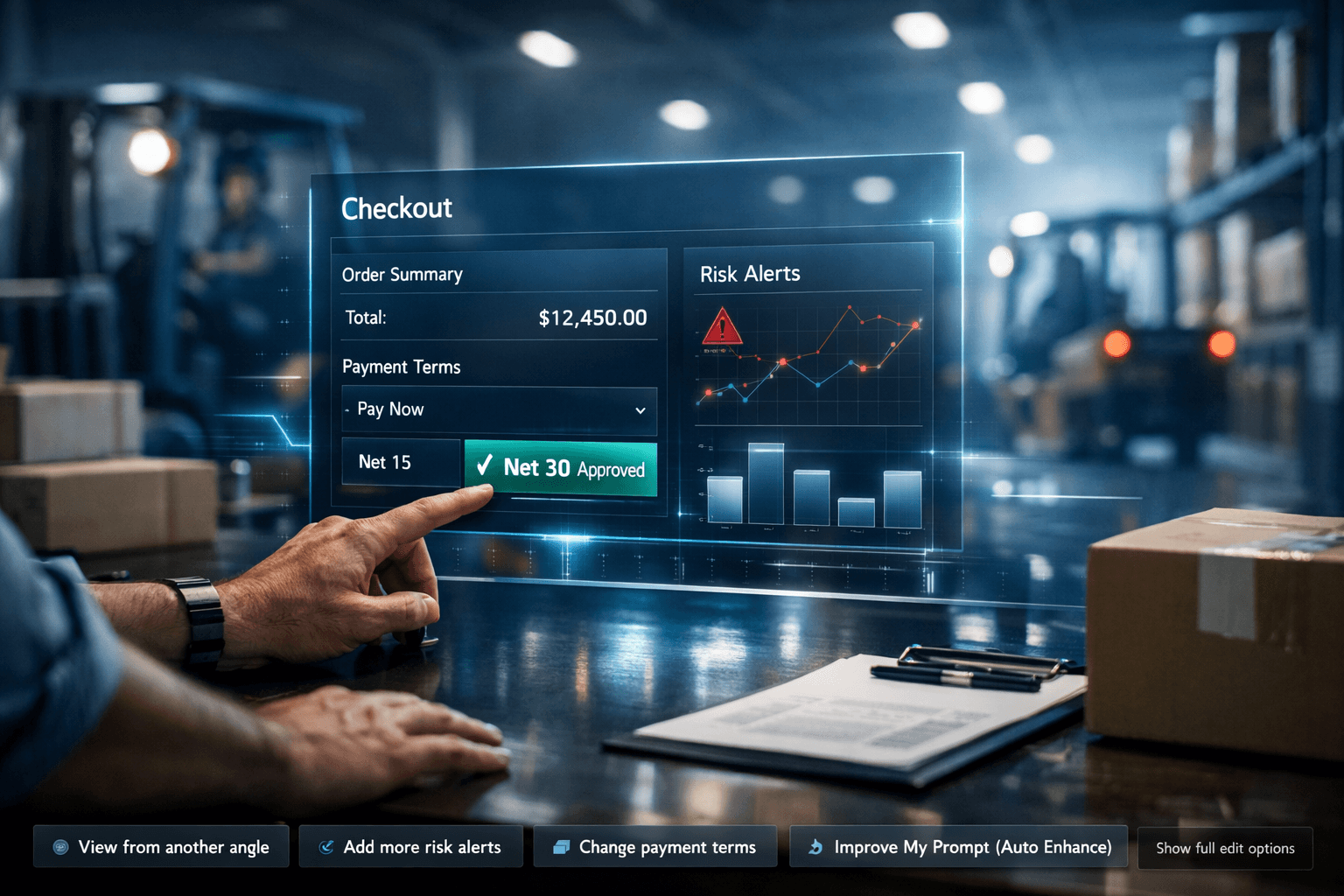
B2B buy now pay later dashboard in a warehouse setting showing approval and payment terms
B2B BNPL makes payment terms faster to approve, easier to manage, and visible at checkout.
Share
Facebook Twitter LinkedIn Pinterest Email Copy Link

We asked industry leaders who work close to trade credit, underwriting, and day to day payments why B2B BNPL is growing faster than consumer BNPL, what is driving adoption, and what buyers and sellers keep getting wrong.

The simple reason is that B2B purchases are rarely impulse buys. They are inputs. Stock, materials, software, parts, services. If the buyer cannot pay on the day, work still needs to move. So the conversation is less about “can I afford this” and more about “can I keep the pipeline moving without breaking cash flow”.

Consumer BNPL is also entering a more regulated and more competitive phase in many markets. Most shoppers already have options, providers have learned the hard lessons on losses, and merchants have more choice. That tends to compress growth.

B2B BNPL is stepping into a different baseline. Businesses already operate on terms like Net 30 and Net 60. So BNPL is not introducing delayed payment. It is productising it. It makes terms faster to approve, easier to manage, and more visible inside checkout and invoicing workflows.

One of the biggest unlocks is underwriting. In consumer BNPL, risk often leans on credit history and bureau style signals. In B2B, the best signals are often operational. Order frequency, repeat behaviour, refund patterns, chargebacks, seasonality, and whether the business pays suppliers on time. When providers can tap those signals, they can make faster decisions and open credit to firms that look “thin file” on paper but are stable in reality.

“B2B BNPL is growing faster because providers can underwrite based on business performance and cash flow rather than relying solely on credit scores, which lets them extend credit to firms traditional lenders would decline. Compared with trade credit that often depends on long relationships and historical scores, BNPL evaluates order patterns, refund behavior, and operational discipline for faster, more targeted decisions. In one case I approved an e-commerce founder with a thin credit file and an old default after reviewing steady sales, low chargebacks, improving month-to-month cash flow, and responsible operational practices. Those kinds of real operational signals are the main driver of adoption, and I see e-commerce merchants adopting this approach most rapidly.”

  • Daniel Kroytor, CEO, TailoredPay

That point about trade credit matters. Traditional trade credit can be powerful, but it often sits behind manual steps. Someone has to request terms, someone has to review, someone has to approve, and someone has to monitor exposure. That works when relationships are stable and volumes are predictable. It struggles when companies want self serve checkout, instant decisions, and clean reconciliation.

B2B BNPL is taking a workflow that used to be relationship heavy and making it software native. For sellers, it can mean fewer abandoned carts, higher average order values, and less time chasing payment. For buyers, it means smoother procurement and fewer moments where a project is blocked because finance and operations are out of sync.

Adoption tends to move fastest where three conditions show up together.

First, ticket sizes are meaningful but not huge. Big enough to hurt cash flow, small enough to approve quickly and repeat often.

Second, purchasing is frequent or seasonal. Businesses with steady repeat orders feel the benefit of terms immediately because it smooths cash flow week to week.

Third, the supplier base is fragmented. When there are many vendors, buyers do not want to negotiate terms repeatedly. They want one way to pay across many suppliers.

E-commerce and wholesale are early movers for obvious reasons. The data is rich, the transactions are frequent, and checkout is already digitised. But the pattern extends beyond retail categories. Think logistics, light manufacturing, construction supplies, professional services, and B2B SaaS add-ons that sit outside annual contracts.

A lot of buyers assume BNPL is a last resort. In B2B, it is often a planning tool. If your cash conversion cycle is tight, or you have lumpy receivables, terms can let you take on more work without borrowing in a traditional way. The best buyers treat it like a lever, not a bailout.

Sellers sometimes make the opposite mistake. They think BNPL is only a marketing add on. In practice, it is a payments and risk decision. The seller needs to understand who holds the risk, what fees exist, how disputes work, and what happens when a buyer defaults. If the product is set up well, it can reduce seller risk by shifting exposure to a specialist. If it is set up poorly, it can create operational chaos with chargebacks, returns, and reconciliation headaches.

Another common misconception is that B2B BNPL replaces trade credit. For many companies, it will sit alongside trade credit. Trade credit still wins in deep relationships and high trust environments. BNPL wins where speed, self serve, and standardisation matter.

Where this is heading is not mysterious. We will see tighter integration into invoicing, accounting, and procurement tools. We will see more role based controls so finance teams can set limits while operations teams keep buying. And we will see underwriting become more “real time” as providers blend payment data, order data, and behavioural signals.

B2B BNPL is growing because it is solving a boring problem that costs businesses time and momentum. The real story is not trendiness. It is terms as infrastructure. When payment terms become a button instead of a negotiation, commerce speeds up.

Share. Facebook Twitter Pinterest LinkedIn Tumblr Email

Related Posts

Romance scams, chargebacks, and the trust problem fintech cannot ignore

February 14, 2026

BNPL, wallets, and the new last-minute Valentine checkout

February 14, 2026

Valentine’s spending is hitting records, and payment habits are changing fast

February 13, 2026
Leave A Reply Cancel Reply

Latest news

B2B buy now pay later is having a moment. Not the hype kind. The “this fixes a real operational headache” kind.

February 15, 2026

NextGen Finance AI Summit Kicks Off at Technopark in Thiruvananthapuram

February 14, 2026

Romance scams, chargebacks, and the trust problem fintech cannot ignore

February 14, 2026
News
  • AI in Finance (2,124)
  • Breaking News (191)
  • Corporate Acquisitions (80)
  • Industry Trends (234)
  • Jobs Market News (334)
  • Market Insights (239)
  • Market Rumors (304)
  • Regulatory Updates (201)
  • Startup News (1,330)
  • Technology Innovations (204)
  • uncategorized (5)
  • X Feed (1)
About US
About US

FintechBits is a blog delivering the latest news and insights in fintech, finance, and technology. We cover breaking news, market trends, innovations, and expert opinions to keep you informed about the future of finance

Facebook X (Twitter) Instagram Pinterest Reddit TikTok
News
  • AI in Finance (2,124)
  • Breaking News (191)
  • Corporate Acquisitions (80)
  • Industry Trends (234)
  • Jobs Market News (334)
  • Market Insights (239)
  • Market Rumors (304)
  • Regulatory Updates (201)
  • Startup News (1,330)
  • Technology Innovations (204)
  • uncategorized (5)
  • X Feed (1)
Happening Now

November 28, 2024

“ Intentionally collaborative ”: how the Rotman school of U of T leads Innovation Fintech

February 6, 2025

‘1957 Ventures’ to Drive FinTech Innovation in Saudi Arabia

September 10, 2024
  • About FintechBits
  • Advertise With us
  • Contact us
  • Disclaimer
  • Privacy Policy
  • Terms and services
  • BUY OUR EBOOK GUIDE
© 2026 Designed by Fintechbits

Type above and press Enter to search. Press Esc to cancel.