Author: Callum Gracie, Founder, Otto Media
Australian payment processing has never offered more choice for small business owners. Yet that choice also makes Australian payment processing more confusing than ever, because Stripe, Square and Airwallex each target a different type of seller. So which one deserves your transaction volume?
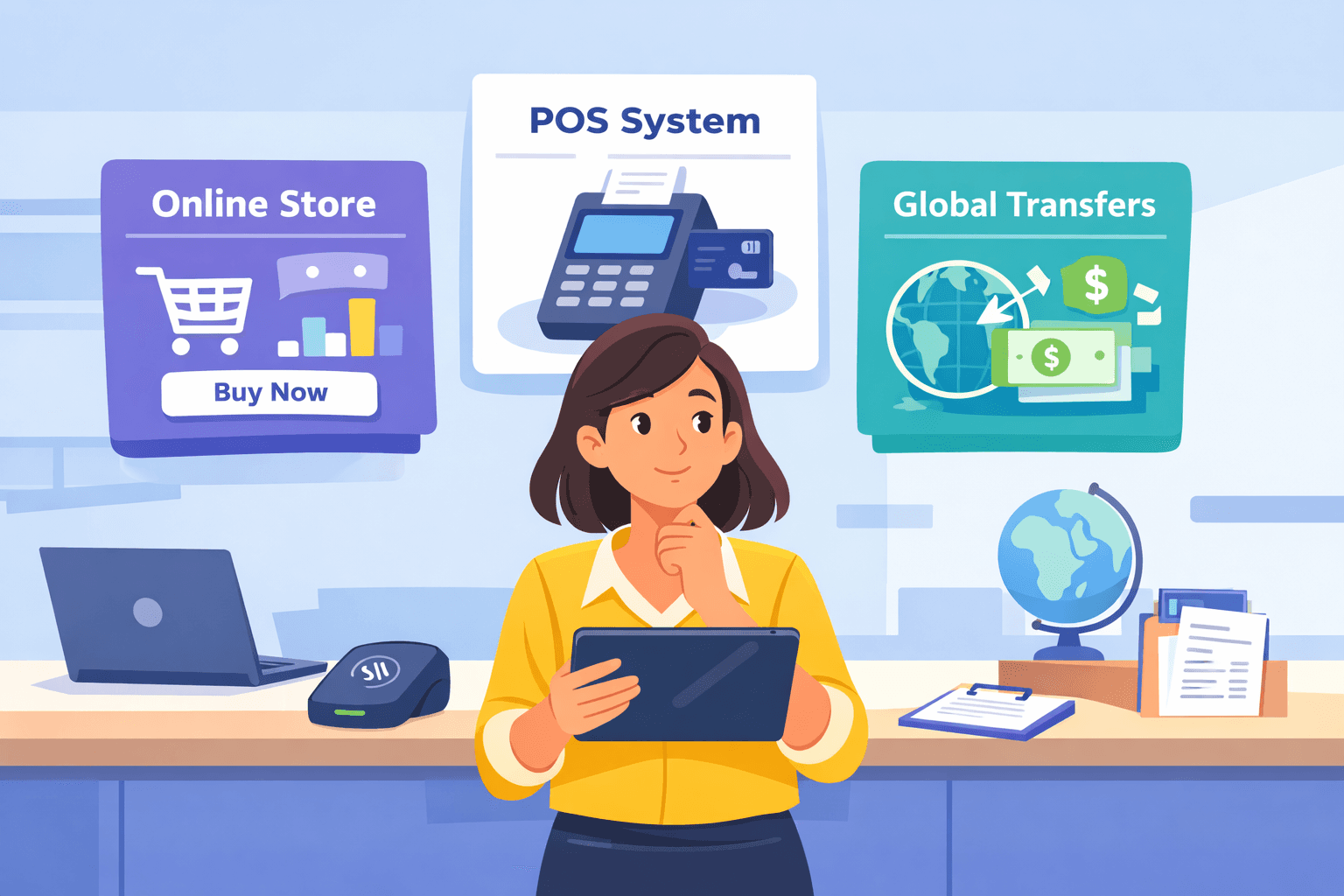
The short answer depends on where your money flows. Square wins at the counter with 1.6% in-person fees. Stripe dominates online commerce at 1.7% + $0.30. Meanwhile, Airwallex delivers unbeatable cross-border value with FX margins as low as 0.5%. Before you commit, though, the details matter more than the headlines.
Australian Payment Processing Fees Side by Side
Every Australian payment processing decision starts with fees, so let’s compare the numbers that matter most.
Stripe charges 1.7% + $0.30 for domestic online card transactions. In contrast, Square charges a flat 1.6% for in-person taps and 2.2% for online payments. Airwallex sits between the two at 1.65% + $0.30 for domestic online cards, although it currently has no POS hardware in Australia.
Those gaps widen once international cards enter the picture. Stripe’s international rate jumps to 3.5% + $0.30, with another 2% added for currency conversion. That pushes the all-in cost above 5.5% on a single foreign transaction. Airwallex, on the other hand, handles cross-border payments far more efficiently. Businesses can settle in 14+ currencies and sidestep forced conversion altogether.
Here is one often-overlooked detail. Square absorbs chargeback fees entirely, while both Stripe and Airwallex charge $25 per dispute. For a micro-business processing thin margins, even two or three chargebacks per quarter can sting.
What Each Platform Does Best for Small Operators
Understanding Australian payment processing strengths means matching features to your business model, not just chasing the lowest rate.
Square is the all-in-one countertop solution. Its free plan bundles POS software, inventory tracking, staff scheduling and a customer directory. Specialised modules cover restaurants, retail and appointments. On top of that, Square hardware is available off-the-shelf at JB Hi-Fi and Officeworks, starting from just $65 for a Bluetooth reader. Terminal units with built-in receipt printers run $329, while the full dual-screen Register costs $1,099. The offline payment mode also lets you accept cards without internet for up to 24 hours, which is essential for markets and mobile trades. Both Square and Stripe now also support Tap to Pay on iPhone and Android at zero hardware cost, giving sole traders a free entry point for occasional in-person sales.
Stripe, however, excels when payments flow through a website. It supports 135+ currencies, over 100 payment methods and integrates with platforms like Shopify and WooCommerce. For non-technical owners, Stripe’s Payment Links and hosted Checkout pages require zero coding. Its built-in Radar fraud detection system uses machine learning to flag suspicious transactions at no extra cost, a feature that mirrors broader trends in AI-powered financial security.
Airwallex, by comparison, is purpose-built for businesses that move money across borders. Its multi-currency wallet holds 20+ currencies with local bank details in 21 countries. As a result, a freelancer billing US clients can receive USD payments via local American rails, hold those funds and convert at favourable rates. Airwallex also offers virtual corporate cards and an interest-earning Yield product paying 3.72% on AUD balances.
Accounting Integration Matters More Than You Think
Smooth Australian payment processing means nothing if your bookkeeper spends hours reconciling messy data.
All three platforms integrate with Xero, the dominant accounting tool among Australian SMEs. Still, the depth of those integrations varies, and that depth shapes the overall Australian payment processing experience. Square’s Xero connection syncs daily sales summaries, captures every transaction type and separates data across multiple locations. Stripe’s Xero integration takes things further with a “Pay Now” button on invoices and Tap to Pay functionality built directly into the Xero app. Airwallex offers hourly bank feed syncing, which is more frequent than either competitor, plus expense management with AI-powered receipt extraction.
For MYOB users, the picture is less appealing across the board. Both Square and Airwallex rely on third-party connectors rather than native integrations. Stripe’s MYOB connection is similarly indirect.
When it comes to setup difficulty, Square is the easiest. You can download the app, create an account and start selling in minutes. Stripe requires a little more configuration but remains manageable for non-developers. Airwallex packs the most features, yet multiple user reviews note a steeper learning curve for simpler use cases.
Regulatory Shifts Are Reshaping Australian Payment Processing
Two major regulatory developments will affect every Australian payment processing decision in the months ahead.
First, the RBA announced on 31 March 2026 that it will ban card surcharging from 1 October 2026. Surcharges on eftpos, Visa and Mastercard transactions will be prohibited entirely. Lower interchange fee caps will accompany the ban, saving businesses an estimated $900 million annually. For micro-businesses that currently pass card fees on to customers, this shift means absorbing processing costs directly. Consequently, even a 0.5% difference between platforms becomes meaningful.
Second, AUSTRAC ordered an external audit of Airwallex in January 2026 over suspected AML/CTF compliance failures. Concerns include transaction monitoring gaps, insufficient customer identification and reporting deficiencies. As it stands, the auditor must deliver findings within 180 days. Daily operations continue as normal, and AUSTRAC has previously audited PayPal, Afterpay and Revolut without shutting them down. Nevertheless, risk-averse business owners should factor this regulatory uncertainty into their choice. This kind of compliance scrutiny reflects broader fintech governance challenges globally.
So Which Platform Should You Pick?
The best Australian payment processing platform depends on your dominant transaction channel.
Go with Square if your revenue flows through a countertop, a market stall or on-site service calls. Its 1.6% in-person rate, zero chargeback fees and free POS software are hard to beat for face-to-face sellers.
Choose Stripe if you run an online store, subscription service or any website-first business. Its developer tools, broad payment method coverage and expanding global footprint make it the default for e-commerce.
Pick Airwallex if your business regularly invoices or pays in foreign currencies. The savings on FX alone can total thousands annually compared to Big Four bank rates. To put it in perspective, an importer paying $500,000 to overseas suppliers each year would save roughly $12,500 by using Airwallex’s 0.5% margin instead of a typical 3% bank spread.
For businesses that need both in-person and online Australian payment processing, a common and practical setup is running Square at the register alongside Stripe on the website. That combination delivers the strongest rate for each channel without overcomplicating your operations.
Whichever platform you choose, the October 2026 surcharging ban makes this decision more urgent than it was six months ago. Now is the time to lock in the Australian payment processing partner that protects your margins before that change hits.