Author: Charitarth Sindhu, Fractional Business & AI Workflow Consultant
For most of fintech’s short history, AI has had a clear job: assist humans.
It might flag a suspicious card payment, rank a borrower’s risk, or surface an alert for a compliance analyst. But the final call, in theory, stayed with a person.
That line is blurring fast. The most important fintech trend right now is not “AI in finance” in the generic sense. It’s more specific than that.
AI is moving from being a tool that recommends actions to being a system that takes actions.
That sounds like a small wording change. It isn’t. It changes who is accountable, what regulators expect, and what “risk management” even means in practice.
What changed
The reason this is happening is not just because models improved. It’s because the environment around fintech changed.
Payments are more real-time than ever. Fraud moves faster than manual review. Customers expect instant approvals. Cross-border money moves 24/7. And financial products are now delivered through apps and platforms that scale quickly.
In that world, “human decides, machine suggests” becomes a bottleneck. The system needs to act at machine speed, with humans supervising rather than steering every single moment.
So the operating model shifts.
Instead of a person deciding each time, the organisation sets boundaries and rules, then the AI system makes decisions within those boundaries. Humans step in when something looks off, or when the system hits an edge case it cannot safely handle.
Where it shows up in real life
This trend shows up first in areas where speed matters and volume is high.
In payments and fraud, AI systems are increasingly trusted to block, allow, or route transactions automatically. It is not just “this looks suspicious.” It is “stop it now.”
In lending, underwriting models are used to approve or reject within certain limits, without a person reviewing every application. Humans still exist in the loop, but more as exception handlers than gatekeepers.
In compliance, monitoring systems do more than generate alerts. They decide which alerts are noise and which are worth escalating. That reduces false positives, but it also shifts judgment from people to software.
Even inside back-office operations, AI is being used to trigger internal actions. Think of automated liquidity moves, automated risk flags, automated incident workflows.
The shared thread is delegation. The organisation is handing over a slice of decision power to a machine.
Why professionals should care
This is the part that gets serious.
When a human makes a bad call, you can ask them why. You can retrain them, replace them, or tighten the process. When an AI system makes a bad call, the “why” is harder. Sometimes it is not even stable, because models can drift as data changes.
That is why this trend becomes less about technical performance and more about governance. The big failures tend not to be “the model was broken.” They tend to be “we did not define responsibility.”
Who owns the decision boundaries?
Who monitors performance over time?
Who can override the system?
What happens when the AI behaves oddly but not obviously “wrong”?
How do you prove to a regulator that the system is controlled?
These questions sit in the uncomfortable middle of product, risk, compliance, engineering, and leadership. They are not solved by one team. And that’s the point.
The hardest risk here is organisational.
The new risk isn’t cyber, it’s accountability
A lot of fintech risk commentary still fixates on technical concerns. Encryption standards. Model accuracy. Infrastructure resilience. Those matter, but they are not the core problem in this trend.
The core problem is the same one that shows up in every fast-moving, regulated business: decision-making under uncertainty.
If an AI system is making decisions, your organisation needs to treat that decision pipeline like critical infrastructure. Not like a feature. Not like a nice-to-have automation layer.
That means clear scope. Clear boundaries. Clear escalation rules. Clear human authority. Clear documentation. Clear measurement.
Without that, you get the most common failure mode: everyone assumes someone else is watching.
Regulation is moving in the same direction
Regulators are not rejecting AI outright. They are focusing on control.
If a system makes decisions that affect customers, money movement, or compliance obligations, regulators will want to see that the firm can explain its decision process at a governance level, even if the underlying model is complex.
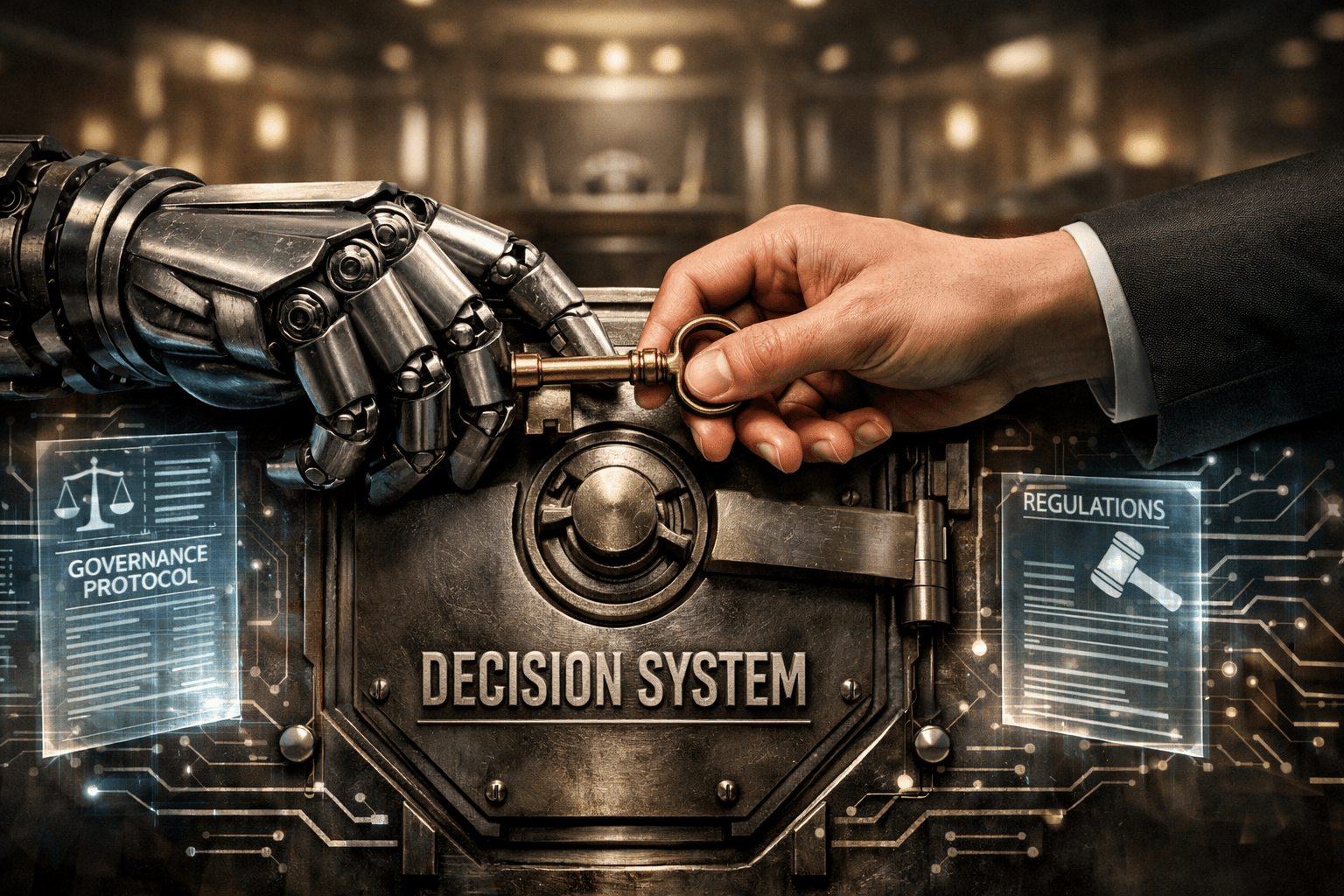
In plain terms, the message is: you can use autonomous systems, but you must prove they are supervised, auditable, and accountable.
That rewards firms with strong risk culture and hurts those that optimise only for speed.
Why this trend will not reverse
Once an organisation trusts AI to decide faster and more consistently than humans in a narrow domain, there is no going back. The economics are too strong. The customer expectations are too strong. The competitive pressure is too strong.
So the competitive advantage shifts.
It becomes less about having the fanciest model and more about having the cleanest decision framework around the model.
The fintech winners in this next phase will not be the ones shouting loudest about AI. They will be the ones that can answer basic questions with confidence:
What can the system decide?
What can it not decide?
How do we know it is behaving well?
Who is accountable for outcomes?
That is what professionals should be studying right now.
Because fintech is not just adding AI.
It is handing AI a set of keys.