

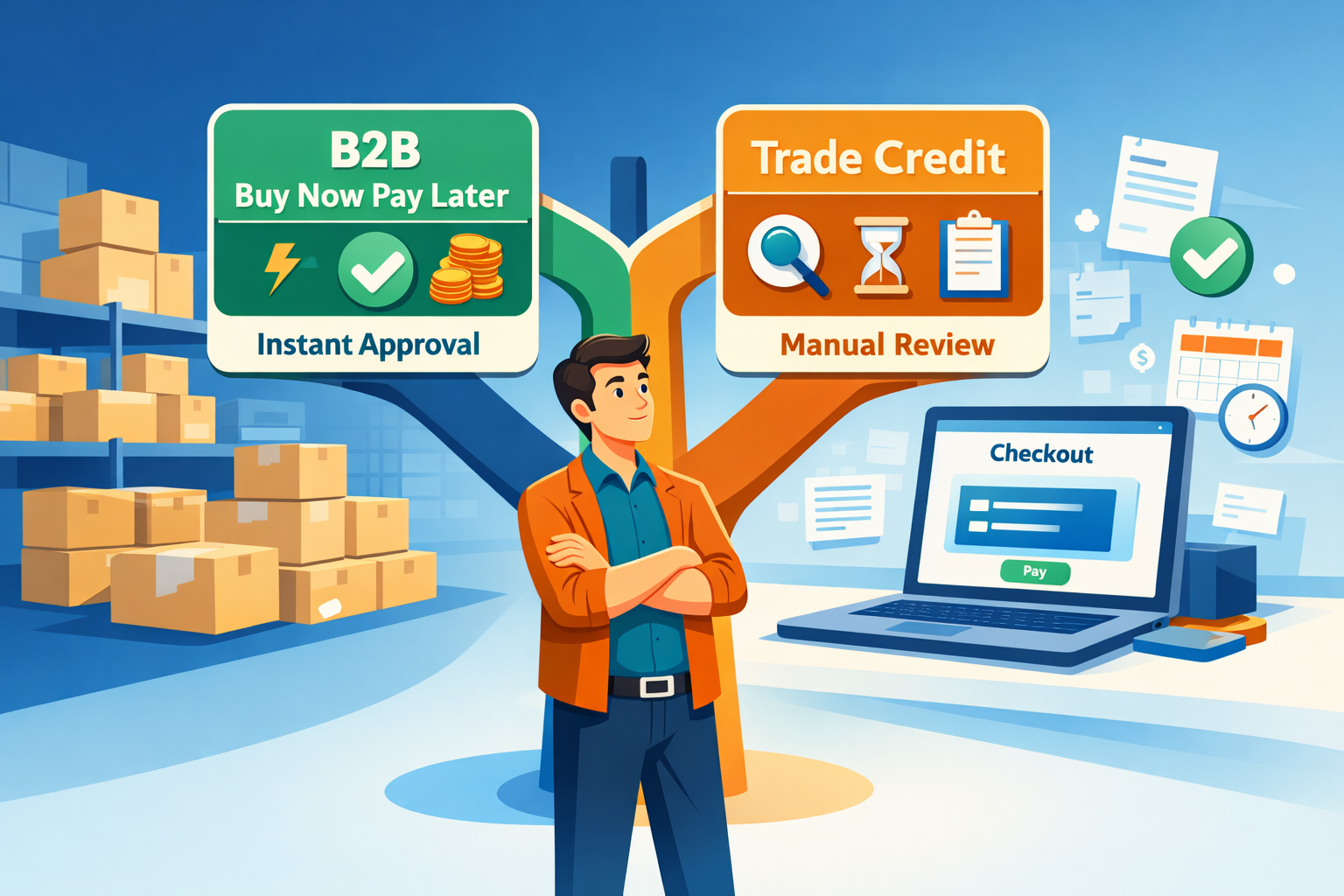
B2B buy now pay later is transforming how small and mid-sized businesses access working capital. We asked fintech product leaders, credit analysts, and institutional finance professionals one question. How do B2B BNPL products perform compared to traditional trade credit, and who benefits most?
Their answers point to a market that reached $14 billion in transaction volume in 2023, growing at a 27.4% compound annual growth rate. Yet that growth comes with critical caveats around credit risk, funding fragility, and market consolidation.
The Working Capital Mismatch That Built a Market
Traditional trade credit remains the backbone of B2B commerce. In fact, 80 to 90 percent of global B2B trade relies on some form of credit terms. However, the system creates a structural imbalance that hurts suppliers. Businesses wait 40.3 days on average to receive payments, and 50 percent of all B2B invoices in the US are overdue.
B2B buy now pay later addresses this gap by inserting a funded third party between suppliers and buyers. The provider pays the supplier upfront within 24 to 48 hours. It then collects from the buyer over 30 to 120 days. As a result, supplier days sales outstanding drops to near zero. Meanwhile, buyers gain the payment flexibility they need to manage cash flow.
“From an institutional finance perspective, B2B BNPL products have addressed a genuine gap: the working capital cycle mismatch that traditional trade credit managed poorly for SMEs. Traditional net-30/60 terms created cash flow pressure on suppliers while buyers retained float, a structural imbalance BNPL products have partially corrected.”
- Pierre Duval, Head of Institutional Partnerships & Growth, BASIS
This working capital cycle mismatch sits at the core of a $2.6 trillion global SME lending gap. Additionally, 95 percent of B2B buyers prefer to pay on invoice, yet fewer than 10 percent of online merchants can offer credit terms. B2B buy now pay later platforms bridge that divide with instant credit decisions at checkout.
“Trade credit is becoming less effective than B2B Buy Now Pay Later (BNPL), and is allowing real-time digitization of creditworthiness. In one case, a potential transaction was lost because it took three weeks for an old-fashioned bank to approve a line of credit. This creates friction taxes that may create enough drag on momentum to kill the transaction.”
- Matt Baharar, Founder and CEO, MKB Media Solutions
B2B Buy Now Pay Later Thrives in High-Frequency Procurement
Speed separates B2B buy now pay later from every traditional alternative. Platforms like Billie and Two deliver credit decisions in seconds, compared to the days or weeks required for conventional trade credit applications. Consequently, merchants offering B2B BNPL report up to 40 percent higher conversion rates and a 60 percent average increase in customer orders.
The strongest performance shows up in specific procurement contexts. Notably, SaaS subscriptions, logistics, and manufacturing inputs all involve recurring, predictable purchasing patterns. These align well with automated underwriting models that improve over time with transaction data. Healthcare SaaS company DearDoc, for instance, reported a 25 percent increase in average selling price after implementing B2B buy now pay later at checkout.
Still, traditional credit facilities dominate above the $500,000 transaction mark. Arthur D. Little excludes construction and defense from the addressable market entirely because these sectors require bespoke, project-based financing. The sweet spot for B2B buy now pay later falls between $5,000 and $100,000 per transaction. That range is too large for credit cards yet too small for most bank credit facilities.
“The data suggests B2B BNPL performs well in high-velocity, lower-ticket procurement contexts particularly for SaaS subscriptions, logistics, and manufacturing inputs. However, for larger institutional transactions, traditional credit facilities still offer more flexibility in terms, collateral structures, and relationship-based risk assessment.”
- Pierre Duval, Head of Institutional Partnerships & Growth, BASIS
Who Benefits Most From This Shift?
Mid-market buyers with predictable revenue but limited credit access stand to gain the most from B2B buy now pay later. Similarly, suppliers seeking accelerated receivables benefit without the typical costs of factoring. Unlike invoice factoring, which runs 1 to 5 percent per 30-day period and often involves recourse, B2B BNPL works differently. It is embedded at the point of sale and fully non-recourse.
“Who benefits most? Mid-market buyers with predictable revenue but constrained credit lines, and suppliers seeking accelerated receivables without the cost of factoring. The limitation remains credit risk underwriting at scale particularly in volatile macro environments where payment behavior diverges sharply from historical models.”
- Pierre Duval, Head of Institutional Partnerships & Growth, BASIS
The cost picture requires context nonetheless. B2B buy now pay later charges merchants 3 to 5 percent per transaction on average. Traditional in-house trade credit appears free on the surface, but Atradius reports bad debts averaging 8 percent of all B2B credit sales in the US. When you factor in administrative overhead for credit checks, invoicing, and collections, managing trade credit internally often costs more than BNPL providers charge.
“BNPL provides strategic flexibility because companies do not have to use their own cash to purchase inventory. Companies experiencing rapid revenue growth are treating fintech platforms as compounding assets to bridge the gap between procurement and revenue.”
- Matt Baharar, Founder and CEO, MKB Media Solutions
The real innovation lies in underwriting speed. Traditional bank approvals rely on financial statements that are 12 to 18 months old. In contrast, B2B buy now pay later platforms use real-time open banking data and behavioral signals. These tools assess creditworthiness in under a second. Edgar, Dunn & Company estimates 35 percent of B2B BNPL resources go to credit assessment alone, reflecting how central risk management is to the business model.
“B2B Buy-Now-Pay-Later (BNPL) has gained traction as a flexible financial option, enabling businesses to acquire goods and defer payments for 30 to 120 days. This contrasts with traditional trade credit, where suppliers extend credit terms for invoice settlement. BNPL offers advantages in terms of speed and flexibility, appealing to businesses seeking to manage cash flow efficiently.”
- Michael Kazula, Director of Marketing, Olavivo
Risks the Industry Still Needs to Solve
Despite strong momentum, the sector faces unresolved risks. The November 2025 shutdown of Hokodo exposed the fragility of the B2B buy now pay later funding model. The company had processed over 500 million euros in invoices before closing. Its founders admitted they tried to serve too many customer segments and mistook early traction for product-market fit.
Adverse selection presents another concern. Stronger firms with established bank relationships tend to stick with traditional financing. As a result, B2B buy now pay later may disproportionately attract higher-risk customers. Furthermore, no major provider publicly discloses default rates. According to Billie, identity fraud accounts for 80 percent of reported B2B BNPL losses. This suggests the primary threat is fraudulent use of business credentials rather than credit deterioration.
Regulatory asymmetry adds another layer of uncertainty. The EU’s Consumer Credit Directive II and the UK FCA’s BNPL rules both take effect in 2026, but they target consumer credit specifically. Business lending regulations remain fragmented, especially across borders. This lighter burden enables faster innovation while also reducing transparency.
The fintech predictions that BNPL would keep rising were correct. However, the path forward for B2B buy now pay later depends on solving unit economics, not just scaling technology. The companies most likely to win are those combining fintech speed with institutional capital and disciplined risk management.