

Author: Brady Souden, Director, Econ Energy
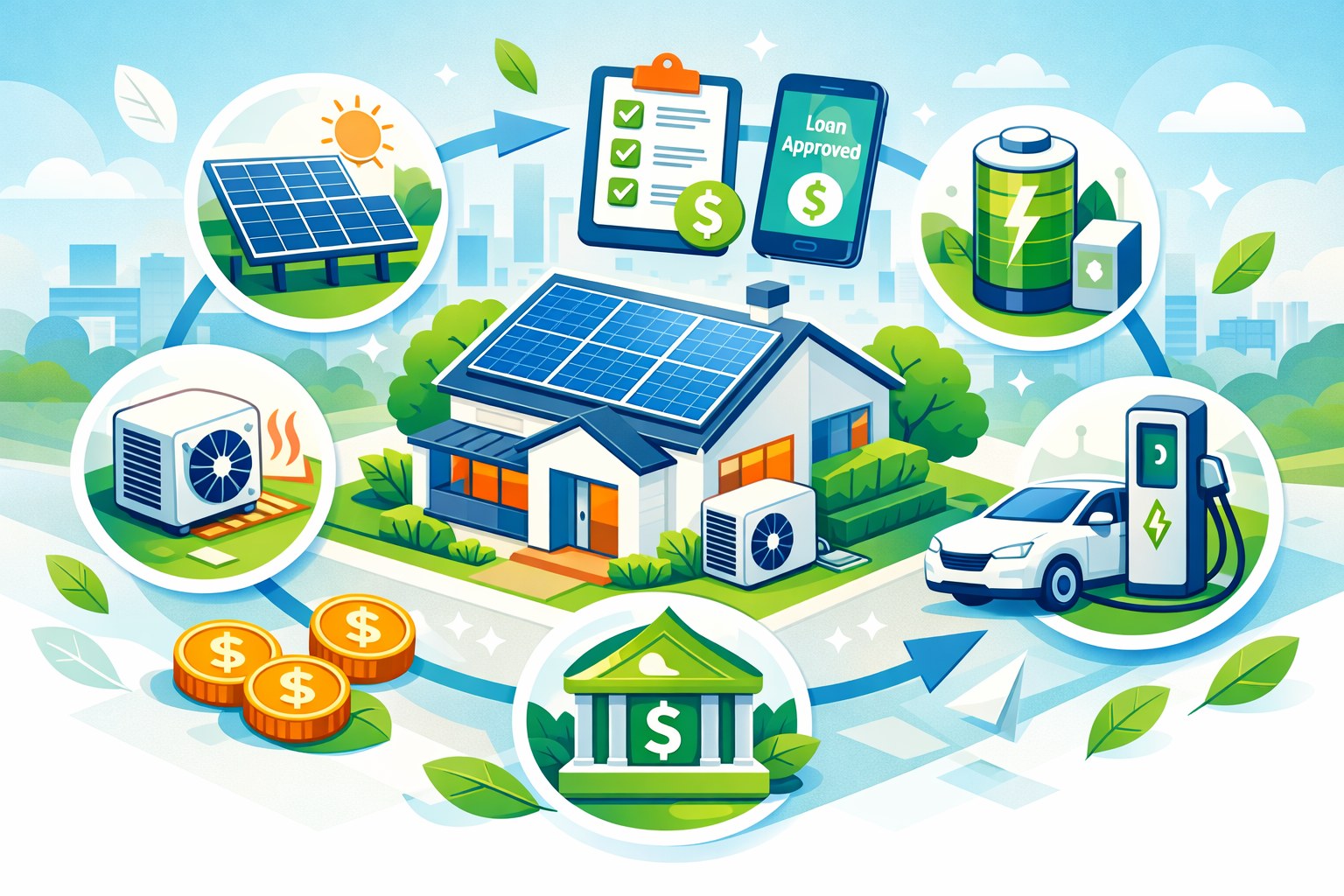
The green loans fintech revolution is transforming how homeowners finance sustainable energy upgrades. In fact, technology-driven lending has reshaped the entire pathway from quote to installation for solar panels, batteries, heat pumps, and EV chargers across Australia.
Consider the numbers for a moment. The ACT’s Sustainable Household Scheme has delivered over $276 million in loans to one in eight Canberra households since 2021. Meanwhile, Australian sustainable loan volumes surged 22% in 2025 to USD $22 billion, even as global volumes declined. For homeowners weighing up clean energy investments, the convergence of government incentives and green loans fintech innovation has made upgrades more accessible than ever before.
What Green Loans Are and Why They Matter
Green loans are purpose-built financial products that offer discounted interest rates for environmentally beneficial purchases. These purchases include solar systems, battery storage, heat pumps, EV chargers, and other electrification upgrades. Unlike standard personal loans carrying rates of 9 to 15% p.a. from major banks, green loans recognise that energy-efficient investments reduce both household costs and default risk. This lower risk profile is precisely what makes green loans fintech models so compelling for lenders and borrowers alike.
Traditionally, securing a green loan meant visiting a bank branch, waiting days for approval, and often holding an existing relationship with that lender. However, the green loans fintech sector dismantled these barriers entirely. Companies like Brighte and Plenti built digital-first lending infrastructure tailored to the clean energy sector.
As a result, a homeowner can now receive finance approval in under 30 seconds through their installer’s app. Compare that to the days or weeks a conventional bank takes, and the shift becomes clear. Brighte’s own research found that more than half of surveyed customers would not have purchased solar without accessible financing. This finding highlights why embedded green loans fintech solutions matter so much for the broader energy transition.
Green Loans Fintech Platforms Leading Australia’s Market
Several specialist platforms now dominate the Australian residential green finance space. Each brings a distinct model and installer partnership approach to the table.
Brighte stands as Australia’s largest dedicated green energy fintech. The platform has financed over $1.6 billion in sustainable home upgrades across 130,000+ households through 2,600+ accredited installers. Brighte offers a 0% interest payment plan alongside a green loan starting from 8.99% p.a. In November 2025, Brighte also secured $40 million from the Clean Energy Finance Corporation (CEFC) under the Household Energy Upgrades Fund. This funding enabled a discounted green loan at 6.99% p.a. for eligible products including batteries, heat pumps, and EV chargers.
On the other hand, ASX-listed Plenti offers green loans from 9.49% p.a. and a zero-interest payment plan up to $30,000. As the inaugural CEFC HEUF financier, Plenti secured $60 million for discounted green loans at rates as low as 6.15% p.a. Furthermore, Plenti’s GreenConnect platform bundles finance with battery deals, energy retailer plans, and virtual power plant sign-ups.
Traditional banks have responded to the green loans fintech challenge too. Commonwealth Bank offers the most competitive green loan at 3.99% p.a. fixed, though only for existing CBA home loan customers. In June 2025, CBA partnered with Brighte to launch a digital Home Energy Upgrades marketplace within its banking app. The gap between fintech and bank rates remains notable. Banks offer lower headline rates with stricter eligibility, while fintechs provide universal accessibility and instant point-of-sale approvals.
How the ACT Sustainable Household Scheme Changed Everything
The ACT Sustainable Household Scheme represents Australia’s most comprehensive government-fintech lending partnership. It also demonstrates how green loans fintech infrastructure can scale a public program effectively.
Launched in August 2021 with a $150 million budget, the scheme provides loans of $2,000 to $15,000 repayable over up to 10 years. Brighte administers the program exclusively. As of March 2026, the scheme has settled 25,000+ loans worth $276 million, generating over $100 million in cumulative household energy bill savings.
A significant change took effect on 1 July 2025, however. The interest rate moved from 0% to 3%, and solar panels lost eligibility for standard participants. The scheme now covers battery storage, energy-efficient upgrades such as heat pumps and electric cooktops, electric vehicles, and ceiling insulation. Concession card holders still retain access to zero-interest loans through the Home Energy Support Program.
For Canberra homeowners, the process flows through approved installers. You attend a free one-hour Climate Choices workshop, get quotes, and the installer initiates the loan through Brighte’s green loans fintech platform. Credit assessment happens digitally, Brighte pays the installer upon job completion, and the homeowner repays over time. Since solar was removed from eligibility, batteries now represent 53% of all SHS loan applications in FY2025-26. That is a dramatic jump from just 10% previously.
AI and Digital Tools Powering Faster Approvals
The technology stack behind modern green lending extends far beyond simple online forms. In truth, several layers of innovation are compressing what once took weeks into mere minutes.
Point-of-sale integration is the most visible change. Both Brighte and Plenti integrate with OpenSolar, an Australian-founded solar design and sales platform that has enabled over $10 billion in global solar sales. Consequently, installers can design a system, generate a quote, and offer finance within a single platform in under five minutes.
Behind the scenes, AI-powered credit decisioning is transforming risk assessment. Australian fintechs increasingly use machine learning to process alternative data sources for faster, more accurate credit scoring. The emerging Green Lending as a Service model provides modular APIs that automate onboarding, underwriting, ESG grading, and compliance in one stack. As trends in AI-powered finance continue evolving, green loans fintech platforms stand to benefit enormously.
Satellite imagery adds yet another dimension. Nearmap, an ASX-listed Australian company, captures high-resolution aerial images of Australian urban areas six times per year. Its AI analyses building characteristics, roof slopes, and existing solar panels. When integrated into OpenSolar, this data enables proposals to be generated from start to finish in under five minutes. Origin Energy, using Nearmap data through Accenture, reduced its quoting time from days to 15 minutes or less.
Australia’s Consumer Data Right further strengthens the green loans fintech toolkit. Now operational across all banks and extending into the energy sector, CDR allows lenders to access income and expense data via secure APIs. With CDR expanding to energy retailers like AGL and Origin, lenders can potentially model savings from proposed solar installations using real consumption data.
Australia’s Battery Boom and Its Impact on Green Lending
The numbers behind Australia’s 2025 battery surge are staggering. The country installed 268,245 home batteries that year. The second half alone matched 99% of all battery sales between 2020 and 2024 combined.
This explosive growth was triggered by the federal Cheaper Home Batteries Program, launched 1 July 2025. The program provides roughly a 30% discount on battery installation costs. Originally budgeted at $2.3 billion, the program was expanded to $7.2 billion in December 2025, targeting 2 million+ installations by 2030. Installation rates jumped from roughly 200 per day to over 1,500 per day after launch.
These subsidies stack powerfully with green loans fintech solutions at the state level. A Canberra household installing a $15,000 battery system can access the federal rebate ($3,000 to $5,000 depending on capacity), the ACT’s Next Generation Energy Storage rebate (up to $3,500), and an SHS loan at 3% for remaining costs. As a result, out-of-pocket expense could drop to $6,500 to $8,500, financed over 10 years.
At the same time, Australia’s rooftop solar fleet reached 28.3 GW by end 2025, surpassing the entire 22.5 GW coal-fired fleet. Approximately 43% of Australian homes now have rooftop solar. The federal Small-scale Technology Certificates continue reducing upfront solar costs by 20 to 30%, though the deeming period steps down from 6 years in 2025 to 5 years in 2026. This gradual reduction means rebate values will shrink until the scheme ends in 2030. The urgency only strengthens the case for green loans fintech adoption now rather than later.
Blockchain and the Future of Verified Green Finance
Blockchain technology in green finance remains more promise than practice. Nevertheless, notable pilots demonstrate real potential. Powerledger, founded in Perth in 2016, built a blockchain-based peer-to-peer energy trading platform. A Fremantle trial involving 48 households processed roughly 50,000 transactions per month.
The technology’s core value for green loans fintech lies in preventing greenwashing. Immutable ledger entries can track use-of-proceeds for green bonds from issuance to expenditure. Similarly, tokenised carbon credits prevent double-counting from creation to retirement. As explored in broader analysis of blockchain in fintech, these verification capabilities could reshape investor confidence.
Globally, the Bank for International Settlements’ Project Genesis 2.0 demonstrated how smart contracts can automate green bond compliance. Funds only release when specific ESG criteria are verified. In addition, Australia’s Sustainable Finance Taxonomy, released in June 2025, creates the definitional framework blockchain verification systems need. Eleven major financial institutions, including all four big banks, are currently piloting taxonomy-aligned reporting.
The Australian Government’s stance on digital assets is also evolving. ASIC received $10 million over four years for enforcement against greenwashing. Meanwhile, the March 2025 policy statement signalled regulatory intent around digital assets. These developments give the green loans fintech sector a clearer operating environment for blockchain-verified products going forward.
What Solar Installers Gain from Fintech Partnerships
For solar and electrification businesses, green loans fintech partnerships have become a competitive necessity. The benefits extend across three key areas.
Conversion rates climb when finance is embedded at the point of sale. When a homeowner sees monthly repayments alongside projected energy savings within the same proposal, the decision shifts from affordability concerns to savings calculations. Both Brighte and Plenti pay installers a lump sum upon job completion, which also eliminates payment risk for the business.
Government scheme access flows through these fintech platforms as well. Brighte’s exclusive administration of the ACT Sustainable Household Scheme gives approved installers direct access to the one-in-eight Canberra households participating. Plenti similarly administers South Australia’s $100 million battery scheme and the NSW Empowering Homes Program. For installers, accreditation with these green loans fintech platforms is a prerequisite for reaching government-subsidised customers.
In addition, bundled offerings expand the value proposition. Plenti’s GreenConnect platform combines finance with VPP enrolment, energy retailer partnerships, and battery package deals. This integrated model represents the future direction of residential clean energy sales, and it ties directly into the broader sustainable finance and fintech collaboration happening at the global level.
Transparency around merchant fees deserves mention, however. Brighte’s 0% interest plans charge installers a significant merchant fee, which most pass through via higher system prices. Interest-bearing green loans carry lower fees. Consumers benefit from understanding this trade-off because a 0% interest system may cost $1,000 to $2,000 more than the cash price.
What Comes Next for Sustainable Lending
Several converging forces will shape green loans fintech over the next two to three years.
Mandatory climate disclosures are accelerating green lending. Under AASB S2, which took effect for large entities from January 2025, banks must disclose financed emissions. This creates a direct incentive to grow green loan portfolios and reduce exposure to carbon-intensive assets. All four major banks are participating in taxonomy implementation pilots and building systems to classify taxonomy-aligned lending.
The battery market will continue its exponential trajectory. With the federal program expanded to $7.2 billion, batteries represent the next frontier for green loans fintech growth. Virtual power plants add a compelling financial layer too. ACCC data shows VPP participants pay the lowest electricity bills in Australia at $217 per quarter, compared to $323 for solar-plus-battery without VPP.
Interest rates present a near-term challenge, though. The RBA raised rates twice in early 2026 to 4.10%, driven by renewed inflationary pressures. Higher borrowing costs may slow discretionary upgrades, yet the economic case for solar and batteries stays strong given electricity price increases of 10 to 15% annually. Government-backed rates of 3% through the ACT SHS and 3.99% through CBA’s HEUF products provide significant insulation from rate movements.
Open finance will enable smarter lending above all. As Australia’s Consumer Data Right extends beyond banking to energy and telecommunications, lenders will combine financial and energy consumption data to model personalised savings projections. A lender that can verify household electricity spend and model precise ROI for a solar-plus-battery installation can underwrite with greater confidence. That capability will drive the next wave of green loans fintech innovation and, in turn, reshape how traditional financial institutions approach opportunity and risk in sustainable markets.
The bottom line is straightforward. Waiting is costly. STC rebates decline annually until 2030. The SHS interest rate already moved from 0% to 3%. Electricity prices keep climbing. The current combination of federal battery subsidies, state government loans, and green loans fintech instant approvals represents a historically favourable window. The opportunity is equally significant for homeowners and the green loans fintech sector alike.